HISTORY | Napoleon: Emperor, Modernizer, and Military Genius
This article was translated automatically and may contain differences from the original. For reference, read the original.

The recent release of the film “Napoleon” by Ridley Scott provides a unique opportunity for a brief analysis of the phenomenon of war through the lens of significant leaders in universal history. This topic intersects with international relations, national security, and defense, as well as military strategy.
As an introduction and context, it is important to briefly highlight the figure of Napoleon Bonaparte from several perspectives: his origins; his legacy as a great modernizer; his status as a military genius; and his role as emperor and protagonist in the history of the West. In summary, a character marked by the lights and shadows of his actions.
In this context, it is worthwhile to begin by referring to the assessment made of him by his commanding officer at the Royal Military School of France in August 1785, to understand his personality:
“Reserved and studious, he prefers study to any form of entertainment, finding pleasure in reading good classical authors; very dedicated [to the study of] abstract sciences, somewhat curious like others, [having] a meticulous knowledge of mathematics and geography; his personality is characterized by solitude, calmness, capriciousness, a bit of arrogance, extremely inclined to selfishness, speaks little, quickly and harshly in his responses, possesses much pride and limitless ambition, this young man deserves to be encouraged.”
This assessment of a teenage Napoleon could not be more accurate and precise, as it reflects that his destiny—as a great figure—was determined by his remarkable individual characteristics, depending only on the opportunities that life would present to him.
ORIGINS. Napoleon Bonaparte was born in the town of Ajaccio, from the Greek agathè, meaning a place of “good fortune” or “good anchorage,” on the Mediterranean island of Corsica, on a Tuesday just before midnight on August 15, 1769. At that time, Corsica had a population of 140,000 inhabitants, while France had 28 million. He was the son of Carlo Bonaparte, a lawyer, and Maria Letizia Ramolino, who were connected to the local minor nobility, but were not a wealthy or rich family. Letizia gave birth to 13 children between 1765 and 1786, of which eight survived childhood. They would eventually include an emperor, three kings, a queen, and two sovereign princesses. A relevant fact is that a year before Napoleon was born, France had acquired the island of Corsica from the city-state of Genoa, Italy. Both circumstances, his aristocratic background and, of course, his French nationality, allowed for his early admission to the Military School.
In 1779, he was first admitted to the Royal Military School of Brienne-le-Château, in the Champagne region. He excelled in mathematics, geometry, algebra, trigonometry, and geography. In 1784, he entered the prestigious Royal Military School of Paris. He served for five and a half years as a second lieutenant; one year as a lieutenant; 16 months as a captain; three months as a major, and from that rank, he became a general at just 24 years old. It is evident that without the events of the French Revolution, which erupted on July 14, 1789, he would not have had this meteoric military career.
His great loves were:
- Eugénie Désirée Clary (Marseille, 1777-Stockholm, 1860), later the wife of General Jean-Baptiste Bernadotte, who would become queen of Sweden.
- Marie Joséphine Rose Tascher de La Pagerie (Trois-Îlets, Martinique, 1763-Île-de-France, 1814), widow of General and Viscount Alexandre Beauharnais, whom Napoleon would call Josephine, married Napoleon on March 9, 1796, just before the campaign in Italy began.
- Marie-Louise of Austria (Vienna, 1791-Parma, 1847). With her, he had his legitimate heir Napoleon II, the King of Rome, who would die young at 21 from tuberculosis.
Outside of marriage, he had two children: the first, with Éléonore Denuelle de La Plaigne (Paris, 1787-Paris, 1868), who was introduced to him in 1806 by Carolina, Napoleon’s younger sister, and would be known as Charles, Count of Léon. The second, with Marie Walewska (Łowicz, Poland, 1786-Paris, 1817), a Polish noblewoman, named Alexandre Colonna Walewski.
MODERNIZER. Bonaparte was the figure who led France into the 19th century with extensive reforms in administration and finance, as well as in constitutional and legal matters. His notable principles, such as equality before the law, individual rights, tolerance and religious freedom, and meritocracy, had a significant impact not only in France but throughout Europe. Additionally, the creation of the Bank of France (1800), the public education system, and the lycées for secondary and higher education were significant contributions. Many of his reforms later permeated the emerging Latin American republics. One example is the French Civil Code, or Napoleonic Code, which was in full operation in the Rhineland until 1900, and today its content survives in the modern European legal system. Undoubtedly, he was a leader and modernizing figure in the context of his time.
MILITARY GENIUS: As a military leader and commander-in-chief of the French Forces, Napoleon conquered half of continental Europe during his 16 years of reign, from 1799 to 1814. Throughout all the wars undertaken during his reign, only two were offensive: the Peninsular War in Spain (1808-1814) and the campaign in Russia in 1812. The rest were defensive wars, triggered by his European adversaries. The characteristics that define him as a military genius are:
- His extraordinary ability to identify the problem to be solved by force.
- His sensitive sense of proportionality in the use of military means and efforts. As well as a particular ability to compartmentalize his thoughts, which he would open as needed, reflecting great mental strength.
- The use of “mass levies,” mass recruitment of soldiers; a key factor for national unity and cohesion.
- His outstanding management of timing and concentration of units to affect the adversary at their weakest and most decisive points. For example, marching separately to converge at the decisive moment and place.
- Striking the adversary at the points of contact between units or their boundaries, that is, at those points where there is usually fragility.
- His unparalleled use of artillery as a decisive weapon in planned maneuvers.
- His deep knowledge of the adversary and their commanders.
- His strength, passion, and conviction of victory conveyed to his subordinates.
- His unique ability to fight different types of battles in such varied geographical environments.
- His brilliant capacity for permanent adaptation, always identifying the opportunities that presented themselves.
- A great reader, fond of reading history books and biographies. He always urged his officers to read and reread the campaigns of Alexander, Hannibal, Julius Caesar, Gustavus Adolphus, Prince Eugene, and Frederick the Great. He expressed that reading is the only way to become a great captain. He always took his mobile library on campaigns.
- His main weaknesses were in the limited success in guerrilla warfare—as has been the case for regular armies to this day—and in the use of naval or maritime power.
The reason he is considered a military genius is that in most of his battles and wars, he was able to win, even when outnumbered by the enemy, whether through advances and retreats, with one or two flanks compromised, or by enveloping the adversary to dislocate them deep within their formation. Although he was an artilleryman, he mastered the command of infantry and cavalry, modifying their organization and doctrine; as well as in coalition formation and warfare (the invasion of Russia involved more than 20 countries. Of the 600,000 troops committed, only 100,000 returned).
EMPEROR. We must remember that Napoleon had three moments in which he exercised power: the first, as a general, depending on the “Directory,” from 1795 to 1799; the second, known as the “Consular Period,” between 1799 and 1804; and the third, known as the “Imperial Period,” from 1804 to 1814. It was in this last period that Napoleon prevented some royalists from returning the Bourbons to the throne of France, as they had attempted before, and he was convinced that an empire was necessary to maintain and expand France’s influence in Europe. In this context, he perceived himself as a “liberator” beyond France, destined to remove peoples from the absolutist rulers who oppressed them. However, he did not gauge that actions in other countries would unleash the forces of nationalism, which would ultimately be the cause of his defeat, alongside a continuous war against Great Britain, which contained economic aspects at the root of all his conflicts.
HISTORY. It is evident that individuals alone do not create history, but equally evident is that great events have always required people to alter their course in a given context. Probably, without the French Revolution, there would have been no Napoleon; although there is no doubt that the events following it would have been very different had the figure of Bonaparte not emerged. In the end, it is individuals who have created history, and not in a vacuum, but in a context, that is, moments and spaces in which events are defined. Just as without Napoleon, a Duke of Wellington cannot be explained, we also cannot explain the independence processes in the Latin American region, much less the significant influence of Franco-Napoleonic officers in our national independence process.
Ridley Scott’s film is concrete evidence that war is part of history and, as such, has accompanied humanity from its origins to the present day. Therefore, it must be known, understood, and studied by all political leaders. Denying war will not prevent it from affecting us. As Trotsky said, “You may not be interested in war, but war is interested in you.” In war, human nature plays a central role, which is characterized—as Thucydides would indicate in the Peloponnesian War—by the phobos, or fear; the kerdos, or selfishness, interest, envy; and the doxa, understood as the desire for honor and glory, and it is precisely this human nature that has defined our history, which has given rise to figures of the stature of Napoleon Bonaparte.
Thank you very much
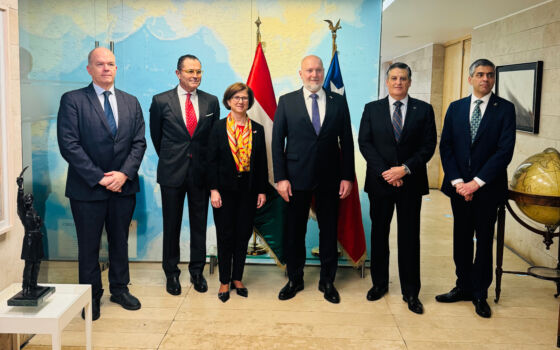
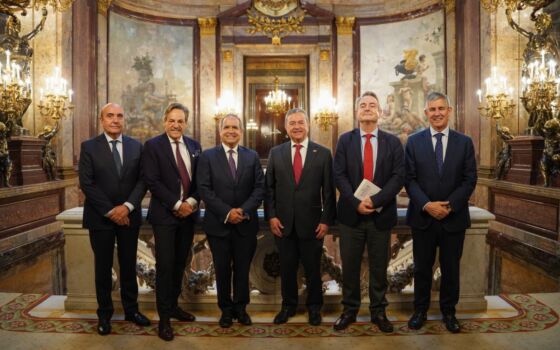
Words of the head of studies at AthenaLab, John Griffiths, at the private screening of the film “Napoleon,” organized by AthenaLab on November 30, 2023
Image Gallery