COMMENTARY | Russian Ships and Chinese Economic Zones: The Caribbean as a Scene of Strategic Competition
This article was translated automatically and may contain differences from the original. For reference, read the original.
Associated with paradise beaches and threats stemming from drug trafficking, the Caribbean occasionally emerges as a scene of strategic competition among powers, due to the natural influence that the United States has in this region and the propensity of its rivals to challenge it in various ways, as demonstrated by the recent presence of a Russian flotilla.[1].
With an area of 2,750,000 km², which includes both the land areas of numerous islands and archipelagos as well as the surrounding maritime areas that are part of the Caribbean Sea, its surface is larger than that of the Mediterranean, a fact that is difficult to grasp on maps.
With a population of 44 million inhabitants, spread across 13 sovereign countries and numerous overseas territories belonging to the United States, France, the Netherlands, and the United Kingdom, it is estimated that between 15% and 20% of global maritime trade circulates through its routes, a traffic that is increased by the extensive presence of tourist cruises.
Despite having a passage between the Atlantic and Pacific Oceans—Chile is the fourth largest user of the Panama Canal in the world—and important cargo distribution ports such as Colón (Panama), Kingston (Jamaica), and Freeport (Bahamas), the presence of large local navies is uncommon, with coast guards being more prevalent. Only the resident Americans and Europeans typically have ocean-going vessels patrolling the area, in addition to Canada.
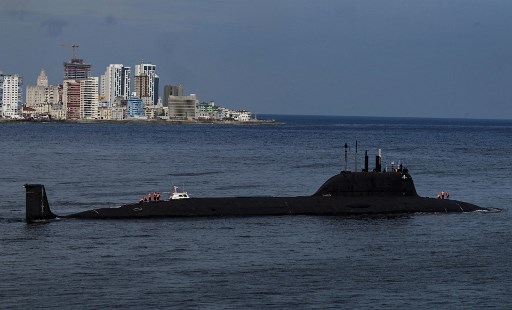
While the arrival of a Russian flotilla in Cuba has raised alarms, particularly with the inclusion of the nuclear-powered submarine “Kazan,” along with a frigate, an oil tanker, and a fleet tug, it seems that the mission is more aimed at displaying the tricolor flag in the sphere of direct U.S. influence than at demonstrating military strength.
With its Navy’s reputation severely damaged by the losses of vessels suffered in the Black Sea at the hands of Ukrainian forces, Russia desperately needs to demonstrate its status as a global great power with ubiquitous interests, which would be an end in itself and a good way to attract media attention, something it has undoubtedly achieved with headlines discussing “tensions in the Caribbean.”
In fact, Russia’s 2022 Maritime Doctrine[2] states that the purposes of the Navy are to defend national interests, maintain political stability at the global and regional levels, and repel maritime aggression, but also to display the flag in the so-called “global ocean,” a task inherent to naval diplomacy.
It is also important to note that the Russian Navy is not even a shadow of its Soviet predecessor, which was a global force capable of causing significant headaches for Western navies. Comparisons with the 1962 Missile Crisis, when the world was on the brink of World War III due to the installation of nuclear weapons on the Caribbean island of Cuba, are not only inaccurate but also completely exaggerated, even though the deployed submarine and frigate have the capability to launch Zircon hypersonic missiles.
Today, it is a green-water navy with clear priorities in coastal defense (surface ships) and in managing the naval component of nuclear deterrence (submarines), where the bulk of its power lies. Although it sends vessels to the Persian Gulf to interact with Iran and to the North Pacific to operate with its Chinese counterparts, its presence in the Black Sea has not only been challenged by Ukraine but also by Turkey, a country that has managed to keep its export routes open. Furthermore, in the Baltic, another area of direct interest, conditions for navigation have become even more complicated since Finland and Sweden joined the North Atlantic Treaty Organization. Lastly, it is worth mentioning that the Caribbean is not mentioned in the Doctrine as a vital maritime area for this country.
U.S. officials consulted by AthenaLab have described the visit of this Russian flotilla as routine, aimed at showing the flag, although they admitted that it is continuously monitored due to its proximity to U.S. shores. In fact, a nuclear attack submarine was sent to the Guantanamo base, where U.S. vessels constantly dock.
After a period during which Russian naval presence in the Caribbean disappeared, a signals intelligence ship arrived in Havana in 2014. A year later, four Russian Navy vessels moved to Venezuelan waters, including the flagship cruiser “Peter the Great.” Finally, in 2019, one of Russia’s most advanced naval assets, the frigate “Admiral Gorshkov”—the same one that is now returning—docked in Havana alongside a logistics ship and a rescue tug.
“Third Frontier”
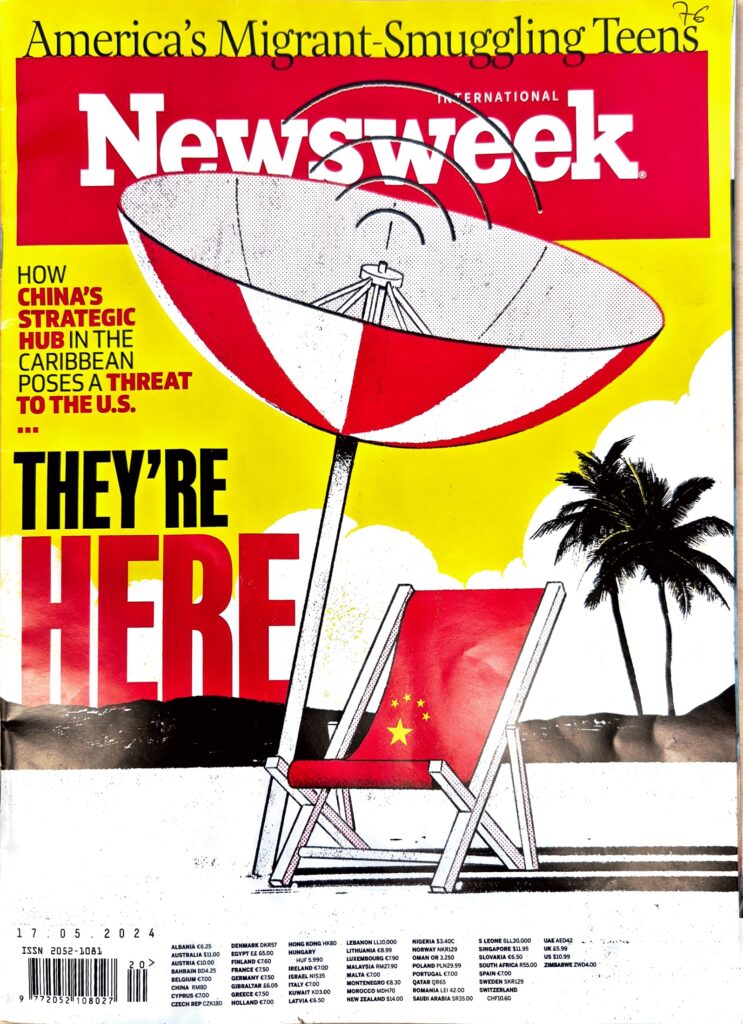
Now, where the United States could find a challenge more similar to that posed by the Soviet Union in its “third frontier” is in Antigua and Barbuda, a country where China is preparing to establish a special economic zone, which will include a port, a special airline, and its own customs facilities, in addition to having a special diplomatic status, as revealed by the magazine Newsweek[3] last May.
Just as it has done in the South Pacific, Beijing has also been courting small islands in the Caribbean with loans, investments, and trade, where there are also five nations that recognize Taiwan. According to officials from U.S. Southern Command who spoke with the publication, the intelligence activities that China could conduct at this outpost would target commercial and military movements in the region.
Undoubtedly, one of the assets that countries like Russia and China have in this area is that they do not have the military intervention history of the United States—Grenada 1983, Panama 1989, Haiti 2004, the most recent.[4]— nor the heavy colonial legacy of European nations. It was from the Caribbean that the New World was discovered and where Washington acquired its “imperial behavior” by permanently expelling the Spanish. Its hegemonic role during the early 20th century, with the application of the “Big Stick” policy, made this sea known as the “American Lake.”
However, in light of the multiple security challenges that this area presents today, in addition to drug trafficking, a collapsed state—Haiti—and rising sea levels due to climate change, the return of strategic competition is increasing calls to regain influence and presence.
In his book Sea Power, former Southern Command Chief Admiral (Ret.) James Stavridis presented seven recommendations for the United States to assume its responsibilities, ranging from working with local forces in a combined manner to providing more development aid. With a little attention and resources, he argued, significant changes can be made, leaving behind the pirate code that states that “those who lag behind are left behind”[5].
The implementation by the United States of a task force based on unmanned systems or marine drones, as was done in the Middle East, could be an innovative and effective solution from a naval perspective in a well-defined environment.
Finally, it should not be forgotten that the area presents a potential conflict due to Venezuela’s territorial claim over two-thirds of Guyana, a country that, despite being located in South America, is a member of the Caribbean Community and shares many cultural, historical, and political affinities with the nations in the area.
The United States does not rule out that the Russian flotilla may set sail for Venezuelan waters, whose Navy has been reinforced with Iranian boats and Chinese anti-ship missiles. Recently, the U.S. Navy also made its move when two F-18 fighter-bombers flew over the capital of Guyana as a show of support.
In an era of strategic competition, even the white sands and turquoise waters of the Caribbean do not seem to remain untouched, despite the apparent calm they convey. As the Trinidad and Tobago-born writer V. S. Naipaul warned: “It is wrong to have an idealistic view of the world. That is where evil begins. That is where everything starts to crumble.” Therefore, it is worth paying attention to what is really happening in this sea in the middle of the American continent.
Juan Pablo Toro V., Executive Director of AthenaLab
June 18, 2024
[1] The Washington Post (12/06/2024). What are Russian warships doing in the Caribbean? by Samantha Schmidt, Dan Lamothe and Mary Ilyushina. Available at: https://www.washingtonpost.com/world/2024/06/12/russia-navy-ships-florida-cuba-caribbean/
[2] Government of the Russian Federation (31/06/2022). “Maritime Doctrine of the Russian Federation.” Unofficial translation by the U.S. Naval War College. Available at: https://dnnlgwick.blob.core.windows.net/portals/0/NWCDepartments/Russia%20Maritime%20Studies%20Institute/20220731_ENG_RUS_Maritime_Doctrine_FINALtxt.pdf?sv=2017-04-17&sr=b&si=DNNFileManagerPolicy&sig=2zUFSaTUSPcOpQDBk%2FuCtVnb%2FDoy06Cbh0EI5tGpl2Y%3D
[3] Newsweek (17/05/2024). “Trouble in Paradise,” by Didi Kirsten Tatlow, Vol. 182, No. 15, pp. 20-31.
[4]Huchthausen, P. (2003). America’s Splendid Little Wars.New York: Viking Adult, p. 65.
[5] Stavridis, J. (2017). Sea Power: The History and Geopolitics of the World’s Oceans. New York: Penguin Press, pp. 321-322.