DT29 | Building Frigates in Chile, a State Challenge
This article was translated automatically and may contain differences from the original. For reference, read the original.
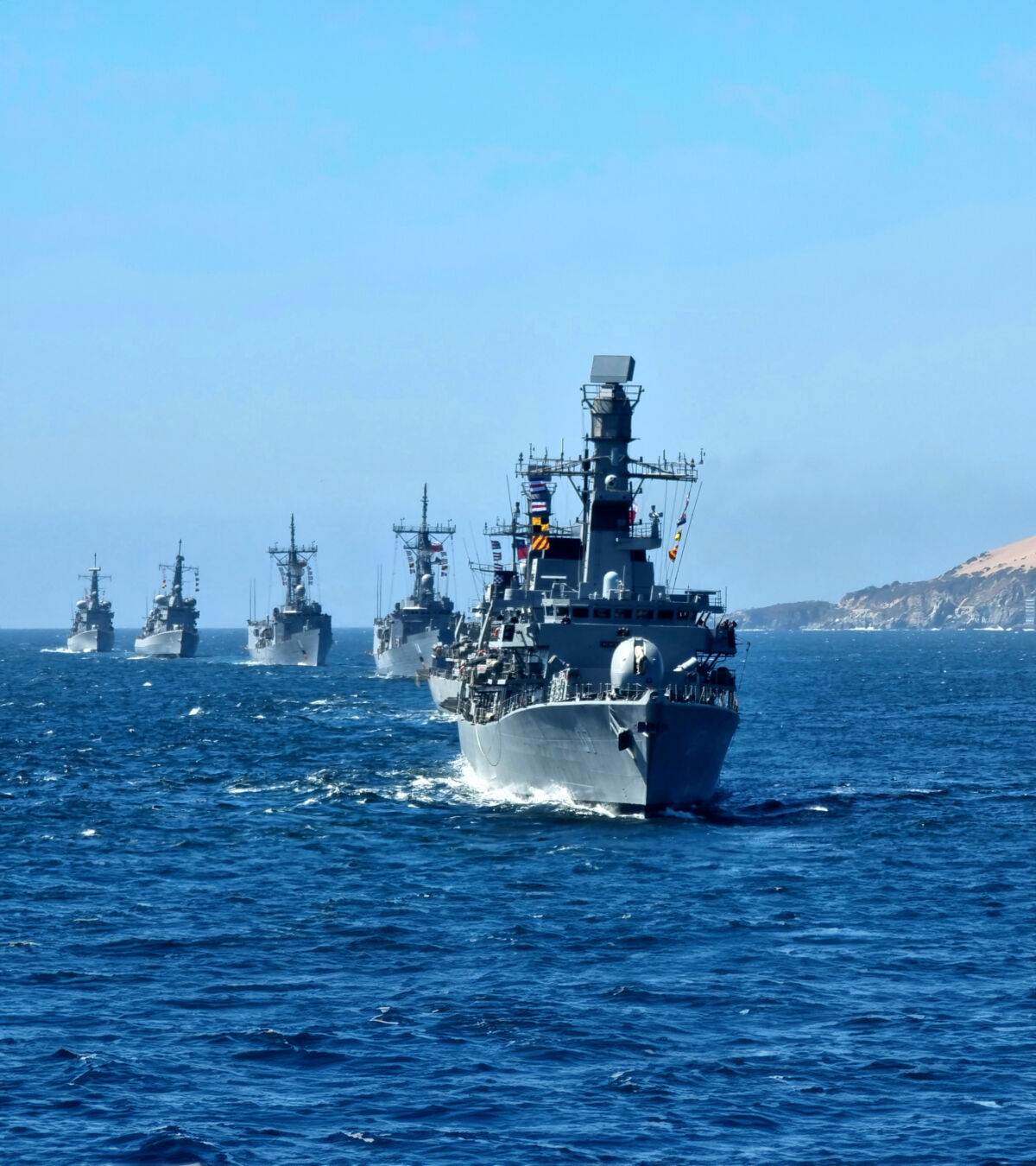
The purpose of this essay is to analyze the implications of building frigates in Chile to replace the current vessels of the National Fleet.
In the early 1990s, Australia began what was then the largest military investment project in its history, the construction of six submarines of the “Collins” class, specifically designed in collaboration with the Swedish shipyard Kockums for the local maritime reality. The project, which extended from February 1990 to March 2003, involved the creation of a public-private corporation, named the Australian Submarine Corporation (ASC), specifically established for this endeavor. To minimize timelines and reduce risks, considering that Australia had no prior experience in building such units, a mixed system was chosen, where the Swedish shipyard would construct the most complex part of the hull, which would then be sent to Australia for completion, integration, testing, and delivery. Soon, the project began to show serious issues, resulting in the first two submarines failing their initial tests due to a series of problems: high noise levels, a key element for remaining undetected; serious integration complications between equipment from different companies, such as the sonar, —of French origin—, the combat system —of American origin— and the torpedoes, among others. Consequently, this “system of systems” was not delivering the expected results. After 10 years since the start of Australia’s most ambitious and technically advanced defense project, the submarine was not meeting the requirements of the Navy and the country for its defense.
Given the magnitude of the resources invested, the increasingly negative criticism from defense experts that the project was receiving, and the insistence among the three main entities involved —Kockums, the ASC, and the Navy— to blame each other, the Australian government decided to conduct an external audit and gathered two prominent Australian businessmen to prepare a report on the project.
The report, titled McIntosh-Prescott after its authors, addressed several key issues: identifying the problems with the submarines; recommending solutions to resolve these complications; and, finally, providing ideas to avoid similar difficulties in future defense projects of this magnitude[1]. The final recommendations resulted in a series of significant changes to the submarines that were yet to be built. However, perhaps one of the most important conclusions was that regardless of all the observations —normal in companies of this magnitude— the project represented a quantitative and qualitative leap for the Australian industry, demonstrating that, despite the complexity and depth of the challenge, it was carried out within a budgetary and temporal framework that not only served to improve the Australian shipbuilding industry but also created an entire industrial ecosystem for research, development, and innovation (R&D&I), which improved over time.
Thus, following the “Collins” class were the “ANZAC” frigates, of German design, but entirely built in the country; the “Hobart” class air defense destroyers, of Spanish design; the “Type 26” frigates of the “Hunter” class, and, finally, the decision to manufacture nuclear-powered attack submarines of the “AUKUS” class in the country, which will replace the “Collins”. Of course, in addition to this development, a series of auxiliary vessels have been added, including their maintenance and modernization.
Probably the most relevant aspect of this industry was, precisely, the incorporation of a civil industrial ecosystem and academia, which favored the development of these projects that, due to their magnitude and duration, became national-level initiatives, and were realized through different governments, allowing Australia to have a first-rate medium navy.
Despite the initial complexities, the Australian shipbuilding industry demonstrated that naval construction has positive externalities for the country.
A similar conclusion was reached by a report commissioned by the Chilean Navy to the Faculty of Engineering of the Pontifical Catholic University in 2018[2]: naval construction in our country was not only viable but also advisable, as it integrated a series of entities whose involvement would lead to an overflow of capabilities into other national productive areas, as well as the creation of a technological and academic ecosystem that would undoubtedly contribute to national R&D&I.
The Navy adopted this conclusion, developing the National Continuous Naval Construction Plan (PNCCN), with the aim of providing the State with a modern, interoperable, technologically advanced navy built in Chile. This study arose from the need to evaluate the replacement of the current combat units; and the issue is not minor. Currently, the National Fleet has units between 30 and 38 years old that, although they have been updated, are nearing the end of their operational life, close to 40 years. If prompt action is not taken, either through the acquisition of used platforms or the construction of new units, national defense will find itself in a complex situation, with operational gaps in its surface force that could extend for years.
The construction of a frigate takes between four and five years, depending on the shipyard and the level of complexity. That is, if a decision were made today to acquire new units, the first would be arriving around 2032 (considering that detailed engineering and administrative processes still need to be carried out), when all current vessels are nearing the end of their operational life. On the other hand, there is currently a global deficit of used frigates available on the market, due to new geopolitical tensions, both in the Western Pacific and in the Red Sea.
Figure 2 shows one of the possible scenarios, indicating the number of units available per year according to their remaining operational life, adding the estimated time for the incorporation of new units, in case a decision is made to begin building frigates in pairs, every four years, which is considered an almost ideal plan.
Even so, in this scenario, the current surface force would have periods that include four vessels in service, although not necessarily all operational, due tol maintenance and training.
The purpose of this essay is to analyze the implications of building frigates in Chile to replace the current vessels of the National Fleet. Indeed, the national shipbuilding industry has managed to establish itself as a reliable source for developing projects such as auxiliary units; some of these represented a significant technical challenge, such as the construction of the scientific research vessel “Cabo de Hornos” and, more recently, the icebreaker “Almirante Viel”, demonstrating that the shipyards possess the technical maturity necessary to undertake more complex projects. To analyze the case, we will use as a basis the description provided by British academic Geoffrey Till in his latest book How to Grow a Navy[3] regarding the shipbuilding industry, applying it to examples of countries that developed their shipbuilding industry, such as Australia and Spain, evaluating the possibility of its implementation in Chile.