Data Integration and Anticipation in Public Security: The Experience of the CFI of Las Condes in Implementing an Intelligence-Based Security Model
This article was translated automatically and may contain differences from the original. For reference, read the original.
- por Gastón Marchant & Francisco Ugarte
- Colaboraciones externas
INTRODUCTION
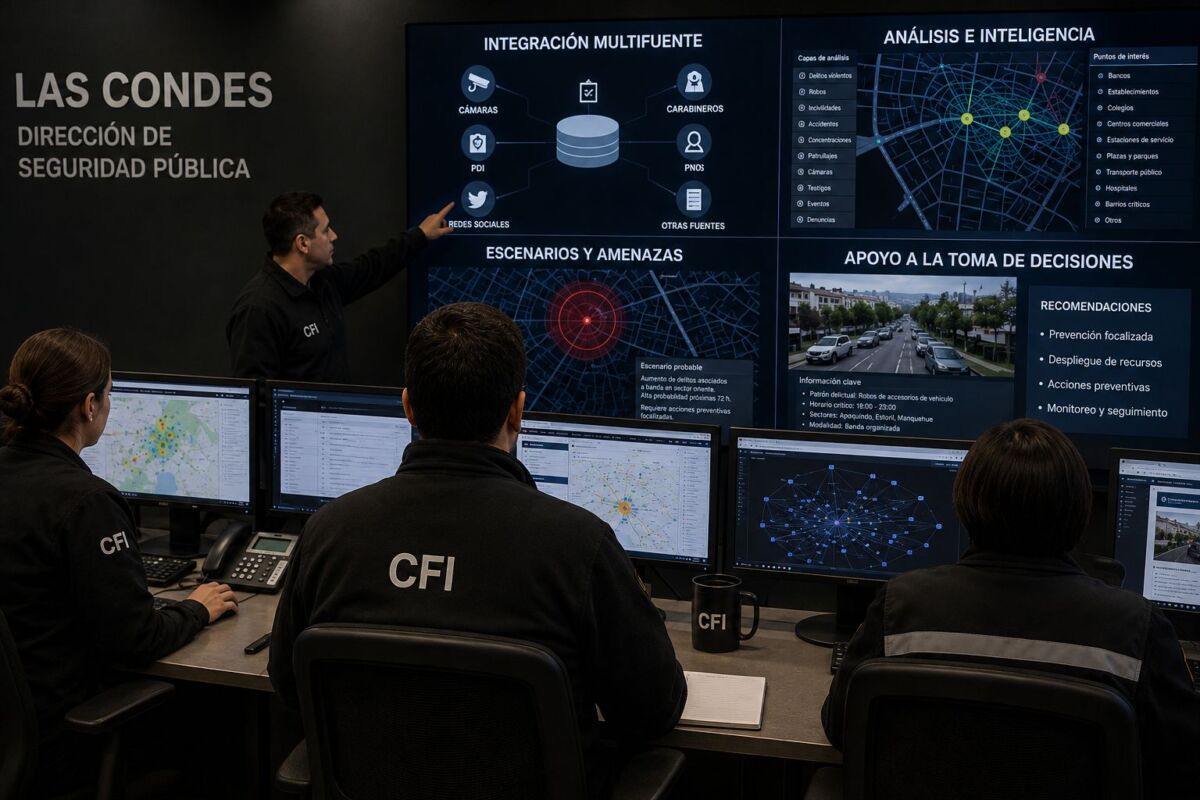
This article addresses the issue of data fragmentation in current municipal public security models and the efficiency produced by the establishment of a Fusion Center for Information (CFI). Following military intelligence principles, this strategic analytical unit integrates information and produces reliable knowledge to assist in decision-making, particularly regarding potential future criminal activities. This, of course, promotes anticipation and proactive action of municipal operational resources.
INFORMATION FUSION IN FRAGMENTED ENVIRONMENTS
Data fragmentation in public security institutions stems from a historical and normalized split between criminal analysis and police intelligence (Ratcliffe, 2007). Criminal analysis, institutionalized in the form of security observatories, seeks to understand completed events. It focuses on characterizing trends, concentrations, displacement, or patterns of crime, which helps direct operational resources to areas with higher crime incidence, thereby preventing these phenomena from escalating. In contrast, police intelligence aims to anticipate criminal dynamics by processing threats associated with gang operations, characteristics of offenders, insecurity situations, vulnerabilities, points of interest, or emerging crimes.
Both fields of analysis and production limit their respective scopes of observation, delineate their working methodologies, and define their areas of competence based on the specific types of requests made from public security decision-making levels. This has led to the development of general views of crimes that do not allow for the anticipation of risks or the application of appropriate strategies to address new territorial threats. On the other hand, investigative actions are limited to pursuing specific criminal gangs without providing comprehensive preventive resources.
A response to this fragmentation—or the configuration of information silos (Carter, et al, 2017)—and the compartmentalization of analytical products that do not allow for a consistent and timely perspective on criminal phenomena is associated with the transition to an intelligence-led policing approach (Intelligence-Led Policing or ILP) (Carter & Carter, 2009). In this approach, information fusion centers (CFIs) are essential. Through the operation of these entities, security departments focus on integrating multi-source information, comprehensive analysis of variables associated with criminal activity, developing future scenarios, and producing intelligence products that enable proactive decision-making rather than merely reactive responses, as is currently the case.
CFIs aim to go beyond simply deploying operational resources to locations where crimes have occurred. They seek to assist in decision-making with well-founded hypotheses about highly probable criminal threats. This strengthens the timely design of anticipatory strategies, improving the effectiveness of actions should the anticipated scenarios emerge.
This last point is crucial, as CFIs do not produce crime overviews; rather, they respond to operational information requirements to prepare institutional responses to emerging threats. One of the most relevant issues in the current functioning of public security lies in the limited flow of information to operational units (Lewandowski, et al, 2018). This is fundamentally due to the inadequacy of analyses based on hot spots and the scarcity of concrete inputs for more complex decision-making. In this sense, all analyses following multi-source integration operate under an imperative of usability. This means that knowledge must be easily translated into concrete actions, as the success of this is key for public security departments to achieve effective coordination and trust among technical teams (Joyal, 2012). In the case of the CFI of the municipality of Las Condes—which replaced the former Public Security Observatory in 2025—these incentives for trust and collaboration are sustained by the type of integration developed. The intention is for the different layers of information not to be separated in a visualization system but to transform into variables that interact with one another. Certainly, this enriches the observation field of each technical team that consumes its products and avoids interference between units. In this way, the CFI of Las Condes offers shared governance within the Public Security Directorate (DSP), based on interoperability and reflexivity of production cycles (US Department of Justice, 2006). This means that the structural rule of monitoring the quality of information and implementing ongoing improvements to its integration and analysis mechanisms is followed. In other words, information fusion is not a state but a permanent process to which various technical teams contribute with their knowledge requirements to enhance their crime prevention actions.INTELLIGENCE CYCLE IN PUBLIC SECURITY
The production of intelligence is based on the continuous collection of information that shapes the reference scenario regarding the territory, its dynamics, and its threats (basic intelligence). It also includes a detailed analysis of public security threats and their evolving behavior (current intelligence). Additionally, the possible trajectories of these threats and the scenarios that could arise are evaluated (estimative intelligence). Finally, it seeks to identify the conditions that make the occurrence of a phenomenon likely before it materializes, a function that doctrine refers to as “alert.”
To this end, the CFI of Las Condes configures a municipal security intelligence system that draws on information from various sources, such as Carabineros; Central 1402 of Las Condes; territorial teams from the Public Security Directorate; programmatic teams working with victims and offenders, and a digital evidence unit that processes and analyzes information from cameras. It also has a technology and innovation area that provides information on various security sensors in the municipality (alarms, SOS buttons, smart poles, camera analytics, and GPS, among others). Additionally, it includes a criminal analysis team that relies on models from the Police Investigations (PDI) to characterize the
modus operandi
of criminal gangs in the municipality and collaborates with the Prosecutor’s Office to produce crime hotspots in the eastern area of the Metropolitan Region. The intelligence cycle begins with the direction of the collection effort, established by the director of Public Security, area chiefs, and specific coordinators of critical prevention tasks. In this phase, information needs are established based on the planning of the Directorate’s tactical tasks, and collection tasks are issued among the various actors in the system. The collection phase exploits the sources of the different actors in the system and delivers them to the CFI analysis team to transform them into intelligence. All this information then enters an analysis phase, which focuses on the detailed description and classification of data, translating into variables that interact with the
corpus
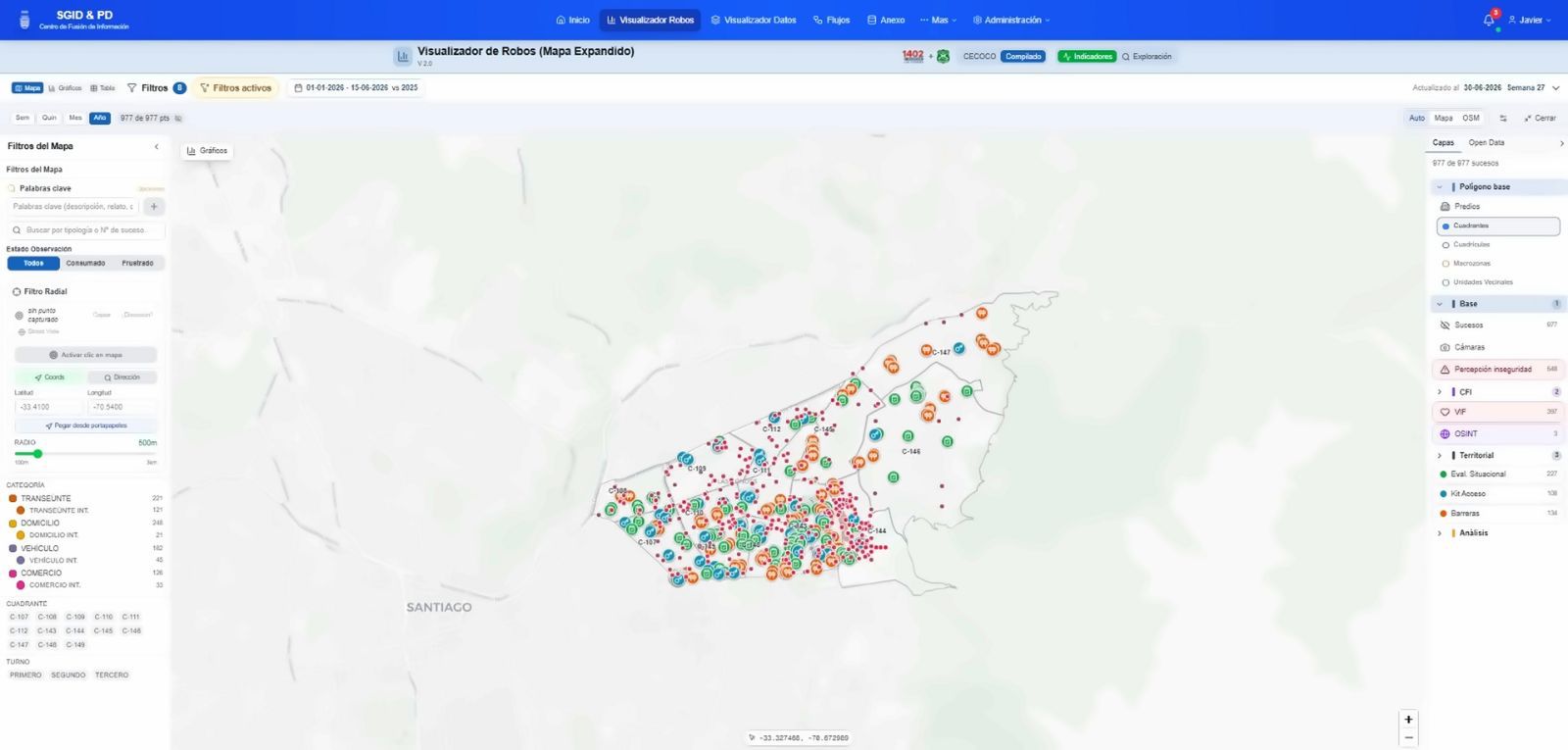
of available information, integration, and comparative analysis through a computer system for visualization and production of aggregated indicators. The SGID (Crime Information Management System) consumes a significant portion of the data sources and transforms the variables according to the description, classification, and translation process developed by the CFI analysts. The result of this process is a data integration that assimilates the criminal categories of Carabineros and Central 1402 of Las Condes for a comprehensive understanding of the crimes that have occurred. It includes the quantitative and geospatial translation of neighborhood fear maps associated with crimes; the placement of cameras and other technological devices from the DSP; execution of territorial interventions; occurrences of domestic violence, and operational results associated with offenses, among others. Figure 1.
Robbery Visualizer (Expanded Map), SGID & PD. Georeferenced distribution of 977 incidents, 01-01-2026 to 15-06-2026, year-on-year comparison vs. 2025.
Source: own elaboration, Fusion Center for Information (CECOCO), week 27 of 2026. Full capture of the system. Base cartography: ©️ OpenStreetMap contributors (ODbL). On the other hand, the SGID, through a Large Language Model (LLM) system called SAGI (Intelligent Analysis and Management System), processes all descriptions of robberies that have occurred in the municipality. Thanks to this, the analysis phase can execute dense descriptions of criminal activity in dimensions such as characteristics of offenders, victims, insecurity situations,
modus operandi
, use of weapons, risk behaviors, movement of offenders, methods of entry into homes, among others. This system enables a final analysis process focused on producing warning indicators that guide the overall efforts of the DSP toward insecurity phenomena with a high probability of escalation according to the developed intelligence analysis.Finally, the intelligence cycle concludes with the dissemination phase of the products for use in operational decision-making and the feedback of the system with the standardization, recording, and systematization of the courses of action taken, allowing for the biweekly production of analyses of preventive effectiveness. This phase is guided by the principles of timeliness of the provided intelligence products and the adequacy of the languages or accesses. Therefore, the CFI continuously monitors the quality of the consumption of these products to adjust their output formats and production rhythms.
WARNING INDICATORS AND FUTURE SCENARIOS
Transcending reactive responses in public security requires the implementation of an anticipatory model that, without providing specific spatiotemporal coordinates about the next crime that will occur in the municipality, allows for timely alerts about types of robberies that exhibit abnormal upward behavior, the spatial location of these threats, their specific characteristics, interaction with other phenomena, and a range of well-founded hypotheses about the future scenarios into which these threats may evolve. This enables decision-making teams to prepare concrete preventive actions in highly probable scenarios.
The SGID adheres to the methodological shift in quantitative criminology, which indicates that methods based on normal distribution for crime analysis, such as the use of thresholds based on Z-scores from the Carabineros STOP system, are inadequate. The frequencies of robberies at the municipal level do not typically follow a normal distribution, as they are low-frequency events and overdispersed, highly dependent on the actions of security devices and characterized by streaks associated with gang activity. In this sense, the SGID uses the Poisson model for low-frequency robberies and the negative binomial model for those crimes that behave in streaks.
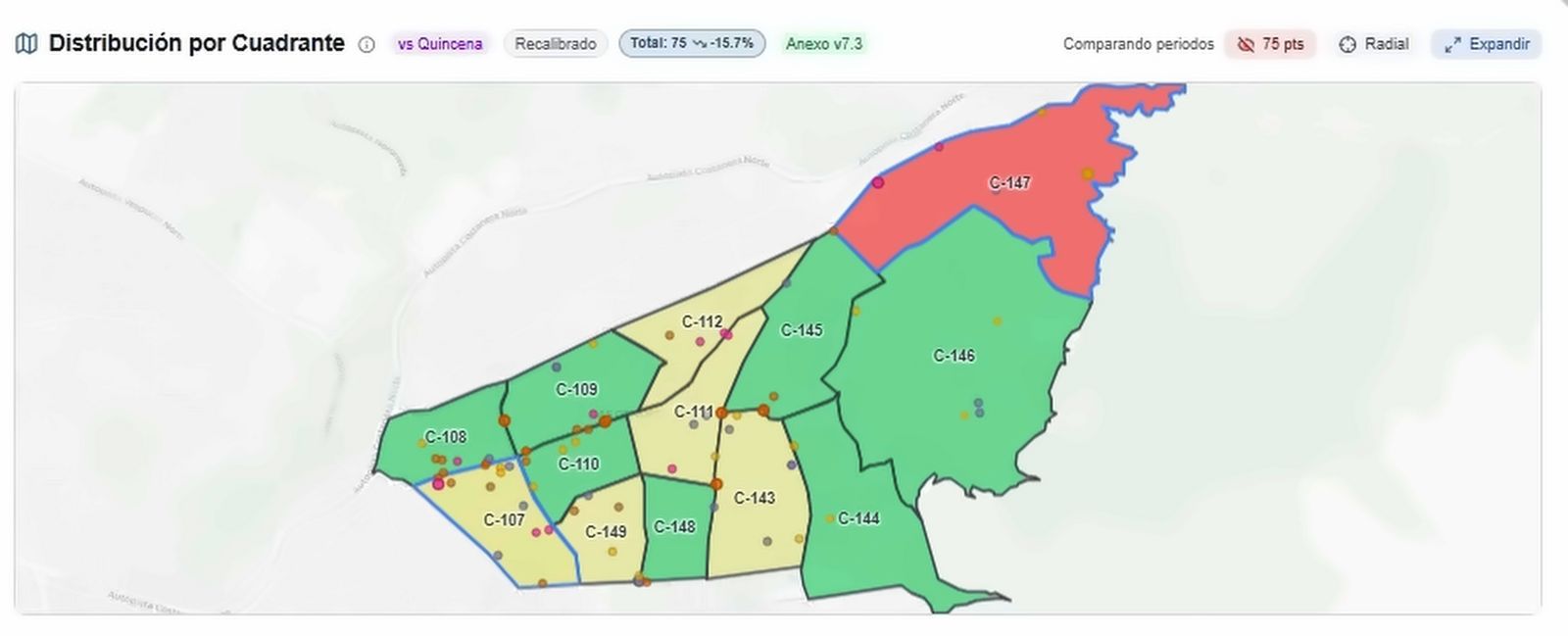
Figure 2.
Distribution by quadrant, biweekly variation recalibrated against the baseline (Annex v7.3).
Source: own elaboration, SGID & PD — CECOCO. Full capture of the system. Base cartography: ©️ OpenStreetMap contributors (ODbL). Due to this difference with the threshold methodology, the SGID provides biweekly alerts about the risky behavior of different types of robbery in each of the 13 quadrants of the municipality of Las Condes. These alerts are consumed by the operational planning team, who review the characterization reports of these alerts, the future scenarios, and make decisions to anticipate the occurrence of these threats.
METHODOLOGY FOR FUTURE SCENARIOS
The future scenarios of the CFI of Las Condes are constructed using structured analytical techniques, whose methods are developed by the intelligence community to reason in an orderly and transparent manner in the face of uncertainty (Heuer & Pherson, 2014).
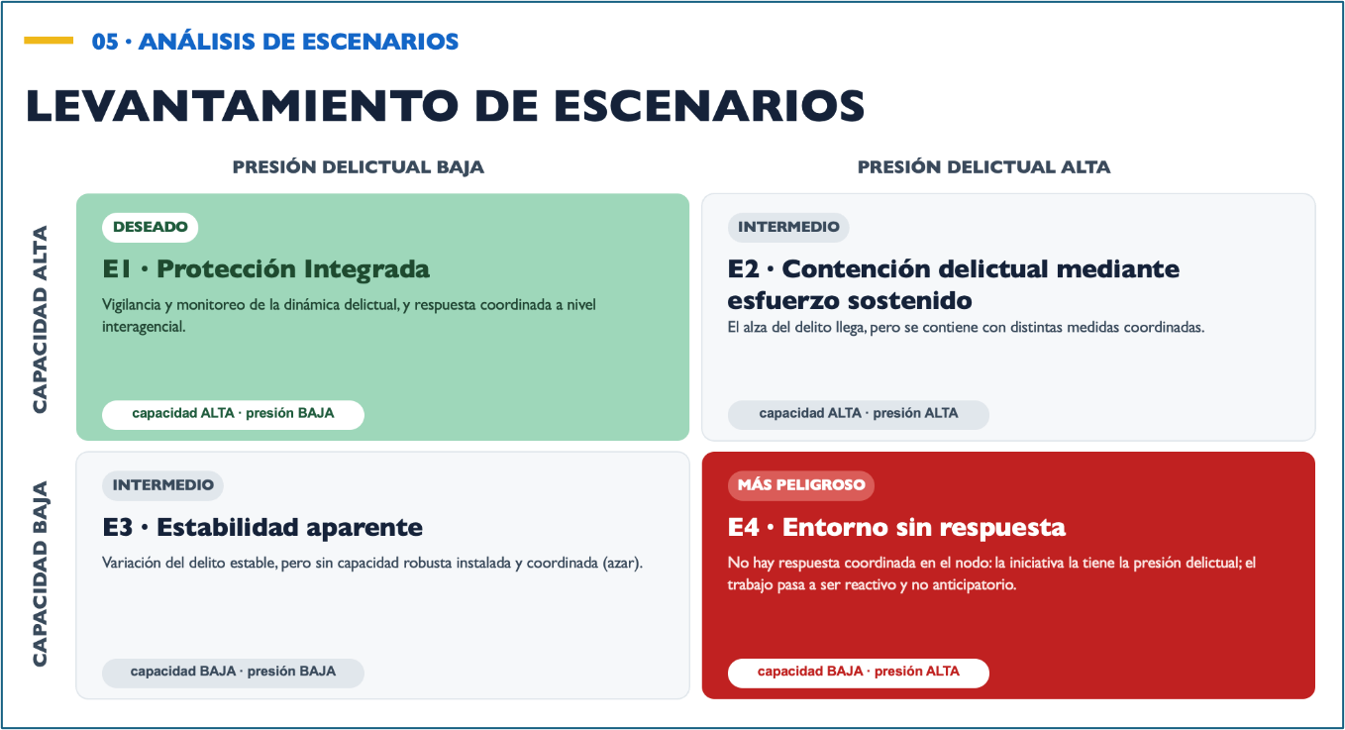
The starting point is the alerts from the SGID and the directive requirements. With this input, the analysis team compares different possible explanations of a threat—a technique known as Competing Hypothesis Analysis (ACH)—and then projects how it might evolve. To do this, it identifies the most important uncertainties that remain unanswered and cross-references them, resulting in a limited set of scenarios.
The CFI’s approach does not advocate for a single future, but it does not shy away from guiding decision-making. An initial matrix establishes four plausible scenarios, which are maintained with their assigned indicators. However, the analysis does not address all aspects equally, as the available information, such as the recorded criminal behavior in the area, the characterization of already present phenomena, and the results of previously executed interventions, allows for estimating which trajectories concentrate greater probability and projecting two of them in depth.
Figure 3.
Alternative Futures Analysis Technique (Heuer & Pherson). Scenario development conducted by the CFI Las Condes, in light of the operation of the future Tobalaba cable car station.
Source: own elaboration based on information from CECOCO. The desired scenario shows what capabilities need to be built and in what timeframe, while the most dangerous scenario compels preparation of decisions before damage occurs. Each scenario is associated with its warning indicators, that is, observable signals that indicate which trajectory reality is moving toward and when to activate each response. The primary function of the product is not to predict which of the two will materialize, but to ensure that both are described, with their signals and decision moments, before the situation emerges.
CONCLUSIONS AND PROJECTIONS
The experience of the CFI of Las Condes demonstrates that data fragmentation in public security is not resolved by accumulating systems, but by changing the logic of knowledge production. When information from diverse sources is transformed into variables that interact with one another and each product responds to a specific decision requirement, the security direction stops merely describing the crime that has occurred as its main effort and begins to anticipate the likely crime. In other words, this model contributes, above all, to the shift from reactive to anticipatory: future scenarios that prepare institutional responses before the threat materializes and warning indicators that detect abnormal behaviors before escalation occurs.
The projection of the CFI aims at a precise challenge: to integrate the real-time institutional layer into the intelligence system, following the international evolution toward Real-Time Crime Centers (RTCC) (NIJ, 2025). Las Condes already has this layer, constituted by cameras and their analytics, panic buttons, license plate readers, alarms, or smart poles; however, it currently operates mainly as support for responding to ongoing incidents.
The challenge is twofold. Technically, it is necessary to ensure that these flows arriving second by second are translated into variables that interact with the
corpus
of information from the SGID, as already occurs with the biweekly cycle sources. Analytically, which is decisive, it is essential to avoid allowing real-time data to reinstate the reactive logic that the model was designed to overcome. In this sense, the real-time layer must operate as a sensor of the intelligence system, feeding warning indicators, verifying which scenario reality is moving toward, and shortening the cycle between alert and decision, rather than functioning as a parallel reaction channel. If this integration is achieved, anticipation will no longer be limited to the biweekly production rhythm and can adjust to the speed at which criminal dynamics actually change in the territory. That is the next threshold of the model: for information fusion to also encompass the immediate present, without renouncing its anticipatory vocation. BIBLIOGRAPHIC REFERENCES
Carter, D. L., & Carter, J. G. (2009). Intelligence-Led Policing: Conceptual Considerations for Public Policy.
Criminal Justice Policy Review
, 20(3), 310–325. Carter, J., Carter, D., Chermak, S., & McGarrell, E. (2017). Law Enforcement Fusion Centers: Cultivating an Information Sharing Environment while Safeguarding Privacy.Journal of Police and Criminal Psychology
, 32(1), 11–27. Godet, M., & Durance, P. (2007).Strategic Foresight: Problems and Methods
(LIPSOR Notebook No. 20, 2nd ed.). Laboratoire d’Investigation en Prospective, Stratégie et Organisation (LIPSOR) – CNAM. Heuer, R. J., & Pherson, R. H. (2014). Structured Analytic Techniques for Intelligence Analysis
(2nd ed.). CQ Press. Joyal, R. G. (2012). State Fusion Centers: Their Effectiveness in Information Sharing and Intelligence Analysis
. LFB Scholarly Publishing. Lewandowski, C., Carter, J. G., & Campbell, W. L. (2018). The Utility of Fusion Centres to Enhance Intelligence-Led Policing: An Exploration of End-Users.Policing: A Journal of Policy and Practice
, 12(2), 177–193. National Institute of Justice (NIJ). (2025).Real-Time Crime Centers: Integrating Technology to Enhance Public Safety
(report prepared by RTI International for the Criminal Justice Technology Testing and Evaluation Center, CJTTEC). U.S. Department of Justice. Ratcliffe, J. H. (2007). Integrated Intelligence and Crime Analysis: Enhanced Information Management for Law Enforcement Leaders
. Police Foundation. US Department of Justice. (2006).Guidelines for Establishing and Operating Fusion Centers at the Local, State, and Federal Levels
. U.S. Department of Justice. GASTÓN MARCHANT ROAAdvisor of the Fusion Center for Information, Public Security Directorate, Municipality of Las Condes.
FRANCISCO UGARTE REYES
Senior Analyst of the Fusion Center for Information, Public Security Directorate, Municipality of Las Condes.
¿Quieres publicar con nosotros? Revisa nuestras normas para colaboradores externos.
Ver normas de publicación