AthenaLab presented a study on national identity and social cohesion
This article was translated automatically and may contain differences from the original. For reference, read the original.
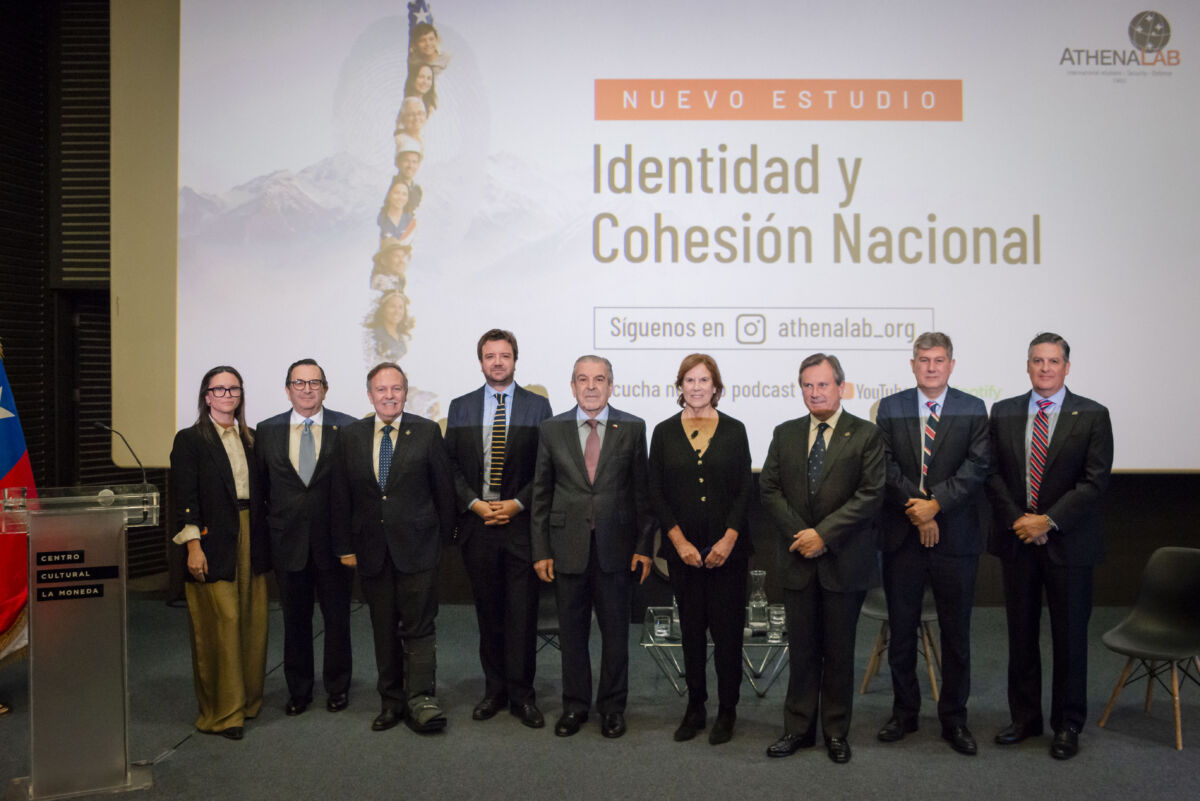
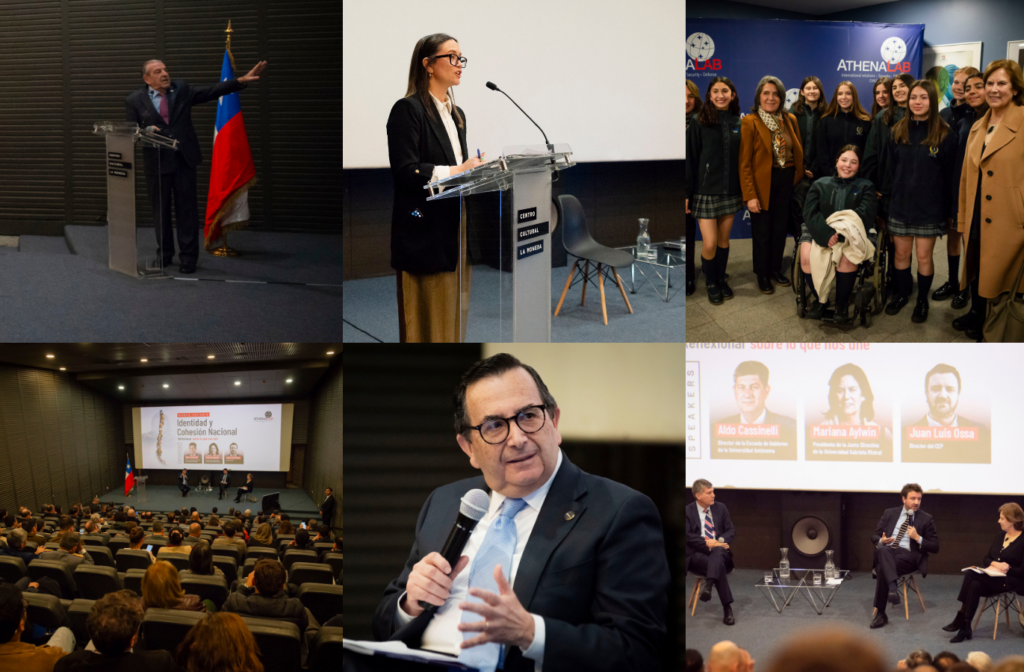
On September 9, AthenaLab launched the study “National Identity and Social Cohesion: Chile in Perspective” at the Centro Cultural La Moneda, providing a public space for reflection on the elements that shape Chilean identity, the foundations of social cohesion, and the challenges the country faces in rebuilding trust and articulating a common project.
The event included remarks from former President Eduardo Frei Ruiz-Tagle; a presentation of the study’s results by John Griffiths and Aldo Cassinelli; a panel discussion featuring Mariana Aylwin, Aldo Cassinelli, and Juan Luis Ossa; an audiovisual message from Mario Kreutzberger; and closing remarks by Richard Kouyoumdjian, executive vice president of AthenaLab.
The study combined a theoretical framework, qualitative research, in-depth interviews, and a national survey of over 1,200 cases. Its objectives included examining the relationship between national identity, interpersonal trust, institutional legitimacy, and social cohesion, as well as analyzing fragmentation factors such as distrust, polarization, the crisis of representation, the weakening of agreements, and the absence of a shared national goal.
Eduardo Frei: trust, development, and the capacity for agreement
In his remarks, Eduardo Frei addressed national identity from the perspective of Chile’s recent historical experience and the challenges that, in his view, condition the country’s ability to build a future. His presentation linked identity, development, modernization, international openness, infrastructure, security, and the quality of politics.
Frei highlighted the transformations Chile has undergone in recent decades, including economic openness, international integration, the expansion of the middle class, and the modernization of various aspects of national life. He stated that Chile retains demonstrated strengths and capabilities but must regain decisiveness, trust, and a forward-looking perspective.
He also referred to deficits in infrastructure and connectivity, particularly in the southern part of the country, and the delays associated with permits for strategic projects. He argued that the ability to inhabit, integrate, and develop the territory is part of the concrete construction of the country.
In the political realm, he identified as priority challenges the recovery of growth and employment, addressing insecurity, and resolving the political crisis. He also warned about polarization, the deterioration of trust in political institutions, and the risks of populism and authoritarianism.
Frei ultimately called for the recovery of the capacity to build agreements and to once again project a national goal.
The results of the study
John Griffiths and Aldo Cassinelli presented the main findings of research conducted over nearly three years. The presentation was organized around a central tension: Chile retains a strong national identity but exhibits fragile social cohesion.
Among the notable results, the study indicates that 68% of respondents identify at the highest level of pride in being Chilean, and when considering the next lower level, the figure reaches approximately 80%. Relevant components of identity include a sense of belonging, inclusion and exclusion regarding the community, and a shared history expressed in customs, traditions, and culture.
The flag emerges as a transversal symbol, along with family as a core of trust, geography and territory, traditions and customs, and a valuation of legality and normative respect. The study also posits that regional identities can coexist with and reinforce national identity.
In contrast, 87% of respondents express interpersonal distrust. This is compounded by the deterioration of institutional trust and a perception of distance between citizens and leadership. The study links this situation to a deficit of social capital and the feeling that different groups do not fully share a common destiny.
One of the central concepts presented was “episodic cohesion“, referring to moments when cohesion emerges strongly, such as natural disasters, sporting milestones, rituals and mass celebrations, and solidarity experiences like the Teletón. The study presents the challenge of transforming this cohesion that arises in response to specific events into a more permanent capacity for cooperation, trust, and collective action.
Moreover, 89% believe that Chilean society is more divided than it was ten years ago. Factors associated with polarization include the confrontational dynamics of politics and the role of the media, along with territorial and generational differences.
As areas for action, the presentation highlighted civic education, understood as training for coexistence, deliberation, and recognition of others; institutional reforms aimed at improving the state’s responsiveness and strengthening decentralization; and intercultural management capable of integrating diversity and preventing processes of marginalization or “ghettoization.”
The presentation concluded with a strategic question: what is the goal today that can act as a unifying force for Chilean society? The loss of shared objectives was identified as one of the central challenges left open by the study.
Identity, institutions, and a common project
The panel discussion brought together Mariana Aylwin, Aldo Cassinelli, and Juan Luis Ossa. The discussion addressed the relationship between national identity, institutional legitimacy, the crisis of the political system, civic education, and the construction of a shared project.
Juan Luis Ossa suggested that belonging to the nation and attachment to its symbols can coexist with a significant distance from institutions and ruling elites. He warned about conditions favorable to populism and authoritarianism and also identified as risks the extreme uses of particular identities and citizen indifference toward those in power. At the same time, he expressed confidence in the strength of representative democracy and Chilean institutions.
Mariana Aylwin focused on the relationship between national pride, interpersonal trust, and institutional trust. She emphasized the need for reforms that generate incentives for cohesion and underscored the weakening of a shared future project. In educational matters, she highlighted the need to strengthen civic education that develops belonging, collective responsibility, and historical, political, and humanistic knowledge.
Aldo Cassinelli delved into the relationship between interpersonal distrust, institutional deterioration, and social capital. He noted that low trust hinders the resolution of collective problems and the construction of a common destiny, although he highlighted that trust and solidarity can emerge more easily when problems take on a concrete face. He also proposed a broad notion of leadership, linked to those with the capacity to lead, and maintained that strengthening cohesion requires responsibilities distributed among various social actors.
Unity and solidarity
Mario Kreutzberger participated through an audiovisual message focused on unity, encounter, and solidarity. He highlighted the presence of the Teletón among the milestones of cohesion identified by the study and asserted that when Chileans set aside their differences and come together around a common cause, they are capable of achieving great objectives.
The closing remarks were delivered by Richard Kouyoumdjian, executive vice president of AthenaLab, who positioned the study within the institution’s strategic agenda and stated that identity and cohesion constitute deep factors of a country’s national security capacity.
View all images from the event