Ukraine: Different Perspectives on the Conflict
This article was translated automatically and may contain differences from the original. For reference, read the original.
News from Europe continues to accumulate as days pass, but none provide any level of reassurance. The buildup of Russian forces at the border with Ukraine, as well as those already stationed in Belarusian territory, remains a direct threat.
In contrast, Western countries have progressively hardened their rhetoric and shown clear support for Kyiv through visits from heads of state and the sending of arms. However, the participation of third states in the event of a potential Russian invasion has been ruled out. In this regard, Ukrainian President Volodymyr Zelensky has called for calm, both among his fellow citizens and the leaders of the major powers involved, while continuing preparations for a possible Russian military offensive on his territory.
The situation is complex: Ukraine, Russia, Europe, and the U.S. view and defend their actions from different perspectives, all rational and justified according to each party, but interpreted differently by their counterparts.
The Different Positions in Conflict
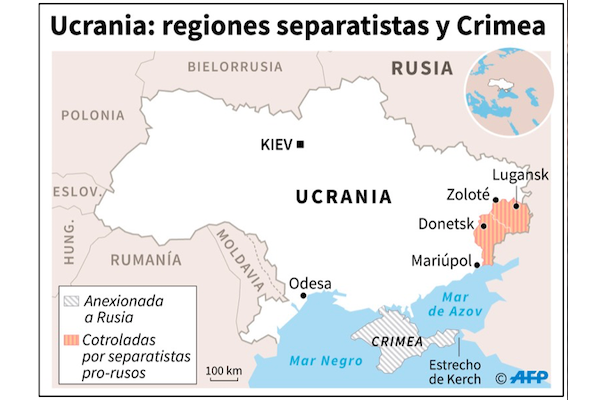
Ukraine, undoubtedly the state most committed to and affected by the crisis, is seen as a threatened and, one might say, unprotected country. While it shares historical roots with Russia, its consolidation as an independent state in 1991 gives it the option to pursue various alternatives to ensure its survival, including NATO membership. It is worth recalling that in 1994, following the disintegration of the Soviet Union, Ukraine agreed to cede all nuclear arsenal within its borders to Russia, with the commitment that its independence, sovereignty, and existing borders would be respected in the future, as outlined in the Budapest Memorandum. The signatories of this document include Russia, the U.S., and the United Kingdom. However, in 2014, Ukraine lost control of Crimea to Russia. During the same period, this country witnessed separatist insurgent groups in the Donbas region, supported by Moscow, using force to demand their separation from Ukraine, resulting in approximately 14,000 lost lives.
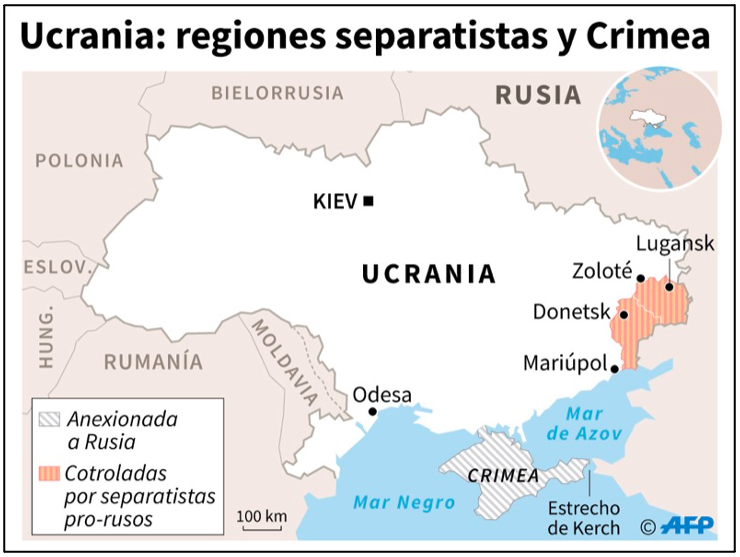
Today, Ukraine faces over 100,000 Russian troops and weapons at its borders, in addition to the threat that a potential invasion could involve crossing through Belarusian territory. For this reason, from its perspective, joining NATO is deemed necessary to integrate into a larger system that provides better security assurances.
For Russia, the issue presents itself as a matter of state security and survival. Since the fall of the USSR, the former Soviet republics that were part of the union and the now-defunct Warsaw Pact have gradually joined NATO, which has meant the appropriation of strategic spaces by the West at the expense of Russia’s security space. Belarus, Moldova, Ukraine, and Georgia remain outside NATO. Here, we must consider the importance of the concept of “security space” for the Russians, as history has shown that having a significant geographical space has allowed them to execute defensive maneuvers, sacrificing territory in favor of time, wearing down the adversary, and extending their lines of communication. The most remembered cases, though not the only ones, are Napoleon Bonaparte’s campaign and the Nazi invasion of Germany. Thus, this concept is fundamental to the Russian security conception, whose security space has gradually diminished over time.
Therefore, the potential incorporation of Ukraine into the Western security pact, either now or in the future, would mean the possibility of having American weapons on its borders, which is considered unacceptable for Putin. In this same process, Russia seeks to revert NATO to its position prior to the fall of the USSR, meaning undoing the inclusion of countries that were under its sphere of influence and are now close to the U.S.
Additionally, for Moscow – and for some Ukrainians as well – Ukraine is part of Russia. It must be acknowledged that its current territories shared what was known as “Kievan Rus” from the 9th to the 13th centuries and, more recently, that Ukraine was part of the Tsarist Empire and the USSR.
This must be supplemented by Russia’s intention to regain its role as a global power, despite its limited economic influence. This rests on its nuclear capability, the projection of its submarines, and demonstrated capabilities in cyberspace. Moreover, in the last two decades, Putin has been committed to restoring the capabilities of its armed forces, both in terms of technology, training, and operational availability. It is no coincidence that there has been a decisive intervention in Syria, knowing the presence of other powers such as the U.S.
The United States is perhaps Putin’s main target in this power confrontation. Americans must strengthen their position while ensuring their European partners of their effective involvement in the security of the continent. This is especially relevant after the Trump administration, with its particular foreign policy, generated many doubts among its allies on the old continent. It should also be noted that the U.S. is one of the main responsible parties for the signing of the Budapest Memorandum.
In this scenario, the prevailing sentiment in the U.S. is that if Russia achieves its objectives in this manner, there will be no real reasons to refrain from making similar demands in the future, threatening the stability and security of European countries. Furthermore, it must provide certainty of its commitment to European security, not to mention that it would represent another setback that China would be waiting for.
For Europeans, the situation is also highly complex. On one hand, they face the aggressive attitude of the Kremlin, while on the other, they depend on Russian gas. Although most countries are part of the European Union and NATO, not all members have reacted in the same way. The United Kingdom, for example, has aligned with the U.S. position by sending arms to Ukraine. France is attempting to act as a mediator. Conversely, Germany has been more cautious, perhaps due to its greater dependence on gas supplied by Russia, especially during the European winter. What prevails in the European political atmosphere is that if concessions are made to Putin this time, there would be nothing to stop him from continuing to advance his demands in the future.
The Latest…
During the last week, progress toward a solution seems nonexistent. On Monday, January 31, an intense debate took place with strong accusations exchanged between the U.S. and Russia during a United Nations Security Council session, with both sides demonizing each other. In the end, nothing was resolved. Subsequently, for the first time this year, Vladimir Putin addressed the crisis, directly accusing the West of using Ukraine as a “pawn” and of not listening to Russia’s security demands, adding that one cannot strengthen the security of some at the expense of the security of others.
For his part, Joe Biden continues to escalate his rhetoric and threats of new economic sanctions, which could include Putin himself. Additionally, the U.S. government announced the decision to deploy 3,000 soldiers to Europe, which adds to the repositioning of forces toward Eastern Europe and the heightened alert status of a significant number of troops. In summary, far from improving, the crisis continues to escalate.
As if that were not enough, on February 4, Putin traveled to Beijing and met with Xi Jinping, marking the first meeting the latter has held with a head of government in two years. China has remained distant in the conflict but has stated that the West must listen to Russia’s security demands. According to The Washington Post, in a joint statement, these leaders expressed shared views on geopolitical issues but avoided referring to the current crisis by name, stating their opposition to NATO expansion and that both countries “firmly support each other in safeguarding their fundamental interests.”[1]
The parties involved do not yield in their positions. The different perspectives illustrate a complex scenario where the demonstration of force takes precedence over dialogue. Both leaders on one side and the other blame each other, failing to recognize that their own attitudes in defending their positions drive their opponents to take more extreme measures, witnessing the classic “Security Dilemma.”
For now, we must closely monitor the development of this crisis, hoping that a miscalculation, a misinterpretation, or even a human error by a simple soldier does not trigger a larger military conflict. As the old Anglo-Saxon saying goes: prepare for the worst, expecting the best.
[1] See https://www.washingtonpost.com/world/2022/02/04/ukraine-russia-china-putin-xi/