Russia, Ukraine, and the Gerasimov Doctrine
This article was translated automatically and may contain differences from the original. For reference, read the original.
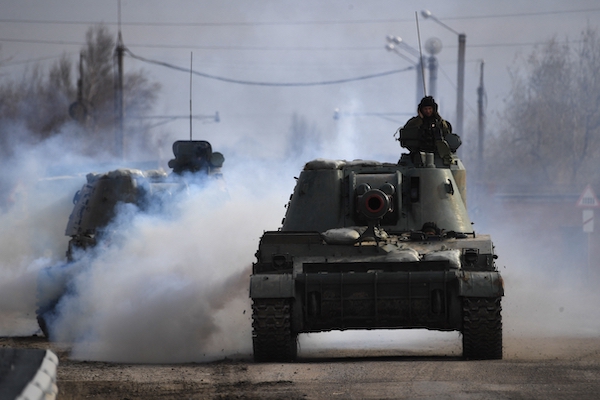
The onset of military operations in Ukraine is the result of a long process whose origins date back beyond the recent concentration of Russian forces at the border since late 2021 and even before the annexation of Crimea in 2014. This action is framed within the Russian strategic doctrine, popularly known as the “Gerasimov Doctrine,” and understanding it allows for a better comprehension of current events and the developments that led to the war we are witnessing.
WHAT IS THE “GERASIMOV DOCTRINE”?
General Valery Vasilyevich Gerasimov has been the Chief of the General Staff of the Armed Forces of the Russian Federation since 2012 and is credited with the strategic conception that currently predominates in Moscow. In 2013, during an address to the Russian Academy of Military Sciences, Gerasimov articulated what he considered the evolution of warfare or, at least, how Western countries, particularly the United States, had undertaken actions to extend their sphere of influence in nations traditionally close to the former Soviet Union.
In his explanation, Gerasimov warned that the so-called “color revolutions” (pro-democratic uprisings in Eastern Europe) or the “Arab Spring” were coordinated actions by the West to change the balance of power in Europe, the Middle East, and North Africa. For this general, instead of using conventional operations that could trigger a war between powers, it was necessary to prioritize non-military actions to pursue the same objectives. According to him, the U.S. employed various instruments to destabilize the “victim” nations in order to achieve a regime change that would be favorable to it. All of this stands in stark contrast to Russia, which would be the main victim.[1].
As a consequence of the above, Gerasimov defined that the primary response to this threat is a series of similar measures that can nullify them. As a result, Russia has updated its strategic approach and developed capabilities to confront these scenarios, becoming one of the states best prepared with an “arsenal” of instruments to act—defensively or offensively—under this strategic perspective.
This proposal, which has continued to evolve over the years, establishes that the new Russian strategy should integrate “hard power” and “soft power” through a broad and coordinated combination of tools (both conventional and unconventional), including military, diplomatic, and economic means. Ultimately, victory must be achieved by minimizing the use of kinetic elements and preferring non-kinetic ones. More concretely, this doctrine proposes that the ratio of non-military to military means should be 4:1. Similarly, it assumes a type of confrontation that exploits indirect action, campaigns and information operations, private military organizations, special operations forces, and the leveraging of potential internal protest groups. All of this is supported by strong and sophisticated conventional and nuclear military capabilities.[2]
In this way, a campaign under this doctrine considers:
- Initiating an informational and psychological phase aimed at neutralizing adversary leaders (those who make decisions), affecting the civilian population, and strengthening internal cohesion.
- Indirect and asymmetric actions through economic, informational, and technological tools to affect the enemy’s military apparatus.
- Non-military actions degrade the adversary’s capacity to employ force and create a negative image in global public opinion, which eventually deters the rival from launching a response.
- Whoever initiates the Gerasimov strategy employs a massive campaign of deception and disinformation to conceal the timing, scope, scale, and nature of the attack.
- Subversion and reconnaissance activities carried out by special forces are covered by information operations that precede the kinetic phase of the campaign.
- The kinetic phase—the initiation of military power—begins with aerospace dominance aimed at selectively destroying critical assets of civil technological-industrial infrastructure and state and military management centers that will compel the state to capitulate.
- Having configured the scenario with all of the above, the phase of territorial occupation follows, where most of the campaign objectives have been achieved, as the adversary’s capacity and will to resist have been broken and collapsed.[3].
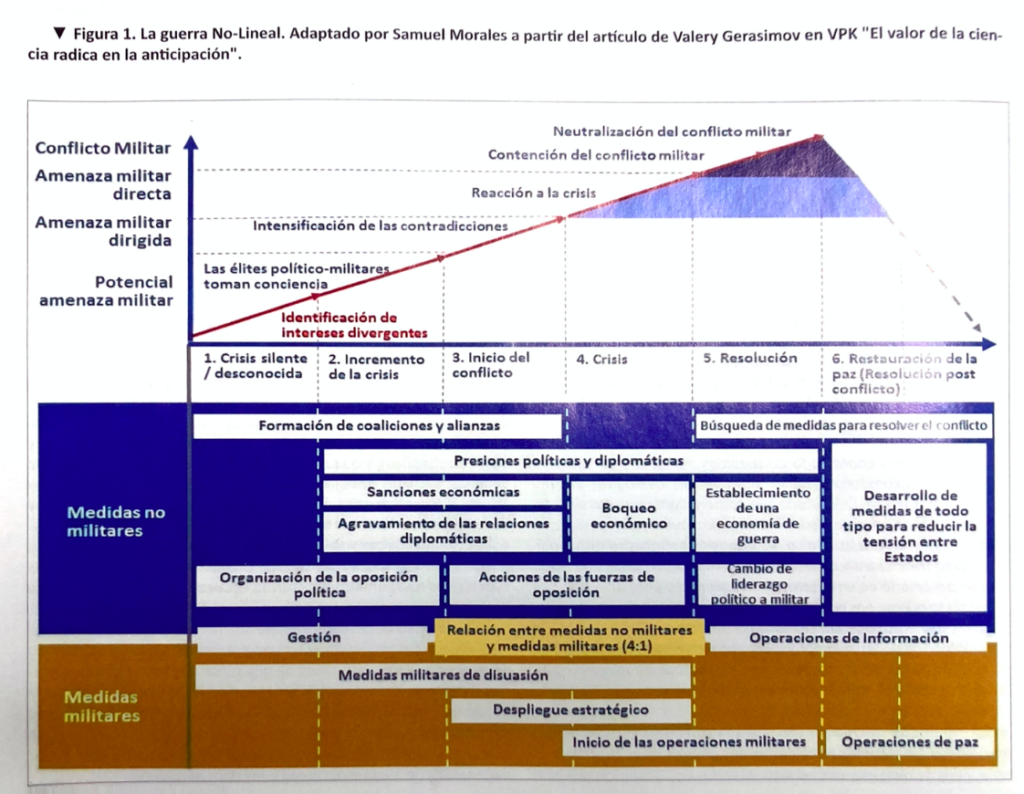
As can be inferred, we are not facing actions that can be considered “new”; however, two aspects should be highlighted that make this approach innovative. First, the open preference for the use of non-military tools over military ones, and second, the Russian strategic thought’s emphasis on an asymmetric and indirect approach, alongside the traditional use of force, for conflict resolution.
FOR CONSIDERATION
Of course, the initiation of Russia’s military intervention is neither surprising nor improvised. Reviewing the evolution of events from the perspective of Russian doctrine, even before the Ukraine crisis, allows for an understanding of how the process that has pitted the troops of both countries against each other developed. From all that has occurred, some conclusions can be drawn. On one hand, the nature of war, in its most basic conception, remains the same: the use of coercive means to resolve differences in pursuit of political objectives and to protect national interests. However, where there may be variations is in the character of the war unfolding in Europe, as the instruments of national power have been employed differently than traditionally observed, particularly with the emergence of significant information operations, massive use of cyberattacks, sabotage, and special operations forces, at levels not seen before. The peculiarity lies in a significant increase in the use of information tools through cyberspace, the only “domain” created by humans.
On the other hand, the West has struggled to confront the threat posed by Russia in recent times, whether due to the aggression exhibited by Putin or having lost “tune” with Russian strategic thinking. After the fall of the USSR and with the rise of China as a global power, the center of gravity of international studies did not remain on Moscow, which does not mean that they have ceased. Upon reviewing analyses conducted by Western countries on Russian strategy, some reveal a lack of understanding or outdated knowledge regarding how Russian strategists think.
For example, in the evolution of the Gerasimov doctrine, the latter named the use of hybrid warfare, which was immediately interpreted through the lens of the concept developed by Frank Hoffman. However, the hybrid nature of the Russian conflict does not fully align with the Western perspective, leading to a misinterpretation of the theory that inspires Russian leaders and, consequently, poor decision-making.
Another aspect worth highlighting is how the international system has become complicated for global actors that rely on respect for International Law. This is because the United Nations Charter establishes the authorization of the use of force in favor of legitimate defense against an armed attack. Here lies the problem, in the definition of armed attack. There is no doubt today that Russia already has conventional means on Ukrainian territory and has destroyed targets within its cities. The issue is that the offensive required to achieve the political objectives set by Putin did not begin in the early hours of February 24, 2022, but much earlier, through other tools available in the new Russian arsenal. Therefore, the challenge arises to update international regulations for such situations, as—by way of example—a cyberattack could eventually result in the loss of human lives due to power outages in healthcare facilities.
Chile, despite the distance, is not unaffected by these events. On one hand, more directly, markets are already feeling the impact of the Russian offensive, and oil prices are rising even further. This could be replicated in other agricultural commodities of which Ukraine is a major exporter. On the other hand, indirectly, the weakening of the international system and the institutions tasked with defending it is not good news for a country like Chile, as it relies on the stability of its rules and security mechanisms to protect its interests.
Now, it remains to follow the evolution of events and verify how far Putin intends to go and how much commitment there will be from Western powers.
[1] Baqués, Josep. “The Gray Zone: The New Playing Field.” Journal “Ejércitos,” No. 12. November 2019. Zaragoza. Pages 11-12.
[2] Adamsky, Dmitry. “Cross-Domain Coercion: The Current Russian Art of Strategy.” Proliferation Papers 54. Institut Français des Relations Internationales (Ifri). November 2015. Page 23.
[3] Ibid, p. 24.