Macron, Taiwan, and Multipolarity
This article was translated automatically and may contain differences from the original. For reference, read the original.
- by Juan Pablo Toro
- Strategic Affairs
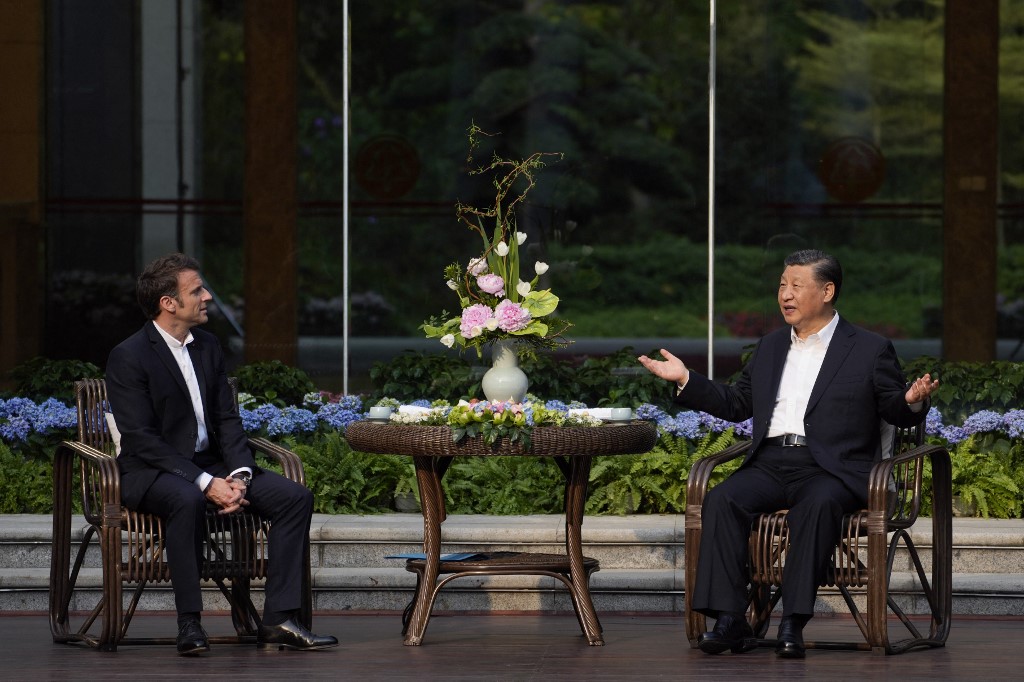
The recent statements by French President Emmanuel Macron, who upon returning from his trip to China warned that Europe “should not get involved in crises that are not ours,” citing Taiwan as a matter that does not concern them, have caused a justified uproar.
If the intention was to explain the scope of the “strategic autonomy” that the European Union (EU) aims for, the French leader took it upon himself to speak on behalf of the bloc, perhaps motivated by France’s military centrality within it.
However, the very community documents of the bloc, such as its Indo-Pacific Strategy, contradict his approach: “The display of force and the increase in tensions in regional flashpoints, such as the South and East China Seas and the Taiwan Strait, can have a direct impact on European security and prosperity.”
The EU is a trading power that depends on the openness of maritime routes to maintain export/import flows with Asian markets. Any disruption would be a significant economic blow, which is why the decision to reinforce European naval presence in the area has emerged.
The timing could not have been worse, as his statements were being reported by the news site Politico, while China was beginning three days of naval and aerial exercises around Taiwan to simulate a blockade, all in retaliation for President Tsai Ing-wen’s visit to U.S. House Speaker Kevin McCarthy.
During his visit, Macron attempted to persuade his counterpart Xi Jinping not to supply arms to Russia and to help convince Vladimir Putin to seek an exit from the war he initiated 13 months ago by invading Ukraine. Whether the French president succeeded in altering Xi’s de facto position regarding his main partner, with whom he has a “limitless friendship,” remains to be seen, but he would be among the few able to effect such a behavioral change in a leader averse to criticism.
However, if the price was to leave Taiwanese democracy to its fate, it is an excessively high cost, assuming that a potential takeover of the island would open the doors for the People’s Liberation Army to realize its leader’s vision of an “Asia for Asians,” where China would be the central hub.
Just as many see Greece as the cradle of ancient democracy, some central elements of modern democracy, such as the separation of powers, the importance of public opinion, and the principles of “liberty, equality, fraternity,” originate from France.
It is true that there is a strategic rivalry between the United States and China, against which countries try not to get dragged, with varying degrees of success, but there is also today a deep and expanding fracture between democracies and autocracies. Downplaying this in favor of a realpolitik may have its logic, but coming from France, it sounds rather surprising. Because France is a cornerstone of the West.
In contrast, the case of Brazilian President Luiz Inácio Lula da Silva is quite different, as he refuses to arm Ukraine, asks it to accept the loss of Crimea, and seeks some form of mediation. Here, there is rather an attempt to distance himself from the Western world and seek partnerships with other countries in the now-called “Global South,” whatever that concept may mean.
When values are prioritized, it is very difficult to conduct foreign policy in a multipolar world where there are different visions regarding societal models and the conditions surrounding them. But when democracies waver, authoritarian leaders advance, as evidenced by the democratic backsliding we have witnessed over the past two decades. Therefore, values also serve to cement alliances and relate to the respect, or lack thereof, for existing international norms.
What would have happened if the United States had not gotten involved in supporting Ukraine and had left Europeans to resolve “another” of their wars on their own, considering it was not their issue? Leaked Pentagon documents indicate that both sides are exhausted and lacking new resources to regain military momentum. And Macron may also know this and is merely seeking to shorten the path to a negotiated exit.
The “strategic autonomy” does not sound entirely bad, but it is still a distant goal that also requires calibration. Especially since today there are dependencies of Europe on Washington for security, on China for trade, and on Russia for energy.
For all the above reasons, Macron’s statements have now become part of a history that includes diagnosing NATO as “brain dead” in 2019 (now in full expansion) and calling for not to “humiliate” Putin in 2022. If he faces significant discontent within his country over his pension reform, Macron has extended that discontent abroad for other reasons.