Carabineros per capita: a comparison between Chile and the international context
This article was translated automatically and may contain differences from the original. For reference, read the original.
- por Constanza Araos
- Análisis
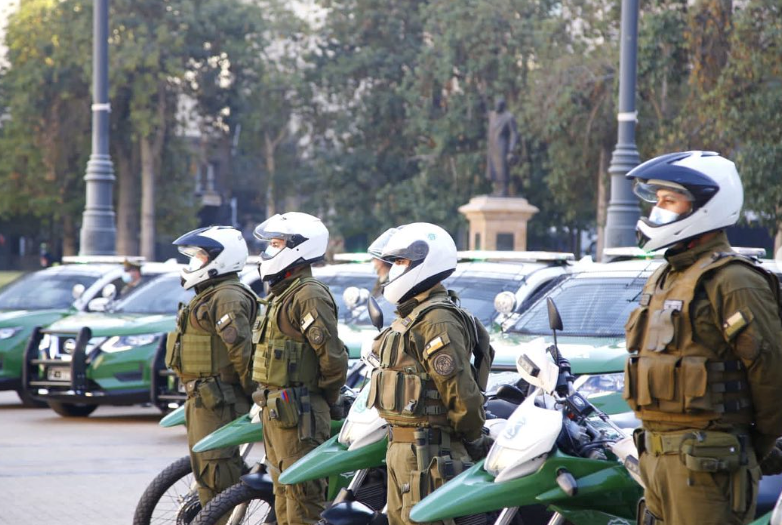
The main objective of this research is to review the number of Carabineros in Chile per capita and then contrast this figure with those from European Union countries, the Organisation for Economic Co-operation and Development (OECD), and other internationally collected data. Members of the Police of Investigations will not be considered, as they are not primarily dedicated to preventive tasks.
Last year, the international average was 280 police officers for every 100,000 inhabitants, while at that time the minimum recommended by the United Nations was 180 police officers for every 100,000 inhabitants.[1]According to official documents, Chile had 230 police officers for every 100,000 inhabitants in the first half of 2022.[2], which places us below the international average but above the UN recommendation.
The national police distribution can be reviewed in the official document provided by Carabineros de Chile, titled “GLOSA N° 9 Report on Operational Management Results 2022 and Goals 2023.”[3], corresponding to the first quarter of this year, which reports the following data regarding operational deployment:
986 Territorial Operational Stations:
• 22 zones
• 55 prefectures
• 224 police stations
• 117 sub-stations
• 201 posts
• 367 checkpoints
Regarding the figures for the “Preventive Security Quadrant Plan” (PCSP), the data were as follows:
448 PCSP stations nationwide:
• 164 police stations
• 61 sub-stations
• 76 posts
• 147 checkpoints
If we analyze the distribution of personnel at the regional level, the region with the highest number of officers per 100,000 inhabitants was Aysén del General Carlos Ibáñez del Campo, with 658, which is explained by its being the least populated region in the country, with a total of 108,047 people recorded. In contrast, the region with the lowest number of Carabineros in proportion to its population is Libertador General Bernardo O’Higgins, with 172 Carabineros for every 100,000 inhabitants, out of a total of 1,009,552 people recorded.[4].
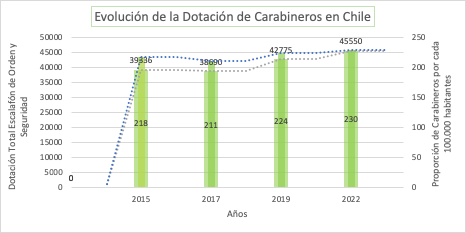
It should be noted that the total number of recorded inhabitants in the country was 19,828,563 in the last period, while the most recent figure for the officially reported personnel was 45,550 active uniformed officers.[5]. However, if we include all civilian and police personnel from the Carabineros de Chile institution, the number rises to 56,967.[6].
Reviewing more historical data, in 2019 the average number of Carabineros per 100,000 inhabitants nationwide was 224, with a total of 42,775 officers, in proportion to a population of 19,107,216 recorded inhabitants.[7]. If we compare with older figures, from the recorded period between 2002 and 2015, with a national total of 18,006,215 inhabitants, there were a total of 39,336 Carabineros, with a rate of 218 per 100,000 inhabitants.[8].
On the other hand, the studies on the distribution of Equivalent Surveillance Units (UVE) prepared by Carabineros de Chile, which serve to quantify the human service provided to the community in relation to local neighborhood realities within preventive security plans, indicate that this distribution of personnel varies across the national territory, according to the socio-vulnerable needs of each municipality in the country. This translates into the quantification of police coverage, which results from the ratio between available personnel and security demand.
Moreover, this distribution not only has a quantitative variable but also considers a qualitative one, as it is not only the number of police officers but also the equivalence between different means of surveillance, referring to the materials used and the equipment or level of training of the personnel to be deployed. For the purpose of carrying out crime prevention tasks, Carabineros has the authority to propose the aforementioned methodology for the distribution of police units, which must also be evaluated and updated in its implementation twice a year regarding supply, demand, and police coverage index.
The origin of this UVE determination methodology took place at the beginning of the 2000s, with the implementation of the “Carabineros de Chile Quadrant Plan.” Furthermore, in a report to the Senate made by Carabineros de Chile[9], corresponding to August 2015, the factors to consider for calculating the UVE were reported, which were technically updated in 2018 through General Orders No. 2,603, dated October 8, 2018, and No. 2,611, dated October 31, 2018, which establish the “Methodology for Determining Equivalent Surveillance Units” and the “Methodology for the Distribution of Human Resources and Vehicles of Territorial Operational Units.”[10].
Now, to conduct a more updated analysis, this methodology is under study. Therefore, there is a collaboration agreement[11] between the Undersecretariat for Crime Prevention of the Ministry of the Interior and Public Security and Carabineros de Chile, dated February 28, 2023, approved by Exempt Resolution No. 86, which aims to update and strengthen this methodology again, now with a focus on “equity and territorial justice.”
To get an idea of the criteria applied in the UVE in the aforementioned reports submitted to the Senate, they were systematized in a simplified manner as follows:
• Population: determines the necessary surveillance capacity for the existing population in the municipality.
• Linear kilometers: measures the amount of surveillance required to adequately patrol the number of linear kilometers of streets and roads in the municipality.
• Crime level: determines the need for police surveillance in relation to the number of crimes occurring in a municipality over a unit of time, measured from the perspective of the consequences or harms they generate.[12].
On the other hand, there are factors that influence the generated demand, which serve as a basis for calculating preventive surveillance, such as:
• Procedural factor: considers the measurement of the resources necessary to address the requests generated by the community, whether a crime has been committed, an infraction has occurred, or attention is required for certain events in social life that can translate into reports, arrests, or guidance from the Carabinero, depending on the intervention. Each procedure is assigned a specific duration, corresponding to the temporal demand for the use of the assigned resource.
• Supervision factor: measures the resources necessary to ensure compliance with specific laws assigned to the supervision of Carabineros, which regulate certain aspects of the functioning of: banking entities, liquor stores, traffic users, open-air markets, among others; and also the support activities developed for certain institutions, such as schools and neighborhood councils. The number of these places and entities and the time associated with the intervention of personnel will determine the demand in UVE for this factor.
• Judicial orders factor: this factor groups the demand originating from mandates from the courts of justice and currently from prosecutors of the Public Ministry, which translate into compliance with judicial orders of various natures, each associated with an average processing time, and depending on the sum and means of surveillance involved, the total demand in UVE assigned to each station will be determined.
• Extraordinary services factor: the measurement of this variable assumes that each operational unit must not only provide permanent and pre-established services to meet the usual surveillance needs of its jurisdictional sector but must also address extraordinary demands that, with greater or lesser frequency, arise in that sector, such as artistic or sporting events with large public gatherings, mass public meetings, etc., all of which require the use of different means of surveillance in variable time and quantity. [13].It is also noteworthy that, according to statements made in response to requests to the Transparency Council, in Chile, it is not possible to directly access, through transparency requests, the exact updated data on the current personnel of Carabineros de Chile or their distribution by municipality, as Law 21,427, which amended the Organic Law of Carabineros de Chile, added the second paragraph of article 2 ter, establishing that information on personnel and their territorial distribution is classified, which is also consistent with the provisions of article 436 of the Military Justice Code. However, the data used for this work were reviewed through active transparency of the information reported in the budget laws by the Senate.
Source: Own elaboration. The data presented in this graph were obtained from public information derived from the budget laws of the years 2015, 2017, 2019, and 2022.
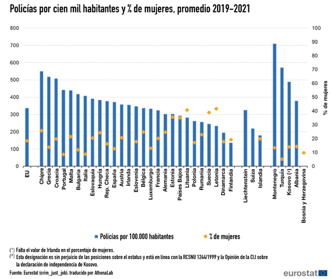
According to Eurostat figures, covering data from 2010 to 2022 and considering figures from both member countries and candidate countries for the European Union, potential candidates, and members of the European Free Trade Association (EFTA), it was reported that there was one police officer for every 300 inhabitants during the period from 2018 to 2020.
Among its member states, the measurements of the number of police officers, in the ratio of police officers per 100,000 inhabitants, showed that the countries with the highest rates were Cyprus, with 556.5; Greece, with 509.0; and Croatia, with 499.3. In contrast, the countries with the lowest police presence were Finland, with 134.1; Denmark, with 192.6; and Sweden, with 200.1.
Source: Eurostat. Statistics Explained. “Police, court and prison personnel statistics.” Available at:
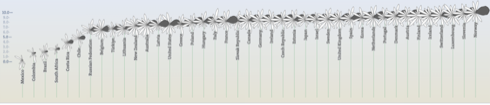
In the case of the OECD, there is no specific figure provided by the organization for quantifying police officers in its member countries. Regarding security analyses, the Better Life Index of the organization, corresponding to 2020 figures, has measured the homicide rate, the rate of deaths in traffic accidents, and the feeling of safety when walking alone at night, with a detailed analysis of the gender difference in the feeling of safety.
[13].Among these figures, the safest countries include Norway, Slovenia, Luxembourg, Switzerland, Iceland, and Finland, while Chile ranks third with the lowest safety index, followed by Colombia and Mexico. In terms of the homicide rate, the countries with the best indicators are Japan, the United Kingdom, Switzerland, Luxembourg, and Germany.
In summary, to view the data, both for member countries and for other candidates or key allies, those that stand out at the top of the list with the best security indicators are Norway, with 194 police officers for every 100,000 inhabitants; Slovenia, with 346 police officers for every 100,000 inhabitants; Luxembourg, with 326 police officers for every 100,000 inhabitants; Switzerland, with 217 police officers for every 100,000 inhabitants; and Iceland, with 136 police officers for every 100,000 inhabitants. Meanwhile, those with the lowest rates include Mexico, with only 90
[14]state police officers for every 100,000 inhabitants; Colombia, with 222 [15]police officers for every 100,000 inhabitants; Brazil, with 267 [16]police officers for every 100,000 inhabitants; South Africa and Costa Rica, with 277 police officers for every 100,000 inhabitants, followed by Chile. Source: OECD. “
How’s Life?: Measuring Well-being.” 2020. Available at:https://read.oecd-ilibrary.org/economics/how-s-life/volume-/issue-_9870c393-en#page154 Source: OECD. “
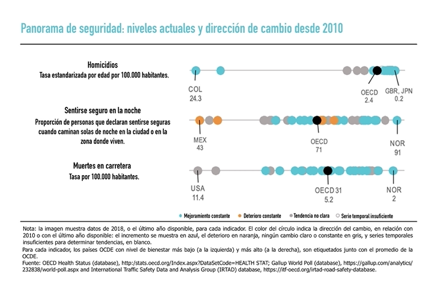
[17], which is below the OECD average of 2.6 homicides per 100,000 inhabitants.Meanwhile, Japan leads the list with the lowest homicide rates in the OECD, with 0.2 per 100,000 inhabitants, matching the indices of the United Kingdom and Luxembourg. Japan has a ratio of 203 police officers per 100,000 inhabitants
[18], and its crime prevention system is based on a close connection with the civil environment, having community police known askōban, with a strong presence in public spaces, and plans to instill a culture of respect and crime interdiction from a very early age in schools. Thus, Tokyo is one of the cities with the highest number of police officers in the world [19].Now, if we analyze the number of police officers in each OECD country in Europe, compared by the number of crimes, broken down by other typologies, we can observe that crime prevention varies in effectiveness. Paradoxically, in some of the countries considered the safest or with the best quality of life, particularly those concentrated in Northern Europe, there are fewer police officers per capita and, additionally, they have the highest rates of sexual violence and rape crimes
[20]; certainly, the figures vary in intentional homicides.Regarding sexual violence crimes, the list is led by Sweden, with a crime rate of 217.7; Iceland, with 177.06; and France, with 109.7 per 100,000 inhabitants. In terms of rape crimes, Sweden leads the list with 89.7; Iceland, with 57.2; and France, with 50.1 per 100,000 inhabitants. Meanwhile, the highest homicide rate in the European region is in Latvia, with 3.7 per 100,000 inhabitants. Additionally, the countries with the fewest police officers are Hungary, with 90 police officers per inhabitant and a homicide rate of 0.9 per 100,000 inhabitants; Finland has 137 police officers per 100,000 inhabitants and a homicide rate of 1.2; Denmark has 186 police officers per 100,000 inhabitants and a homicide rate of 0.5; and Sweden has 203 police officers per 100,000 inhabitants and a homicide rate of 1.1.
Chile, for its part, according to the OECD, recorded 2.4 homicides per 100,000 inhabitants
[21], However, according to new figures, in 2022 the homicide rate increased by 32% compared to 2021, leaving Chile with a rate of 4.6 per 100,000 inhabitants[22]. While it is the lowest rate in the region, it is the country with the highest rate of increase in homicides in Latin America[23].Source: Own elaboration
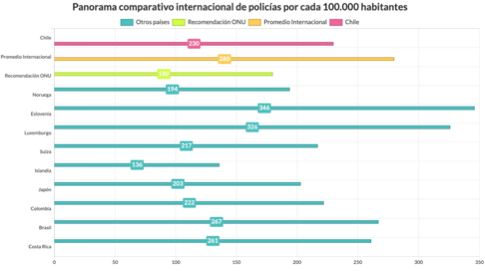
In summary, according to updated figures for 2022, Chile has about 230 police officers for every 100,000 inhabitants, a figure similar to that of Latvia (232.41); however, our homicide rate, according to these new figures, would be above that of Latvia, which has the highest rate in Europe. Thus, it has been studied that a higher number of police officers in countries is often more related to areas with higher crime rates.
On the other hand, there is a significant dispersion of data: if one observes the OECD indicators, they vary compared to those from the OAS or the information provided within the countries. Additionally, there has been a radical change in the statistics, as the figures currently handled by the OECD for Chile were below the average homicide rates, which has changed significantly, as the new figures now place us in a worse position within the
ranking .Considering the emergence of new criminal phenomena in Chile in recent years, it will be necessary to pay special attention to the update of the methodologies for determining police personnel described in this document, related to territorial distribution within the country, expressed in the UVE, as the needs in response to crime are not the same across the national territory, considering the conflicts in the southern macrozone or the phenomena of irregular migration and organized crime in the Northern Grande. Thus, as already analyzed, it does not only depend on crime rates but also on factors that pertain to the actions of other state bodies, such as the criminal justice courts, the Public Ministry, or other extraordinary services.
While it is difficult to access updated data on the total national personnel for the last measurable semester of 2023 due to transparency legislation, according to the figures reviewed, we are in a good comparison with the average and international recommendations, but not with the increase in crime rates. Therefore, it becomes necessary to evaluate the deployment of police personnel intelligently. This not only pertains to the distribution of personnel but also to the specification of police functions, limited to crime prevention, preventive police surveillance, public order control, coverage of procedures, selective supervision, and compliance with judicial orders.
This will depend on how much personnel enters the police forces, the qualities of those recruited, the personnel that is actually operational, and that, in addition, actions are coordinated with a comprehensive, permanent, and robust state security policy. The ideal is that it not only responds to criminal phenomena in an
ex post , but also anticipates and deters them, as is the case with the Japanese model, for example, which has a strong community component and constant interaction with civil life. Furthermore, it is necessary to reinforce police action itself, providing robust institutional support so that officers can effectively carry out their crime prevention duties, allowing the police officer to faithfully fulfill their duty without being subject to questioning for performing their functions.Ultimately, while the personnel figures are at a good comparative level with the international context, the improvement that can be made to the system would not necessarily involve increasing the number of Carabineros, but rather refining their functions and providing adequate effective support for their actions. In this regard, it will be necessary to review what legal and institutional support will be granted in the upcoming bills to be processed in the area of security and what direction the institutions will take in this matter to truly reinforce the police function.
[1]
Emol: “Number of Carabineros in Chile,” May 17, 2022. Available at:https://www.emol.com/noticias/Nacional/2022/05/17/1061178/numero-carabineros-chile.html#:~:text=Tomando%20como%20referencia%20los%20aproximadamente,uniformada%20por%20cada%20mil%20habitantes [2]
Official Letter No. 18,277, dated August 19, 2022, Ministry of the Interior and Public Security to the Special Joint Budget Commission of the National Congress. Available at: https://www.senado.cl/site/presupuesto/2022/cumplimiento/Glosas%202022/05%20Interior/0531_18277%20CCH.pdf [3]
Carabineros de Chile, “GLOSA N° 9 Report on Operational Management Results 2022 and Goals 2023,” first quarter of 2023. Available at: https://www.carabineros.cl/secciones/glosa9/assets/INFORME_GLOSA_N9_MARZO_2023.pdf [4]
Gloss No. 15. “Report on the Number of Carabineros in Service by Municipality and per One Hundred Thousand Inhabitants, First Half of 2022.” Available at: https://www.senado.cl/site/presupuesto/2022/cumplimiento/Glosas%202022/05%20Interior/0531_18277%20CCH.pdf [5]
Idem. [6]
Participatory Public Account Ministry of the Interior and Public Security. May 2023. Government of Chile. Available at: https://www.interior.gob.cl/media/2023/05/Cuenta-pu%CC%81blica-participatica-MISP-mayo-2023.pptx.pdf [7]
GLOSS No. 9. “Report on the Number of Carabineros in Service by Municipality and per One Hundred Thousand Inhabitants, Second Half of 2019.” Available at: https://www.senado.cl/site/presupuesto/2019/cumplimiento/Glosas%202019/Cuarta%20Subcomision/05%20Interior/135%20Carabineros.pdf [8]
GLOSA N°9 “Report on the Number of Carabineros in Service by Municipality and per One Hundred Thousand Inhabitants, First Half of 2015.” Available at: https://www.senado.cl/site/presupuesto/2015/cumplimiento/Glosas%202015/cuarta_subcomision/05%20Interior%202015/ORD.%2019430%20Carabineros/GLOSA%20N%C2%B0%209,%201ER.%20SEMESTRE%202015.pdf [9]
Ibidem .[10]
Official Letter Number 117, dated June 9, 2022, General Sub-Controller, Public Information and Lobby Department, Carabineros de Chile. Available at: https://www.consejotransparencia.cl/wp-content/uploads/instruccion/2022/08/Archivo_para_subir.pdf [11]
Exempt Resolution Number 86, dated February 28, 2023, of the General Directorate of Carabineros de Chile. Available at: https://www.carabineros.cl/transparencia/convenios/2023/RESOLEX_86_28022023_BO5051_178461567_redacted.pdf [12]
GLOSA N°9 “Report on the Number of Carabineros in Service by Municipality and per One Hundred Thousand Inhabitants, First Half of 2015.” Available at: https://www.senado.cl/site/presupuesto/2015/cumplimiento/Glosas%202015/cuarta_subcomision/05%20Interior%202015/ORD.%2019430%20Carabineros/GLOSA%20N%C2%B0%209,%201ER.%20SEMESTRE%202015.pdf [14]
Badillo, Diego. El Economista. “We Need More Local Police… and Better Treatment.” Published on Sunday, September 25, 2022. Available at: https://www.eleconomista.com.mx/politica/Necesitamos-mas-policias-locales-y-que-reciban-mejor-trato-20220923-0078.html [15]
Infobae. “Colombia is the Second Country in Latin America with the Highest Public Spending on Defense.” Published on September 5, 2022. Available at: https://www.infobae.com/america/colombia/2022/09/05/colombia-es-el-segundo-pais-de-latinoamerica-que-mas-gasto-publico-hace-en-defensa/#:~:text=Los%20datos%20actuales%20indican%20que,por%20cada%20100%20mil%20habitantes [16]
OAS. Inter-American Security Observatory. Available at: http://www.oas.org/ios/indicatorsdetails.aspx?lang=es&indicator=41 [17]
OECD. Better Life Index, Safety, Topics. Available at: https://www.oecdbetterlifeindex.org/topics/safety/ [18]
Villalobos, Gabriela. Pauta. “The Resolved Doubt: How Many Carabineros Are There in Chile.” Published on Friday, June 15, 2018. Available at: https://www.pauta.cl/nacional/la-duda-resuelta-cuantos-carabineros-hay-en-chile [19]
Ibidem .[20]
EUROSTAT. Recorded offences by offence category – police data. Available at: https://ec.europa.eu/eurostat/databrowser/view/CRIM_OFF_CAT/default/bar?lang=en .[21]
OECD. Better Life Index, Safety, Topics. Available at: https://www.oecdbetterlifeindex.org/topics/safety/ .[22]
InSight Crime. InSight Crime Report on Homicides in 2022. Available at: https://es.insightcrime.org/noticias/balance-insight-crime-dhomicidios-en-2022/ [23]
Batarce et al. La Tercera. Published on February 8, 2023. Available at: https://www.latercera.com/nacional/noticia/ranking-insight-crime-chile-en-el-top-tres-de-los-paises-de-america-latina-y-el-caribe-donde-mas-aumento-la-tasa-de-homicidios-el-2022/LZ65CIRCUNCZTHBSGC5DC3HRZI/
por Constanza Araos
Investigadora de AthenaLab