Land Warfare Conference 2023 - RUSI
This article was translated automatically and may contain differences from the original. For reference, read the original.
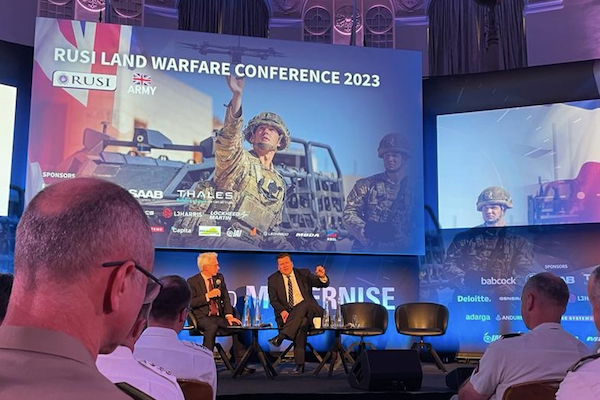
“Mobilization and Modernization of Armies” was the title chosen by the Royal United Services Institute (RUSI) of the United Kingdom for the traditional “Land Warfare Conference” held at the end of June, featuring significant participation from state ministers, chiefs of staff, and military leaders from various European armies, as well as civil and military authorities from several countries.
The following will present the highlights of the conference, as well as the main conclusions that, in the opinion of Athenalab, can be drawn from this significant event.
MAIN TOPICS DISCUSSED
In opening the conference, the Chief of the General Staff of the British Army, General Sir Patrick Sanders, stated that it is necessary to have an optimal state of mobilization of forces, as well as adequate industrial mobilization capacity. Threats in European territory will continue beyond the current conflict, hence the obligation to continuously reevaluate the employment doctrine. According to Sanders, success will come from how force is used in an environment marked by the various domains that currently exist. The centrality of data and the ability to integrate information, as well as the effects of artificial intelligence, will be crucial challenges for achieving a decision-making cycle faster than that of the adversary. Furthermore, he asserted that the planning of army employment must extend beyond just the initial operations, as this will constitute the best recipe for failure.
In his view, the conflict in Ukraine has left, as one of its observed lessons, the necessity of having adequate reserves of personnel and materials, as these allow for the realization of the effects of “resilience and mass” in the war effort. An additional aspect that stands out is the need for adequate fire bases. In this regard, field artillery has played a significant role. Finally, he concluded his presentation by emphasizing the importance of attracting, training, and retaining talent within the force. There is a thin line between success and defeat, and it is often the expression of the capabilities and skills of the force to employ and adapt to uncertainty. [CONTINUES…]