New Developments in the Hamas-Israel Conflict
This article was translated automatically and may contain differences from the original. For reference, read the original.
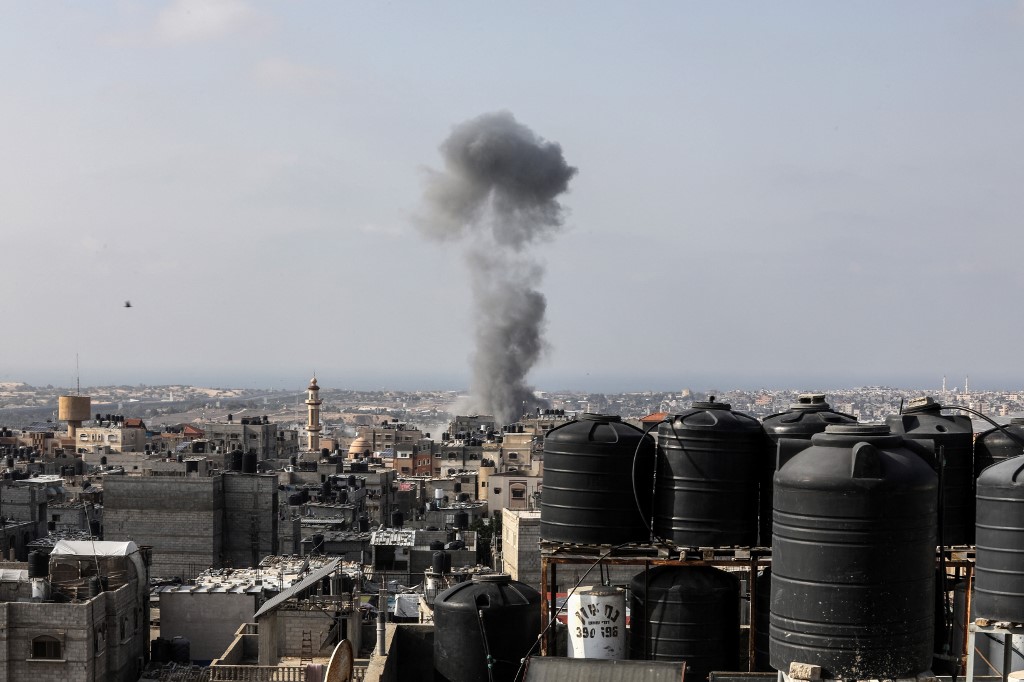
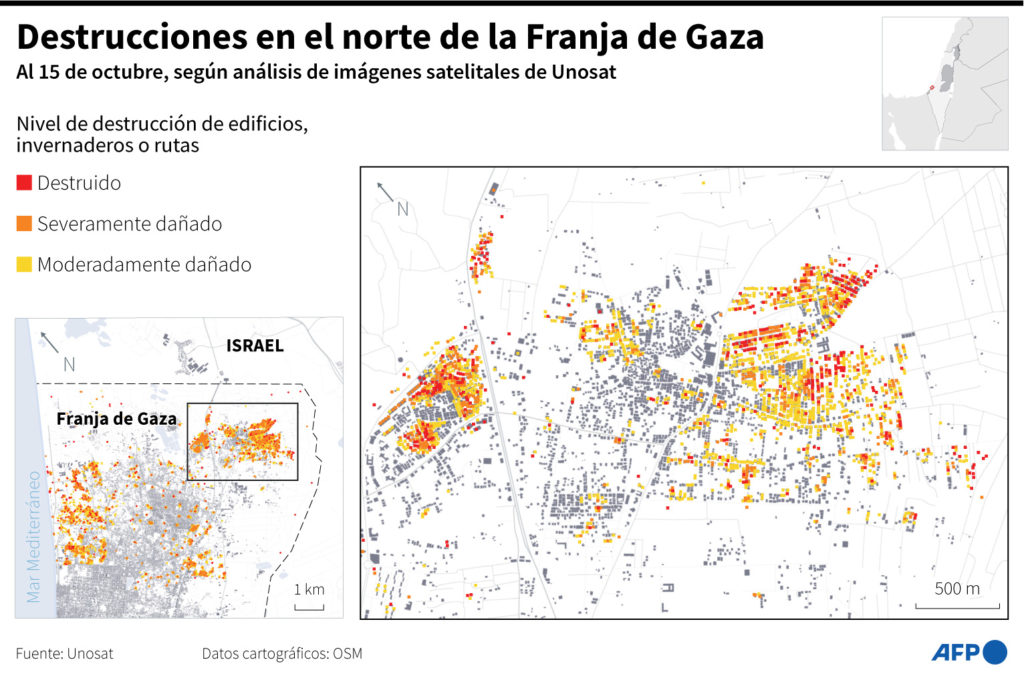
WHAT HAS HAPPENED? As of the publication date of this document, Israeli forces have not yet initiated the ground offensive, although they are conducting air operations to disrupt the command and control of Hamas and the Palestinian Islamic Jihad (PIJ), as well as their related logistical infrastructure. This is complemented by intelligence and special forces actions to identify and locate operational leaders of the groups.
All of this occurs in a context where, on one hand, attacks from Gaza using rockets continue, and on the other, the Israeli Air Force has continued bombing the Strip, primarily in its northern sector, focused on the areas of Gaza City, and in the south, in Khan Younis. These bombings aim to additionally affect the complex network of tunnels in the northern sector of the Gaza Strip, which is estimated to extend 480 kilometers.
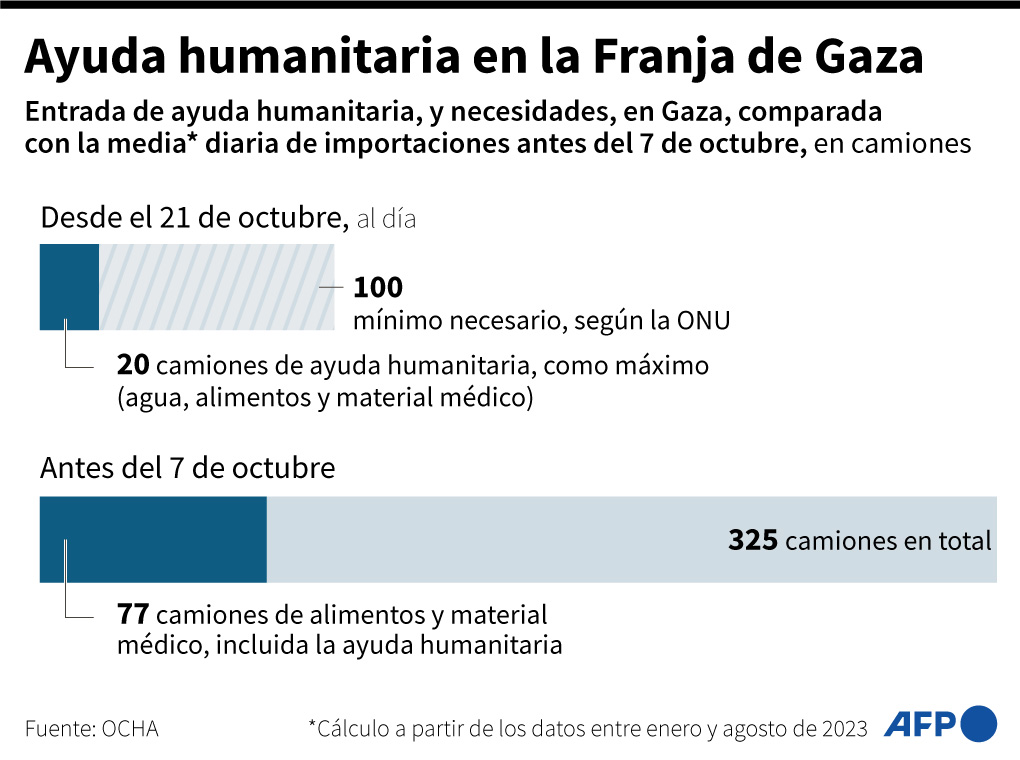
As a result, there are 1.4 million displaced persons in the Gaza Strip, including 750,000 residents of Gaza City, which had a population of 1.1 million. While a large number of these displaced individuals are attempting to seek refuge in Egypt through the Rafah crossing in the south of the Strip, they have been unsuccessful.
As preparations for the ground offensive—set to be executed soon—continue, logistical supply means are still arriving in Israel. These are expected to be crucial for sustaining the offensive. In recent hours, more than 50 cargo planes have arrived at airports or air bases in Israel.
It is hypothesized that this offensive has not yet materialized due to the following considerations:
- To finalize the configuration of the terrain and adequately degrade command posts, command and control means, logistical facilities, and the tunnel network of Hamas and the PIJ.
- Additionally, to account for and enable the recovery of hostages held by Hamas, through international and local diplomatic efforts.
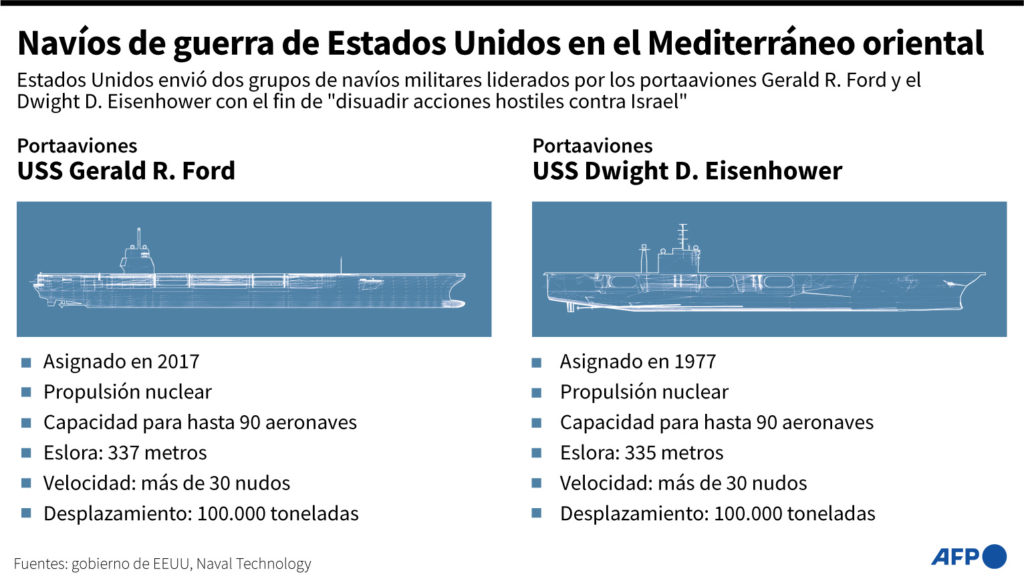
- The deployment of a second battle group from the United States led by the aircraft carrier USS Dwight D. Eisenhower to the Arabian Sea, which joins the already deployed group led by the USS Gerald R. Ford in the Mediterranean.
REGIONAL SITUATION. On the northern front, with the border of Lebanon, Israel has continued its policy of evacuating the population to create a security buffer in anticipation of a potentially larger confrontation with Hezbollah forces. This past weekend, more than 14 communities in border towns were evacuated. In total, over 60,000 people have been displaced since the beginning of this conflict. To date, there have been mutual fire attacks between this group and the Israel Defense Forces (IDF), primarily located in Mount Dov and Mount Hermon. In this sector, the main concern is the opening of a second front, which could potentially lead to the Third Lebanon War (1982 and 2006).
On the West Bank front, in response to the increase in waves of protests and attacks by Hamas, Israel has initiated incursions against Hamas facilities in Jenin, as well as carrying out its first airstrike in this area last Sunday. The opening of a third front in this sector would complicate the current efforts of the IDF, necessitating greater employment and deployment of forces.
In recent hours and since the weekend, more drones and missiles have targeted U.S. bases in Iraq and Syria. More than 14 such attacks have been reported. The drones used have been of the Iranian-made Shahed-136 type. The attacks have been claimed by the group Harakat Hezbollah al-Nujaba (HHN), translated as “Movement of the Party of Nobles of God” or “Nujaba” (a Shiite paramilitary group of Iraqi origin).
It is estimated that Iran continues to affect and influence the conflict indirectly through its network of groups aligned with its cause, throughout the region and through economic and logistical support, both in Syria and in southern Lebanon.
Egypt continues to restrict the movement of humanitarian aid through the Rafah crossing—in the south of the Gaza Strip—in order to prevent the establishment of refugee camps on its territory, which could affect its security due to the potential infiltration of Hamas elements that exercise control in Gaza and its historical relationship with the Muslim Brotherhood.
ROLE OF INFORMATION AND DISINFORMATION. Information represents power, as Francis Bacon stated, and this has been demonstrated in recent armed conflicts. Operations planned and developed in this realm can have an impact as significant as operations involving the use of force, representing a perfect complement to achieving war objectives. If we add to this the fact that we are living in the information age, we find ourselves in a highly complex and difficult-to-control scenario. The speed of communications, the immediacy provided by social media, and the independence of the media make it virtually impossible to control the message. However, for these same reasons, it also becomes impossible to prevent the circulation of false information, whether deliberately or inadvertently. Previously, the difficulty lay in the lack or delay of information; today, the problem is managing an excess of information, which also includes false, incomplete, or inaccurate information.
In this context, each side will try to exploit the facts to its advantage. This occurred with the explosion that affected the Al-Ahli Hospital in the Gaza Strip on Tuesday, October 17. Hamas rushed to blame Israel and disseminate this message in public opinion, reinforcing its communication campaign regarding the crimes committed by the State of Israel. On this occasion, the Israeli government not only denied the facts but also identified the source of the problem as a rocket launched by the PIJ itself. Within the first 24 hours of the incident, it presented evidence that, according to its version, demonstrates that the Palestinian group is responsible for the explosion. Faced with the same event, there are two versions. In recent hours, British intelligence has also stated that the attack on the hospital was carried out by a rocket belonging to the Palestinian Islamic Jihad.
In light of this, it seems that time is working against Israel and in favor of Hamas, given the general tendency to support the one perceived as weaker. This was the case on October 7 and 8, when the brutalities executed in Hamas’s attack on Israel were revealed, garnering widespread support for the latter. However, this sympathy and backing have been waning as images of the results of Israeli airstrikes on Gaza emerge, as well as the effects of the displacement of citizens to the southern part of the Strip and the entire humanitarian drama that entails. In the end, it is not enough to be right—whoever that may be—but one must also engage in the struggle for the information domain with the same strength and commitment, as part of a larger strategic maneuver.
On the other hand, it seems that in cases where errors occur in the destruction of targets, it is advisable to accept what happened and take responsibility. This was the case recently when Israeli forces accidentally fired on an Egyptian Army post at the southern border of Gaza, for which the Israeli government acknowledged its responsibility, committing to investigate the incident and offering apologies for what occurred.
The success of a military campaign does not depend solely on victory in the battlefield; it is also very relevant to consider communication aspects and fight to uphold one’s own narrative.
WHAT CAN BE EXPECTED:
- Israel, or more precisely its Prime Minister Benjamin Netanyahu, has defined the political objective of destroying Hamas. This goal, while understandable amid the emotions of the initial days, is difficult to achieve. First, because it would require a military effort whose cost could far exceed what Israelis are willing to pay. Second, because some of the political and military leaders of the group are not in Gaza, meaning they will need to be pursued beyond its borders. Third, even if all or most of the current leaders are eliminated, there will always be replacements to fill the vacant positions. Ultimately, it is more convenient and realistic to define an objective that seeks to weaken Hamas sufficiently so that it does not pose a threat to Israel for an extended period (eliminating key leaders, destroying arsenals, and neutralizing the maximum number of combatants).
- On the other hand, a larger military campaign in Gaza will result in a loss of political authority in the Strip. Therefore, Israel must consider who and how power will continue to be administered. It appears that Tel Aviv would not assume control nor allow groups similar to Hamas to do so. Consequently, a government with support from the Arab world and the United Nations could be an alternative. However, negotiations and consensus will be needed, which are not visible on the near horizon.
- The main risk today for Israeli planners is the potential escalation of the conflict, with the involvement of other regional actors. Actions by Hezbollah seem inevitable, as does pressure from the West Bank. However, the number of Iranian or pro-Iranian assets in Syria represents a permanent threat to the operational balance that Israel seeks to maintain for the execution of its ground campaign. All of this, without mentioning the direct threat that Iran itself poses.
- Consequently, without attempting to define what will happen, it is possible to expect: that the work of Israeli intelligence agencies will intensify to determine the location of Hamas leaders and arsenals in Gaza; with attacks preferably by the Israeli Air Force alongside special forces actions to eliminate confirmed targets.
- Having configured the scenario, the ground offensive could begin, which is essential when aiming to destroy Hamas. This includes anticipating the movement of American assets in the Mediterranean Sea, as well as towards the Arabian Sea, given the events that have affected Washington’s armed forces in that area.
- Nonetheless, actions against Iran, whether as a reaction to that state’s apparent support for Hamas and Hezbollah or against its nuclear program, cannot be ruled out in the medium term.
Sources: Reuters, BBC, Israel Defense Forces, Foreign Affairs, Hoover Institution, Al Jazeera, CNN.