One Month into the Israel-Hamas Conflict: The Dilemma of Escalation
This article was translated automatically and may contain differences from the original. For reference, read the original.
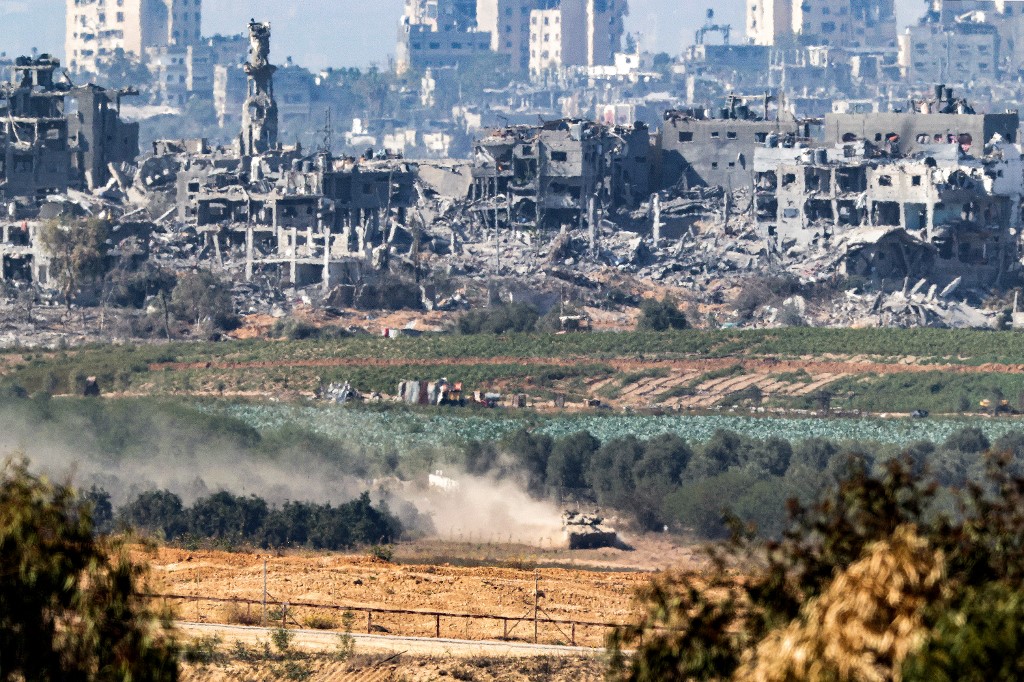
One month has passed since the large-scale terrorist attack launched by Hamas against Israel, which on October 7 resulted in 1,400 deaths, thousands of injuries, and over 220 hostages. This incursion was characterized by a high level of barbarity, violence, and indiscriminate targeting of civilians, the elderly, women, and innocent children. All of this occurred amid the most severe intelligence failure in the history of the Jewish state since the Yom Kippur War, exactly 50 years ago.
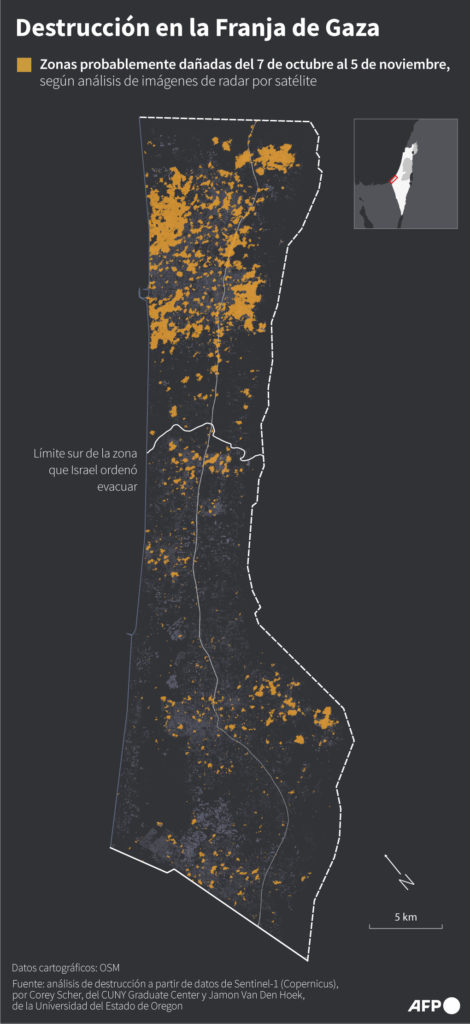
Israel’s response was swift. Immediately, Tel Aviv began an air campaign and artillery bombardments on targets in the Gaza Strip in reaction to the attack. Simultaneously, a state of war was declared; a national unity cabinet was organized; intelligence operations were intensified to determine targets and the location of hostages, and civilians were forced to relocate from the north to the south of the Gaza Strip. At the same time, a large-scale ground operation was planned, the only way to achieve the declared political objective of “destroying Hamas.” As of now, since Friday, November 3, ground forces are already positioned in Gaza, with two units advancing from the north and another with armored means isolating the territory to the south, surrounding Gaza City.
The effects on the Palestinian civilian population have been severe. According to information provided by the authorities in the Gaza Strip controlled by Hamas, the death toll from Israeli attacks exceeds 10,000 people; many of them are innocent children, women, and the elderly. The United Nations—led by its Secretary-General, António Guterres—has condemned the military incursions and called for a cessation of hostilities to deliver aid to the victims, statements that have provoked annoyance in Tel Aviv.
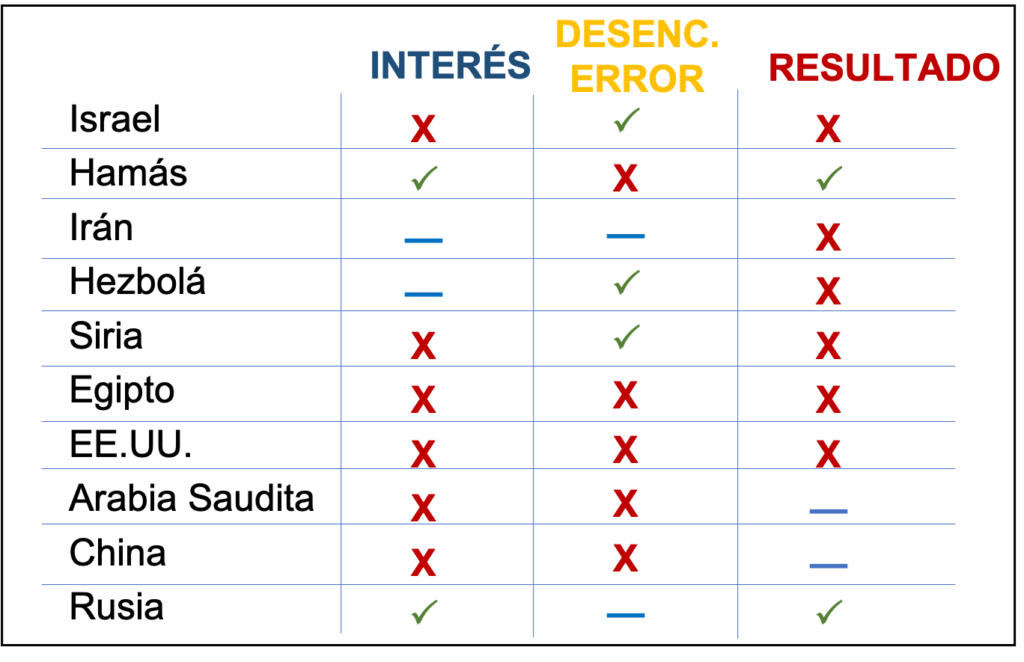
Beyond recounting what has happened in these 31 days, a crucial question relates to the possibility of the conflict escalating to a regional or even global level. In this regard, it is deemed appropriate to evaluate three aspects: 1) What interest does each party have in extending the violence beyond Israel and Hamas; 2) Whether this act could voluntarily or accidentally trigger an escalation of the conflict, and 3) If it expands, who stands to benefit or be harmed.
ISRAEL
It is estimated that the State of Israel has no interest in the conflict expanding; in fact, it would not be advantageous from any perspective. Currently, its northern border with Lebanon and Hezbollah, along with the eastern border with the West Bank, are maintained with ongoing minor actions, requiring a considerable deployment of forces as a precaution. Additionally, there is the ongoing threat from Iran, through its proxy forces in Syria, Iraq, Lebanon, and Yemen (Houthi rebels). In summary, an escalation would mean opening operations on two or three simultaneous fronts, which would significantly hinder the development of actions and the outcome of the war. However, Tel Aviv could end up triggering an escalation if it does not limit collateral damage to people and civilian infrastructure with its actions in Gaza, or if it conducts attacks on targets in Lebanon or Syria, without considering the possibility of operational errors in launching a missile, rocket, artillery, or aerial bomb. Nevertheless, there is no doubt that an expansion of the conflict would harm Israel’s interests, as it would extend its war efforts to limits over which there is no total certainty of being able to cope within the temporal and spatial factors that are visualized.
HAMAS
The terrorist group is the primary party interested in escalating the conflict. This is because it would force Israel to divert forces to different fronts, alleviating current pressure while draining its arsenal of weapons and ammunition. In terms of generating an escalation, it is difficult for Hamas to do anything greater than what it did on October 7, either in magnitude or surprise, especially since it remains under constant military pressure. This group could also gain greater political and military support for its cause, which is key to its survival, being its main problem.
IRAN
Tehran’s situation is not as clear as it is often thought. While there is evidence linking it to both Hamas and Hezbollah as a sponsor—along with insurgent forces in Syria, Iraq, and Yemen—it does not mean that Iran would benefit from a regional escalation of the conflict. This is because an escalation, while weakening Israel, could end up involving it directly in the war, either against Tel Aviv or against the United States, considering that not only the future of the Gaza Strip is at stake, but also the geopolitical balance in the Middle East. Of course, one must never forget the ongoing threat posed by the Iranian nuclear program. For this reason, it is estimated that Iran could be more harmed than benefited by an escalation in the conflict, with its most favorable option being for Israel to continue investing resources and for the situation to remain confined to Gaza and, at most, to the north with Lebanon and Hezbollah. Iran’s main objectives may already be potentially fulfilled in general, as it has disrupted the normalization of relations between Tel Aviv and Riyadh, demonstrated that Israel is vulnerable, and put the most powerful state in the region in check. Furthermore, with the current situation, Iran is already in a better position to reassess its stance in the Middle East and the Persian Gulf, in particular, without risking part of its power. The geopolitical balance with Saudi Arabia and the survival of the regime are undoubtedly the main concerns of the leaders in Tehran, especially considering that the regime was facing significant internal protest movements before the conflict began.
HEZBOLLAH
It is also not clear that the Lebanese terrorist group would benefit from the expansion of the conflict. While it pursues similar objectives to Hamas, a new direct confrontation against Israel could have serious consequences for its survival. There is no doubt that Hezbollah is in a better position to confront Israel, as it has more fighters (better trained, experienced, and equipped), a larger arsenal, and a wide territorial dispersion. However, none of this guarantees success, particularly due to the significant wear and tear from its participation in Syria for over 10 years.
The experience of facing Israel militarily has been harsh; however, there are some notable results from the 2006 war. Engaging again in large-scale operations could compel the Jewish state to pursue the same objective as with Hamas, namely, the political and military destruction of Hezbollah. In summary, this could be detrimental to the survival of the terrorist group in the medium term.
Today, the border situation is delicate, with exchanges of fire occurring daily and casualties on both sides, increasing the possibility of an error or that some unit will take an action that ends up triggering, voluntarily or involuntarily, a larger confrontation with the Lebanese militia. If we consider the recent words of the group’s leader, Hassan Nasrallah, he has walked a delicate line that shows commitment to Hamas’s cause, but without declaring open war against Israel, clarifying that they had nothing to do with the October 7 attack. Hezbollah must assert that it is interested but not too involved.
UNITED STATES
The United States has deployed its diplomatic and military power to prevent the conflict from escalating to the rest of the region. Secretary of State Antony Blinken has been seen on several occasions visiting the most important leaders in the area to assess reactions and avoid the expansion of military actions. Washington should not be interested in opening a new military front in the Middle East if it has to become directly involved in the conflict. However, should it be forced to do so and face its main antagonist in the region, Iran, this could be used as an opportunity to address Tehran’s nuclear program. Nevertheless, it is estimated that an escalation of the conflict would be detrimental to the U.S., considering its commitment to the war effort between Ukraine and Russia and, particularly, that its main interest lies in China and the Indo-Pacific.
RUSSIA
Russia is geographically distant from the area, but not from its interests. It is important to recall the military support provided by Moscow to Bashar Al Assad’s regime in Syria to understand that there are issues at stake in the region for Vladimir Putin. While its involvement would be more indirect, the escalation of the conflict and a potential U.S. participation in the actions would only add to Putin’s advantage, being the main beneficiary of the conflict in Gaza continuing to distract global attention, which until a month ago was focused on Ukraine.
OTHER REGIONAL ACTORS
It is estimated that for other states in the region, such as Egypt or Saudi Arabia, there would be no interest in the conflict escalating, as the harms derived from instability far outweigh the potential benefits that could arise, such as for Riyadh if Iran were to be weakened and its regime replaced.
Finally, while for most actors there are more reasons—interests and benefits—to avoid the escalation of the conflict, it is estimated that the possibilities of it expanding remain high. This is due to the underlying emotionality, the risk of an error or an involuntary action, or the execution of deliberate acts, either by the involved parties or by interested third parties.
Probable Interest in Escalation