Venezuela and Guyana: 5 Key Aspects of a Potential Conflict
This article was translated automatically and may contain differences from the original. For reference, read the original.
- por Juan Pablo Toro
- Análisis
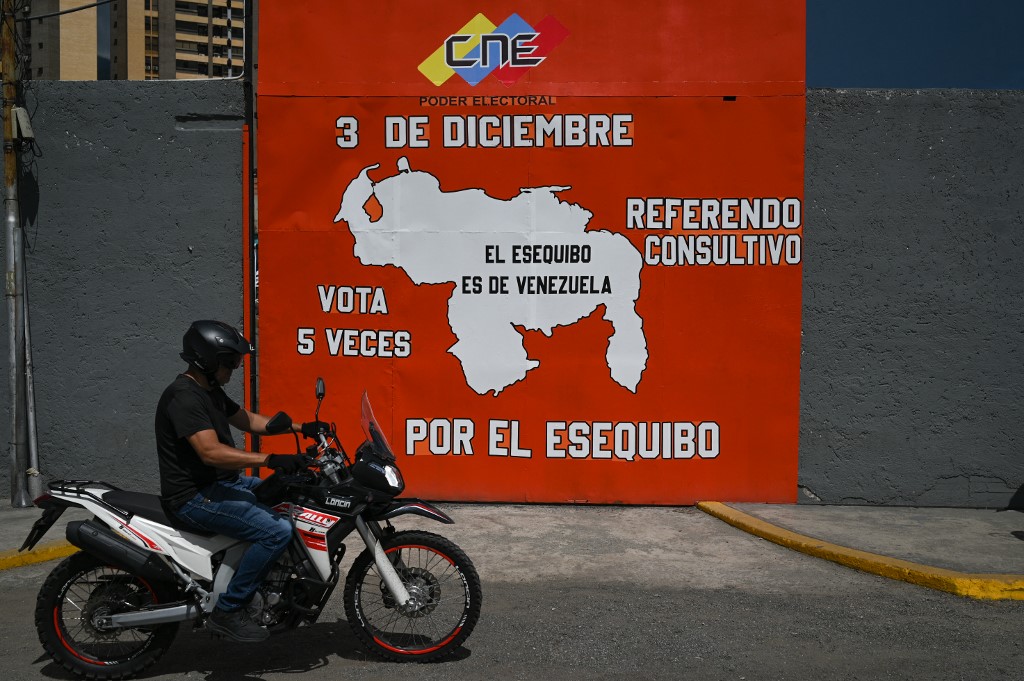
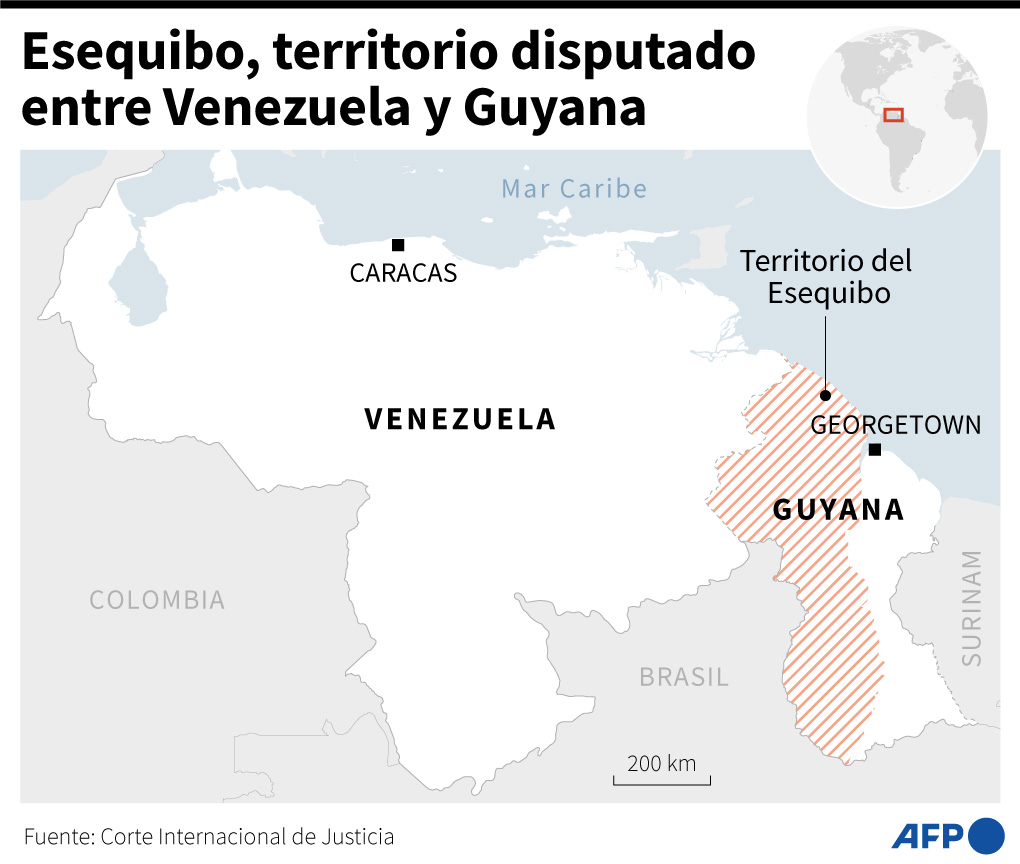
POLICY. A potential conflict appears to be brewing in South America due to the decision by Nicolás Maduro’s regime to organize a non-binding referendum this Sunday, December 3, to ask Venezuelans whether they wish to incorporate “Guyana Esequiba” (approximately 159,000 km2) as a province and whether they agree not to recognize the International Court of Justice (ICJ) in The Hague, which is set to issue its ruling on Friday, December 1[1] to resolve the territorial dispute with neighboring Guyana.
Although this is a long-standing dispute, tensions have escalated since Guyana began experiencing an economic miracle in 2015, following the discovery of vast offshore hydrocarbon reserves and the subsequent arrival of foreign oil companies.
The referendum, which has been strongly promoted by Maduro’s government, is preceded by military exercises at the border, leading Guyana’s Vice President, Bharrat Jagdeo, to admit last week that his country plans to establish military bases with “foreign” support and that a U.S. delegation will soon arrive[2].
Guyanese authorities estimate that Maduro is using the consultation to achieve internal objectives, which seems logical given the upcoming 2024 elections and the overwhelming support garnered by opposition leader María Corina Machado.
Below, we provide the background to understand this potential conflict in the South American region.
HISTORY. The current dispute between Venezuela and Guyana has its roots 180 years ago. When Venezuela began to define its eastern borders, it found that the British Empire had acquired a territory of about 50,000 km2 from the Netherlands through a treaty.
The differing positions on the common boundary led to an arbitration ruling in Paris in 1899, which determined that the division would follow the so-called “Schomburgk Line,” named after a British explorer.
However, Venezuela, dissatisfied with the outcome, insisted that the territorial division should follow the course of the Esequibo River, which is why it refers to “Guyana Esequiba,” which today corresponds to about 159,000 km2, a region rich in mineral and forest resources. Two-thirds of Guyana’s territory appears on current Venezuelan maps as disputed territory.
Subsequently, the United Kingdom and Venezuela signed an agreement in Geneva in 1966, months before Guyana’s independence, which recognized Caracas’s claim and stipulated that if the countries could not agree, they should seek peaceful solutions through the good offices of the United Nations.
In the absence of consensus between Caracas and Georgetown, Guyana submitted a request to the ICJ in 2018 to validate its border established in the 1899 arbitration ruling, but Venezuela does not recognize the court’s jurisdiction over what it considers its territory.
With the ICJ ruling set to be issued next Friday, December 1, Guyana has stated that it is not open to any bilateral negotiations before knowing the court’s pronouncement. Meanwhile, Venezuela accuses its neighbor of being a “pawn” of American oil companies, such as ExxonMobil and Chevron, which would prevent it from seeking an amicable solution based on the 1966 agreement.
MILITARY. The last interstate conflicts that occurred in South America were the brief war between Ecuador and Peru (1995) and, prior to that, the confrontation between Argentina and the United Kingdom (1982) over the Falkland Islands.
Both conflicts had in common that they were initiated by authoritarian governments, based more on internal political calculations than on realistic military assessments, and their outcomes spoke for themselves.
In the case of the invasion of the Falkland Islands ordered by the Argentine military dictatorship, it was about fulfilling a long-held desire, but also a “forward escape,” as Jorge Luis Borges would say. A desperate attempt by Leopoldo Galtieri to gain popular support to prolong the so-called “Process,” which was rapidly collapsing. The maneuver undoubtedly gained temporary support in the streets, but the resounding defeat at the hands of the British not only highlighted the ineptitude of the generals in what they were supposed to be good at, but also paved the way for the return of democracy.
On the other hand, the military conflict between Ecuador and Peru was driven in part by Vladimiro Montesinos[3], the sinister advisor to Peruvian President Alberto Fujimori, who saw the possibility of boosting his imminent presidential reelection. After a month of fighting from January 26 to February 28, Peruvian aircraft suffered the worst losses, with seven units downed. Negotiations then began. Fujimori was reelected in April, and as would later be known, Montesinos profited from the urgent purchases of weapons for his country.
In the case of Venezuela and Guyana, their armed forces are incomparable[4]. While the Bolivarian National Armed Force (FANB) possesses predominantly Russian heavy weaponry—including Sukhoi-30 fighter jets, Mi-35 attack helicopters, T-72 tanks, and BMP-3 armored vehicles—the Guyana Defense Force is akin to a national guard composed of infantry dedicated to border control and the pursuit of illegal activities. Thus, on paper, the situation appears highly favorable for Maduro’s troops.
However, those who have interacted with the FANB and visited its bases know that they are highly politicized and corrupt forces, which undermines the professionalism needed in any sustained confrontation. Evidence of this is the deep penetration of Colombian guerrillas into Venezuelan territory and the identification of the so-called Cartel of the Suns, which would consist of negligent generals or those co-opted by drug trafficking organizations, according to the U.S. Department of Justice.
Outside the Latin American region, there is a distant but very enlightening precedent: the decision by Iraqi dictator Saddam Hussein to invade the neighboring emirate of Kuwait to demand economic compensation for the alleged “looting” of oil wealth in cross-border underground fields. Undoubtedly, Guyana’s exponential economic growth, based on hydrocarbon exploitation, presents a potential prize for Maduro, which is already a very poor example of his disastrous management.
INTERNATIONAL. The international context in which this crisis arises is very complex, as it is marked by the war between Russia and Ukraine and the conflict between Israel and Hamas in the Gaza Strip.
In this regard, Venezuela has aligned itself with Russian President Vladimir Putin while expressing its rejection of the Israeli military retaliation against the terrorist organization Hamas on Palestinian soil.
At the same time, Caracas is beginning to enjoy temporary relief from U.S. economic sanctions on the oil, gas, and gold sectors, which is a counterbalance to the promise of organizing a free and fair electoral process by Maduro’s regime for 2024, a bet that remains to be seen. The Bolivarian dictatorship’s assault on opposition candidate María Corina Machado has included everything from her political disqualification to the annulment of the primaries, in which 2.5 million people voted.
Undoubtedly, in the Miraflores Palace, they know that Washington is focused on maintaining its military support for Ukraine, but now also on providing strong backing to Israel, both tactically and strategically, by sending two aircraft carriers to prevent third parties from expanding that confrontation in the Middle East. A new conflict would pose an additional challenge for the Pentagon, knowing that, moreover, positions toward the Venezuelan dictatorship are divided in Latin America, between those who condemn the regime and those who coexist with it.
Additionally, President Joe Biden is preparing to fully engage in the 2024 electoral process, where his likely competitor would be Donald Trump. Viewed this way, the dilemma of whether to act or not in the event of a conflict in the Western Hemisphere could be colored by calculations that exceed the military realm.
The Brazilian Ministry of Defense, which shares borders and good relations with both countries in conflict, reported that it is closely monitoring the situation and has also reinforced its actions at the border, which would include movements of armored transports and troops.
Brazil’s National Defense Policy had already warned in 2021 that “the possibility of armed conflicts in South America cannot be ignored, so Brazil may be motivated to contribute to the resolution of potential regional disputes or even to defend its interests.”
ECONOMY. Until recently considered one of the poorest countries in South America, the Guyanese economic miracle[5] began in 2015 when ExxonMobil and Hess Corporation discovered a massive oil field 193 km offshore.
As the extraction of the estimated 11 billion barrels that make up the commercial reserves began, the Gross Domestic Product reached growth rates of up to 57% in 2022, totaling US$4.28 billion. Per capita income rose to US$19,000 in just eight years.
With a daily projection of 400,000 barrels of oil, the International Energy Agency estimates that by 2035, Guyana could produce up to 1.3 million barrels. It has already become a viable alternative to replace Russian oil.
The World Bank forecasts that this country of 800,000 inhabitants will continue to grow at double-digit rates for many more years, which would allow it to develop enormous infrastructure projects, such as a deep-water port. This, as long as an unforeseen obstacle, such as a territorial annexation conflict, does not arise in its path.
CONCLUSIONS. In his quest for internal support, Nicolás Maduro is repeating the script of other authoritarian regimes that exacerbated nationalism by stimulating dangerous situations with disastrous outcomes. The emergency triggered by a potential conflict would also allow him to suspend the 2024 elections, where he risks losing power as long as he permits fair and clean elections with international observers.
The constant pressure on Guyana and Caracas’s refusal to recognize the ICJ’s jurisdiction to resolve the territorial dispute has forced Georgetown to align with the United States, which in turn is focused on other conflicts and heading toward an electoral process. It will be interesting to observe Brazil’s role, especially as President Lula da Silva has sought, albeit unsuccessfully, an opportunity to shine internationally as a mediator.
South American countries that support the rules-based international order must not remain passive if a conflict were to erupt, as has been observed both in the European theater and in the Middle East, where autocrats or radical groups take advantage of democracies’ hesitations to gain ground. Once they resort to force, the game has changed forever.
While the ICJ seems to be the appropriate path to resolve the issues between Venezuela and Guyana, as several countries in the region have proven, Maduro does not appear interested, for now, in allowing that possibility unless convinced otherwise. Undoubtedly, the coming days will be crucial, between the ruling and the referendum result.
[1] https://www.vozdeamerica.com/a/venezuela-cij-anunciara-fallo-medidas-solicitadas-guyana-contra-referendo-consultivo-por-el-esequibo/7373390.html
[2] https://www.vozdeamerica.com/a/guyana-plantea-bases-militares-con-apoyo-extranjero-zona-reclamada-venezuela/7368623.html
[3] Bowen S. and Holland J, (2003). The Imperfect Spy. Lima: Peisa.
[4] International Institute for Strategic Studies. The Military Balance 2022.
[5] https://www.bloomberglinea.com/2023/11/27/guyana-milagro-economico-o-espejismo-a-corto-plazo-en-america-latina/