Iran and Hezbollah… in Chile
This article was translated automatically and may contain differences from the original. For reference, read the original.
Following the massive drone and missile attack executed by the Islamic Republic of Iran against Israel on the night of April 13 to 14, much of the attention from national media
has focused on covering the presence of Iran and its allies in the Latin American region, aided by recent statements from Argentine Security Minister Patricia Bullrich. This official claimed the existence of Iranian citizens and members of Hezbollah in various countries, including Chile. The reaction from national authorities aimed to refute Bullrich, while condemning her remarks, adding that they harmed Chile’s image. However, there was no indication from these authorities of any concern regarding the matter, nor any openness to the possibility that her claims might be correct or at least partially true.
What is most concerning about this situation is Chile’s immediate denial that what was raised is even an indication of Iranian presence, or that of its allies, in Chile, as well as the diversion from the underlying problem through a rather confrontational discourse. Thus, we citizens must ask ourselves what we know about Iran’s presence in the region—particularly in Chile—and, more importantly, what we do not know about its activities.
WHAT WE KNOW AND WHAT WE DO NOT KNOW
We know that Iran has expanded its presence in Latin America, especially since the beginning of the 21st century. Following the rise to power of Persian President Mahmoud Ahmadinejad (2005-2013), the diplomatic representation of this Asian country doubled. Before 2005, there were five delegations, and Colombia, Ecuador, Bolivia, Uruguay, Nicaragua, and Chile were added. We also know that in 2010, the channel HispanTV began broadcasting, an Iranian Spanish-language service that covers almost the entire region, as can be seen on its website[1].
Another interesting media outlet is Al Mayadeen, which has also been broadcasting programming in Spanish for the region since 2012, based in Beirut, Lebanon[2], the birthplace of the Hezbollah militia. We also know that Tehran has increased its ties with Venezuela, Cuba, and Bolivia in economic and security areas; at least, this is what the head of the U.S. Southern Command, General Laura Richardson, stated in her presentation before the U.S. Congress in March 2022[3].
On the other hand, we have
become aware of unprecedented activities in the region, to put it somewhat
mildly. On one hand, a plane with Iranian pilots and a Venezuelan crew was
detained in Argentina and ultimately sent to the United States. There is also
information linking Iranian citizens to obtaining Bolivian identity credentials and crossing international borders. At the
Santiago airport, two Iranians with fake British passports were
detained while attempting to board a flight to Europe[4].
Furthermore, we know
that, in addition to Venezuela, Cuba, and Nicaragua, Iran has shown particular interest
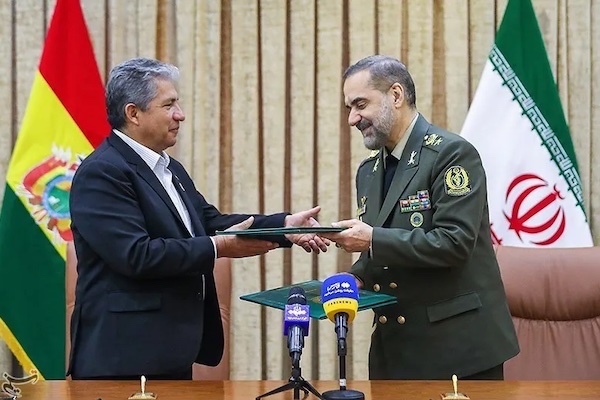
in its relationship with Bolivia. In fact, a memorandum of understanding
or cooperation was signed between Bolivia and Iran less than twelve months ago in the field of
security and defense. While details about this are not known, the
Bolivian authorities stated that the Iranian industry could provide them with
advanced drone technology for border control and the fight against
drug trafficking[5].
Additionally, vessels for river navigation and maintenance personnel
for aircraft, among other things, would be included[6].
It has also been mentioned that there are already more than 700 Iranian officials in
Bolivia[7].
The prior presence of the terrorist group Hezbollah in Latin America has long been known. Argentine justice directly held this organization responsible for the
terrorist attacks of 1992 and 1994 in Buenos Aires, and also directly linked
Iranian citizens to the preparation and execution of the attacks.
There is ample evidence to confirm Hezbollah’s presence in the Triple
Frontier, usually related to illicit and criminal activities
linked to fundraising. There have also been voices placing
this group in Iquique, as cited by a U.S. cable referenced by Ciper Chile[8],
or linking it in some way to factions of the Lebanese diaspora in the
region of which Chile is a part[9].
In short, there is consistent information, some
with greater certainty and credibility than others. What remains unknown is the real interest
that Iran and Hezbollah might have in this part of the world. Some have ventured to decipher it, as proposed by Alberto Priego in a document
from the Spanish Institute of Strategic Studies, who suggests that the intention
of the Islamic Republic in question and its associates may be to increase their
international reach, destabilize the United States, obtain foreign currency—both
by laundering and generating assets—seize natural resources, and recruit
individuals and train them for violent purposes. Beyond the reliability of these
hypotheses, what is proposed is not something absurd or far removed from what Iran already
does in other parts of the world. All of the above, at the very least, should compel
the authorities in Chile to be concerned.
The problem underlying
all of this, as reflected in what can be read in the media, is that rather than focusing on the core of the problem, we remain
on accessory aspects, such as demanding explanations, protesting certain
expressions, or arguing about the country’s image. Even more serious is the fact that
the links that are indeed quite confirmed are those of Iran with Hezbollah and
with Bolivia, a neighbor with which we share a long and porous common border.
Likewise, with Venezuela, from which uncontrolled migration originates. Just
to complete the picture, we must mention that the national intelligence
system is very limited—if not nonexistent—making it difficult to learn
about what occurs inside and outside the territory. In other words, the fact that
we have no evidence of Hezbollah’s presence in Chile does not mean that
it is not present or that it does not intend to do so. It is like driving
a vehicle without lights in the dark and trusting that we will not crash into
a tree in a forest just because we do not see them.
Finally, worse than not knowing about what
is raised in this text is that there are few possibilities that we can clear
the doubts. On one hand, the authorities start by outright denying the
possibility that the information received could be true, or partially
true, or that it may just be the beginning of something that could
transform into a real threat in the future. And, on the other hand, as mentioned, the country lacks
a modern, integrated, permanent intelligence system capable of
providing or confirming this type of information or other vital
background for the security of the State and the citizens residing in its
territory, not to mention that we do not have a national security architecture
that addresses these issues and provides ongoing advice to the political
power.
So, can we
really assert that Iran or Hezbollah are not operating in Chile?
[1] https://www.hispantv.com
[2] https://espanol.almayadeen.net/aboutus
[3] Presentation
by the Commander of the U.S. Southern Command, General Laura Richardson, before the committee of
Armed Forces of the House of Representatives of the U.S. Congress,
on March 8, 2022.
[4] News
published by Radio Bíobio on April 17, 2024. Available at: https://www.biobiochile.cl/especial/bbcl-investiga/noticias/reportajes/2024/04/17/inteligencia-en-alerta-iranies-con-pasaportes-falsos-fueron-detenidos-el-2023-en-santiago.shtml
[5] Available
at: https://www.bbc.com/mundo/articles/cld9nq1zqwyo
[6] Available at: https://understandingwar.org/backgrounder/iran-update-july-20-2023
[7] Patricia Bullrich, Security Minister
of Argentina, interviewed on the podcast “Border Wars.” Available at: https://www.youtube.com/watch?v=Y_l2s_nl4E4
[8] Available at: https://www.ciperchile.cl/2011/02/23/cable-47948-chile-2005-reporte-nacional-sobre-terrorismo/
[9] Presentation
by the Commander of the U.S. Southern Command, General Laura Richardson, before the committee of
Armed Forces of the House of Representatives of the U.S. Congress,
on March 8, 2022.