80 Years Since D-Day: The Keys to a Unique Military Operation
This article was translated automatically and may contain differences from the original. For reference, read the original.
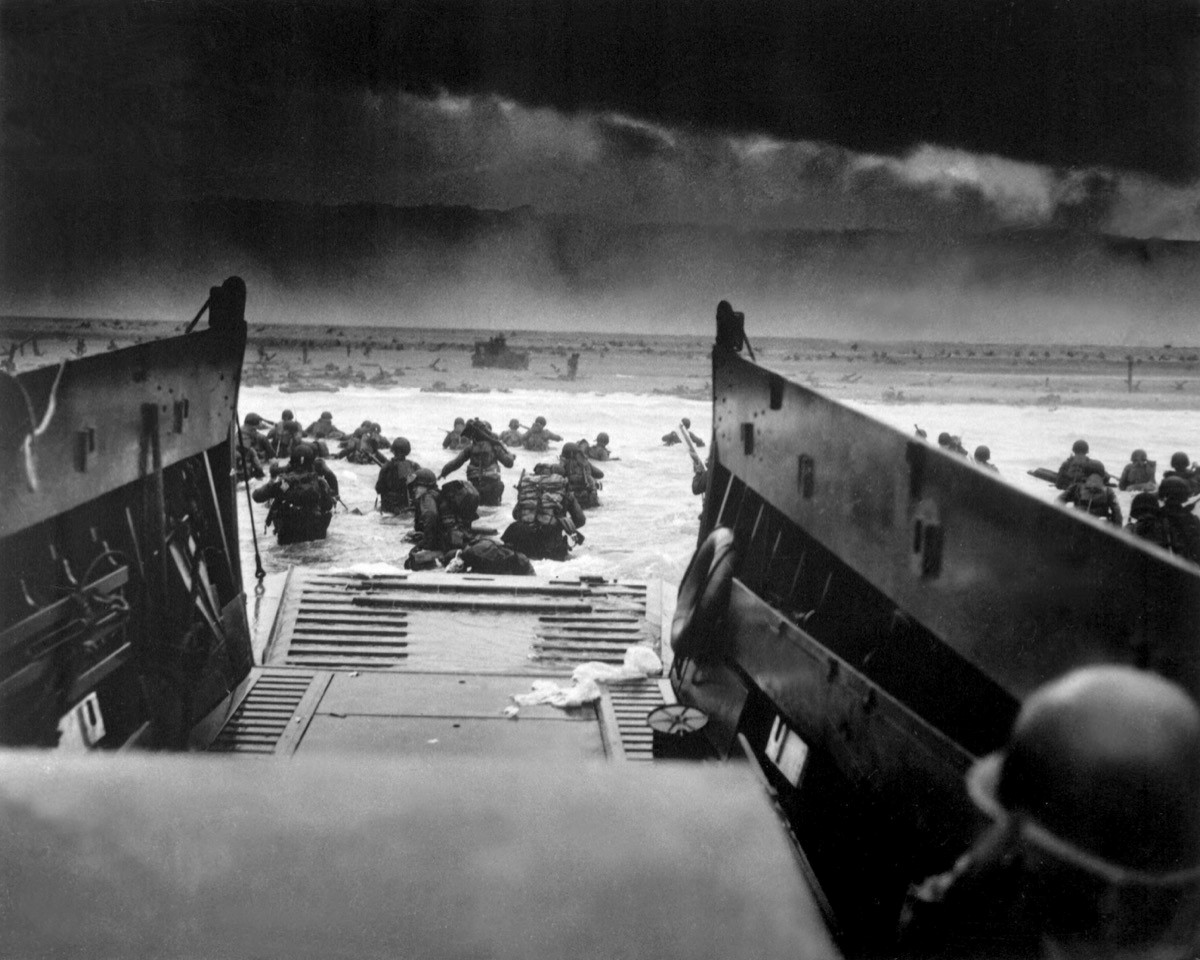
With war returning to Europe following Russia’s invasion of Ukraine, June 6 marked the 80th anniversary of the Allied landing on the French beaches of Normandy, a turning point in the outcome of World War II.
“Here we demonstrated that the forces of freedom are stronger than the forces of conquest,” stated U.S. President Joe Biden in a speech at the Colleville-sur-Mer military cemetery, overlooking Omaha Beach, the central point of the landing, where French President Emmanuel Macron, King Charles III of the United Kingdom, and Canadian Prime Minister Justin Trudeau, among other officials and veterans, were also present.
Due to the magnitude of the forces involved, the complexity of coordinating thousands of ships, aircraft, vehicles, and other equipment, as well as the obstacles posed by weather conditions and the subsequent German response, Operation “Overlord” became a military action that entered the annals of history. In the following lines, we provide some keys to understanding this campaign planned and executed eight decades ago.
GENERAL STRATEGIC SITUATION AT THE TIME OF THE LANDING | By mid-1944, the situation varied significantly across different theaters of operations globally. On one hand, campaigns in North Africa had led to the surrender of German troops in May 1943, following intense battles fought in the northern part of the continent, marked by the Allied landing in Operation “Torch” and the confrontations between units led by General Bernard Montgomery and Field Marshal Erwin Rommel. In the Pacific, the Allies had halted the Japanese advance and begun their offensive with the recapture of the Solomon Islands. Undoubtedly, many actions were still ahead in this theater.
In Europe, the situation was complex. Germany continued to occupy the center and west of the continent and was preparing for a potential invasion attempt that it assumed would occur at some point in 1944, for which it was consolidating a defensive position known as the “Atlantic Wall.” By the time of the landing, the Allies had attacked Sicily (Operation “Husky”) and Italy (“Avalanche”), and on June 5 had liberated Rome. In the east, Russia had managed to halt the advance of Berlin over its territory, lifting the siege of Leningrad in January and recapturing cities such as Sevastopol and Odessa in Ukraine. However, the pressure on Russian forces was enormous and far from being considered stable or free from the danger posed by the Wehrmacht. Wehrmacht. Russia required the Allies to open a new front in the west, forcing Germany to divert efforts and relieve pressure on the Red Army, as Josef Stalin himself expressed to Franklin D. Roosevelt and Winston Churchill at the Tehran Conference in November 1943.[1]
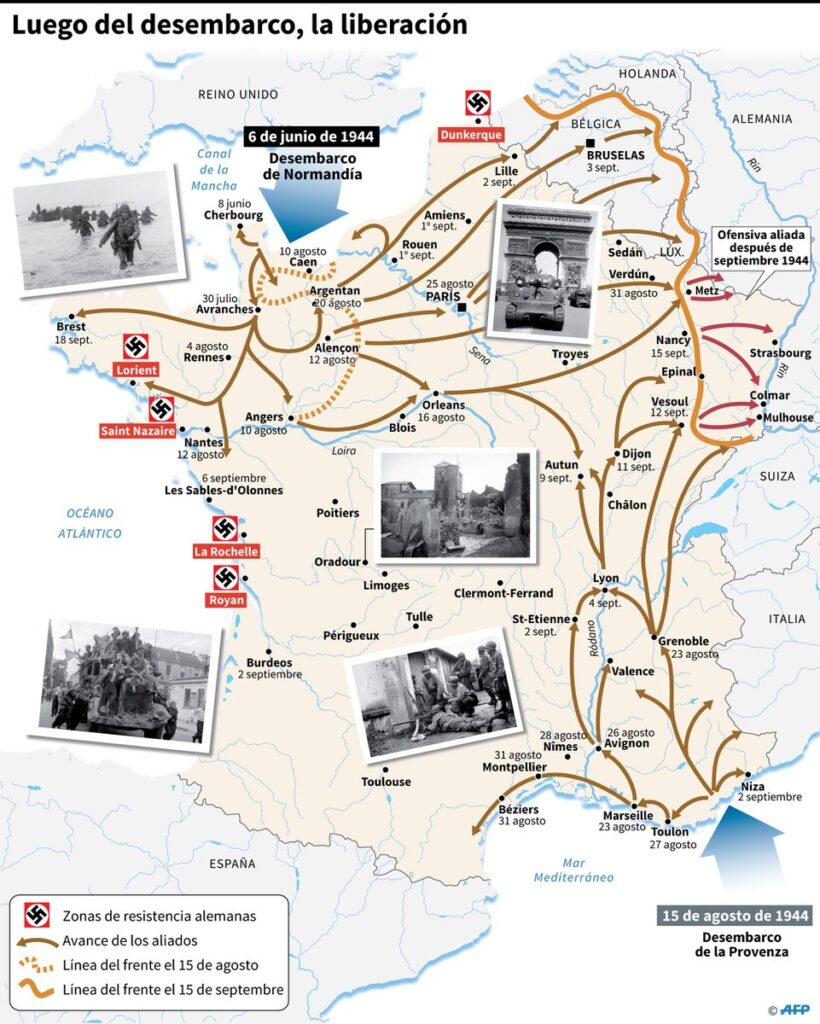
PLAN FOR THE INVASION | The planning for the invasion was developed by the Supreme Headquarters Allied Expeditionary Force (SHAEF) established in the United Kingdom, under the direction of General Dwight D. Eisenhower[2]. While there were plans for an operation like the one intended, carried out by a group of British officers led by General Frederick Morgan, this group did not have the necessary information or allocation of forces for this undertaking; however, their meticulous work was of great utility.[3] Among the original alternatives, a double landing operation was considered, both in the English Channel and in southern France, but it had to be dismissed due to the amount of resources it required; however, it was executed later as Operation “Anvil” in mid-August 1945.[4] Ultimately, a frontal assault in Normandy was chosen.
Among the multiple problems that had to be faced were the strong German defensive position, the need to generate a deployable force that could penetrate France, logistical support for operations from the English islands, as well as issues such as the superior quality of German weapon systems and the weather conditions.
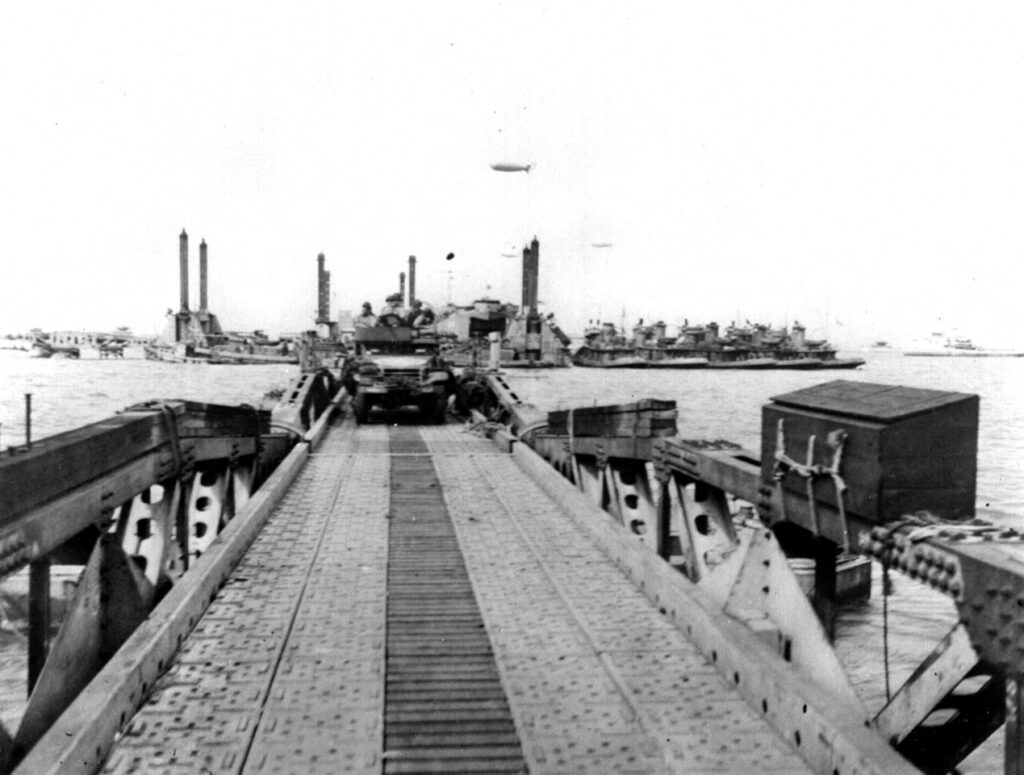
The main logistical problem required the capture of an important port to serve as a base and distribute supplies. The Germans were aware of this and would try to prevent it. To solve this, the Allies designed and transported an artificial port across the channel, which allowed them to supply during the first days of the invasion.[5]
The planning of an operation of this nature required certain conditions for crossing the channel, a low tide at dawn that would allow time to project the invasion into the European continent (months). Additionally, there was a commitment to Stalin to execute the landing in May 1944. Subsequently, May had to be discarded for two main reasons: first, the decisive nature of the operation did not allow for failure, as sufficient forces needed to be generated, which required more time than anticipated; second, the preparation of air forces and reconnaissance for the targets to be hit also recommended extending the timeline[6]. Under these conditions, the options were limited to a few days, specifically, June 5 to 7, with June 5 chosen as “D-Day” and the hour “H” at 5:58 AM.[7]
Given the great difficulty of concealing an operation of this magnitude from German spies and achieving an acceptable level of surprise, SHAEF developed a deception plan (“Bodyguard”), highlighted by the well-known operation “Fortitude.” Among the actions to mislead German intelligence, attempting to make it assume that the landing would occur in multiple locations and that the main effort would be at Dover-Calais, was the “creation” of units such as the “Fourth Army” that simulated the landing of forces in Norway, with limited results. What had a greater effect was the orchestration of the so-called First United States Army Group (FUSAG), a fictitious organization under the command of General George Patton. All of the above was fed by other information, including documents carried by an Allied pilot, supposedly shot down near Spain, which fell into Nazi hands, confirming the intention to invade via the Calais passage.[8]
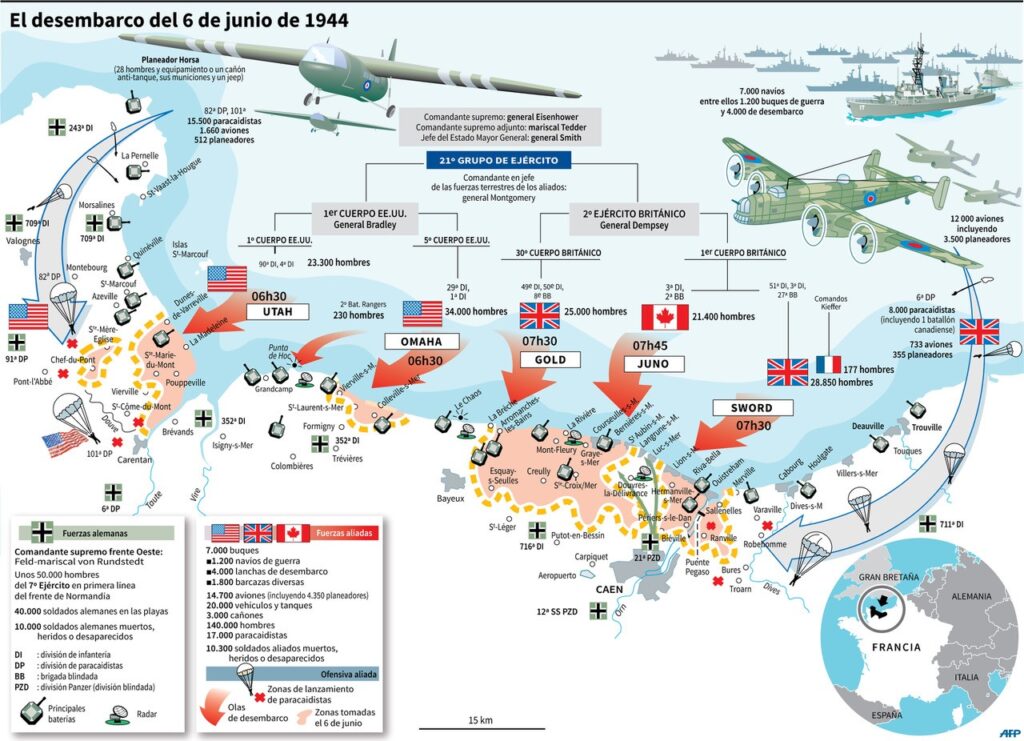
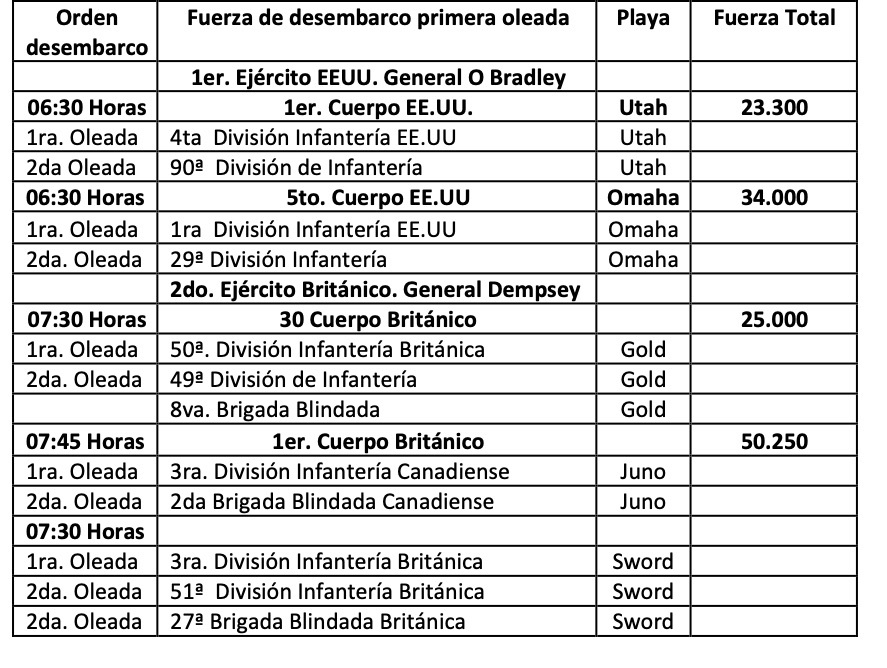
Finally, the Allied plan included five divisions, along with three armored brigades for the amphibious assault organized across five landing beaches: Utah and Omaha for the U.S.; Juno, Gold, and Sword for the British and Canadians. Similarly, two U.S. airborne divisions and one British division were to advance to land behind German lines and threaten defensive positions.[9] (see chart)
The decision to launch the assault on June 6, 1944, was a complex and tense process within the Allied Supreme Command. The prevailing weather conditions during the time window were not favorable. In summary, everything was organized and planned, but there were no conditions to land and launch paratroopers with acceptable risk. Thus, the SHAEF meeting to decide whether the invasion would proceed on June 5 took place on June 4 at 4:00 AM. The report, according to Eisenhower’s own words, was disappointing, postponing the landing by 24 hours to June 6. Again, SHAEF met for the same evaluation, this time at 4:00 AM on June 5. At that moment, the location of the headquarters was battered by a storm, which suggested a similar outcome to the previous day. However, the meteorological group reported that there would be a window of relatively good weather and visibility, which would last approximately 36 hours. With this information, the Supreme Commander made the decision to invade Europe on June 6, 1944.
D-DAY | Operation “Overlord” (D-Day) is the amphibious landing operation that gathered the largest number of ships in history. The Allied fleet included 1,213 warships from the following countries: Free France, Canada, Norway, Poland, and the Netherlands. In total, with British and American ships, the number reached 7,000 vessels and 12,000 aircraft. The fleet was organized into two task forces: the Western and Eastern forces. The Western force was primarily organized with American ships to support landings in the deployment areas of their own forces; while the Eastern force was organized with Royal Navy assets to assist the Anglo-Canadian landing forces. Regarding the assault forces, there was one for each assigned beach for the landings (from West to East: Utah, Omaha, Gold, Juno, and Sword).
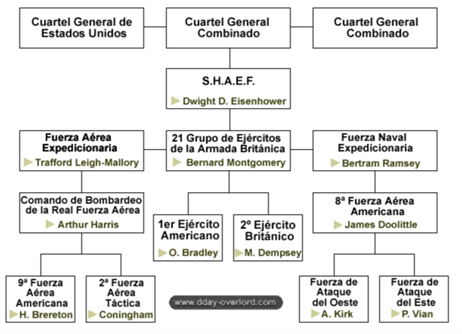
Regarding the organization of the Allied command for the invasion of Europe, it was configured as shown:
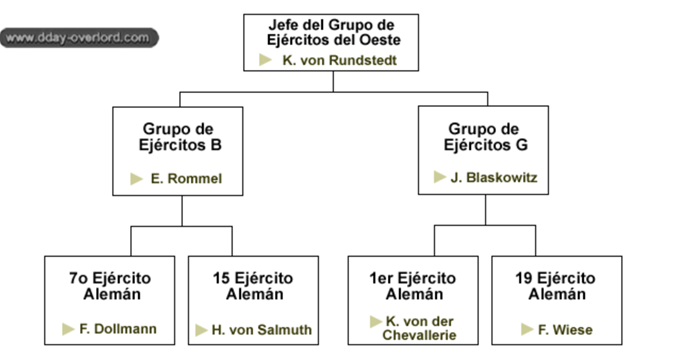
On the other hand, the German high command in the defense of Normandy was configured as follows:
The Allied fleet set sail from the English coast in the afternoon of June 5, after days of waiting for weather conditions that would make the amphibious expedition possible. The first forces to reach continental Europe were the reconnaissance units or pathfinders of the Airborne Assault Force, tasked with placing radio beacons and light signals in the fields, marking the drop zones for the waves of paratroopers between Utah Beach to the west and Sword to the east.
Airborne assault forces

Along with the advance group of scouts, British paratroopers landed in gliders towed by Halifax bombers, tasked with capturing the strategic bridges over the canal in Caen and the Orne River, located east of Sword Beach and the city of Caen, the main objective of British forces. In the U.S. sector, paratrooper drops faced strong gusts of wind that scattered the landings. The 101st Airborne Division was dispersed over an area 40 kilometers long by 15 wide. Meanwhile, the 82nd Airborne Division had better luck and was more concentrated in Sainte-Mère-Église, a few kilometers from Utah Beach, the first town liberated in France.
In these early moments, the reaction of German units was slow as they were convinced that any probable Allied operation would involve distraction actions, which led them not to employ either their reserves or the armored Panzer tank forces. Fortunately for the Allies, Rommel was in Germany, and most local commanders in Normandy were in Rennes for a coordination conference.
BEGINNING AND DEVELOPMENT OF THE AMPHIBIOUS LANDING | The first landing actions were scheduled for Utah Beach at 06:30 hours, by Naval Force “U.” The time had been set shortly after dawn, due to the tide being at its lowest point, to avoid German obstacles in anticipation of an attack at high tide. The different landing times were established based on the tides and their diversity across the five beaches. Utah Beach was the westernmost and very relevant as from this approach route the attack on the large port of Cherbourg would subsequently begin. Naval preparatory fires at Utah began prior to 05:30 hours. The Allied landing in this sector occurred 1,800 meters from the planned point due to currents that diverted them from the intended course. By 10:00 hours, the first vanguard battalions and some Sherman tanks had left Utah heading inland to link up with the forces of the 82nd and 101st Airborne Divisions, a task complicated by strong German resistance. During the day, most of the 4th Infantry Division was able to land. In total, 23,250 men, 1,742 vehicles, and 1,650 tons of supplies touched down. The number of casualties on this front was around 60 men, where the forecast had been set at 3,000 due to drowning. The landing at Utah was the most successful of all fronts.
On the Omaha front, located about 20 kilometers east of Utah, the actions were to be carried out by the 29th and 1st Infantry Divisions, both units belonging to the V Corps. On this front, the fleet transported 34,000 men and 3,300 vehicles. The conditions of the assault were very difficult and complex due to the bad weather, which resulted in significant losses of motorized and armored equipment. At 06:30, the landing craft began their progression toward the landing points. In this sector, the prepared and organized German defenses wreaked havoc on the landing units. One of the most effective weapons of the defense was the MG42 machine gun, which had a rate of fire of 1,400 rounds per minute. Many landing craft ran aground on sandbanks, making the landing more difficult, and many drowned due to the difficulty and weight of the additional equipment they carried. In this sector, the activity of breaching and mine-clearing by engineers to improve advance and mobility was of great relevance. In communications, a failure rate of around 80% was reported, complicating coordination due to the effect of seawater on the systems. In this front, where chaos and initial disorder were the main characteristics, the Allied command had to direct naval fire in direct support, which proved crucial. Additionally, this sector was characterized by the overcoming of significant cliffs, which were another difficulty to overcome. Nevertheless, by around 12:30 hours, 18,772 men had already landed, allowing for the securing of precarious positions and the advance toward the first defined towns inland. By the afternoon of June 6, the situation on this front began to come under control.
On the Gold front, actions were carried out by the 50th British Infantry Division, a veteran unit from the desert war in Africa. The attack plan was very similar to that of the other fronts, involving air bombardments and naval support fire. In this sector, special vehicles designed by Major General Percy Hobart were employed with great success and in greater numbers to neutralize and eliminate beach obstacles, as well as in breaching.
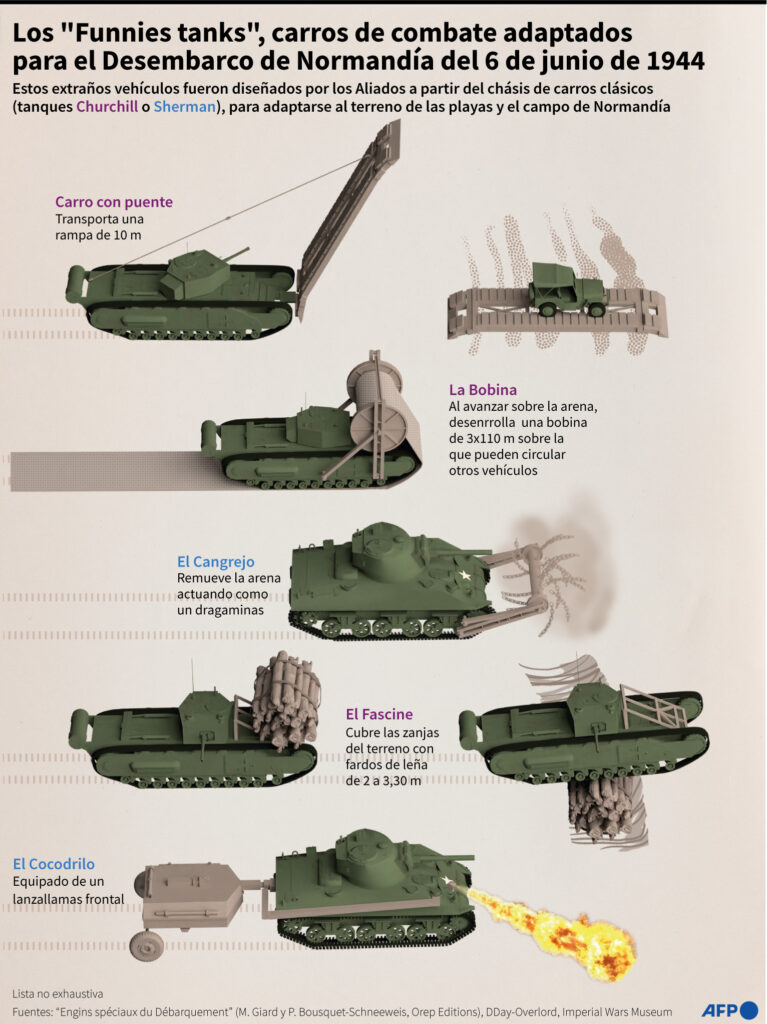
In this front, the landing began at 07:30 in the morning between Arromanches and Le Hamel, the left sector of the beach where the hardest fighting occurred. Likewise, the bad sea conditions were another obstacle to be overcome by the landing force. On the other hand, the troops landed at the right end of Gold also faced serious confrontations due to the limited damage inflicted on the German defensive forces in this front. However, by 11:00 hours, all the planned passages in this sector had been opened, allowing units to advance inland in search of their deeper objectives.
The actions at Juno were executed by Canadian units in a sector between the towns of La Riviere and Saint-Aubin-sur-Mer. The geographical area of this sector was cut off and affected by the mouth of the Seulles River. The occupation was under the responsibility of the 3rd Infantry Division, which began its landing with the 7th and 8th Brigades. However, the bad sea and weather conditions also delayed the landing, which began at 07:45 hours. The naval preparatory fire did not significantly affect the Nazi defensive positions in this front, where there were 961 casualties. Of the two brigades, the 7th had better luck, managing to advance relatively easily to the towns inland. The fighting was intense and took place in locations at close distance. In this sector, defenders had prepared houses with a network of connected tunnels that provided them with greater mobility and surprise. Saint-Aubin was taken in three hours and Courselles during the afternoon. The beach was secured, and the vanguard units began to press inland, although the rising tide reduced mobility for the landed vehicles.
On the Sword front, at the easternmost end, the fifth landing area extended over eight kilometers. Heavy resistance was expected in this sector from coastal batteries, so naval support fire was reinforced in this front. The conquest of the beach fell to the 3rd British Infantry Division, which faced reefs where mobility was severely restricted, necessitating the staggering of forces. By 09:30 hours, the British had managed to open several approaches in the German defensive device, capturing the town of Hermanville-sur-Mer. The 3rd British Division managed to control the beach, but its objective of capturing Caen was complicated by the German defenses inland, with organized and prepared positions, supported by a very good level of artillery fire of 122 mm. By mid-afternoon that day, British forces ended up five kilometers from their objective, Caen. French units from Free France also landed on this front.
IMPACT ON THE WAR | The landing in Normandy had a direct impact on the final outcome of the war. On one hand, it opened a new front of war for the Nazis, allowing for the alleviation of pressure on Russia. Along with the landing in southern France in August 1944, it created a scenario that would not change until Germany’s final defeat, despite some attempts to reverse the situation, such as the Ardennes offensive. On the other hand, it demonstrated to Stalin the firm Allied commitment to defeat Germany, prioritizing actions in the Pacific. After D-Day, the European countries occupied by Nazi German troops were progressively liberated, culminating in the final capitulation of Berlin.
FINAL CONSIDERATIONS
This military operation represents the most appropriate case study in terms of planning and executing a military campaign, given the magnitude and use of human resources and military material, a circumstance that is no longer repeatable today, given the sensors and other techniques that make unit movements more “transparent.” However, the existing technology also provides other opportunities and strategic advantages, in a scenario where war has not changed its nature, but its character is always evolving.
After 80 years, Europe is once again experiencing large-scale war due to the Russian invasion of Ukraine. While the international scenario is different, as the North Atlantic Treaty Organization has provided stability and security to its member countries, the feeling of having regressed to the 1930s is palpable on the old continent. The armed forces in the region have progressively lost their capabilities amid a pacifist environment and today, just like in the years leading up to the outbreak of World War II, are making hurried efforts to regain strategic capabilities. This is concrete evidence that such capabilities for national defense are not improvised.
In 1934, Germany and Poland signed a non-aggression pact; in 1938, the Nazis took Austria and the Sudetenland with the consent of the United Kingdom and France, powers that wanted to avoid a continental conflagration. However, the following year, Germany disregarded the treaty with Poland, demanding part of its territory, while the British signed an assistance agreement with Warsaw. In the end, nothing prevented Berlin from launching its offensive on September 1, 1939.
Meanwhile, in 1994, the Budapest Memorandum was signed, through which Ukraine ceded the nuclear arsenal that remained after the disintegration of the Soviet Union, handing over all nuclear warheads to Russia in exchange for guarantees of its security, territorial integrity, and political independence, with the United States, the United Kingdom, and Russia acting as guarantors. However, in 2014, Moscow unilaterally annexed Crimea in front of the international community and the guarantors and directly supported the separatists in Donbas. In the end, once again, nothing prevented the invasion of a sovereign state by a military power, and the ineffectiveness of the international system to prevent it became evident.
[1] Richard Overy, Why the Allies Won. W.W. Norton & Company: New York, 1995. 143
[2] Dwight D. Eisenhower, Crusade in Europe. Doubleday & Company: New York, 1948. 220.
[3] Ibid, 230.
[4] Opcit, Overy, 146
[5] Opcit, Eisenhower, 234.
[6] Ibid, 230
[7] Opcit Overy.
[8] Ibid, 151.
[9] Williamson Murray and Allan R. Millet. A War to Be Won. Harvard University Press, Cambridge: 2000. 420.