Ukrainian Incursion into Russia
This article was translated automatically and may contain differences from the original. For reference, read the original.
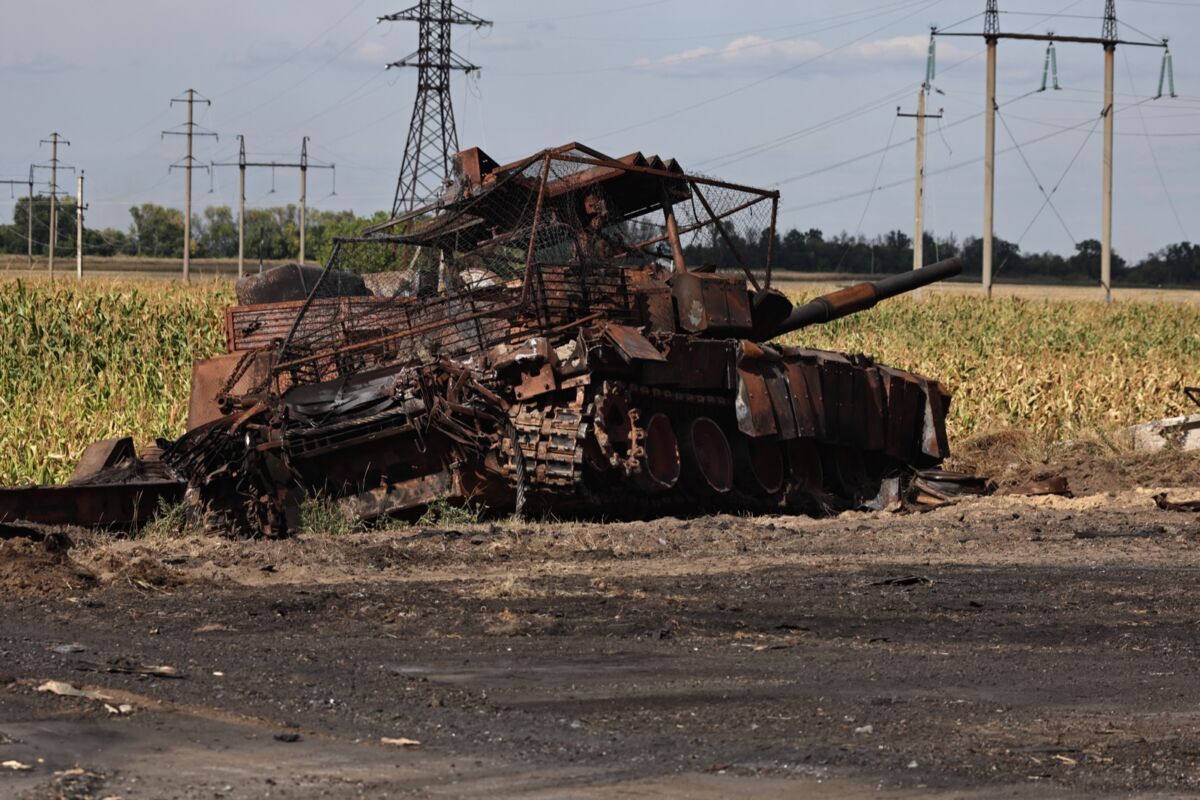
Tanque ruso destruido cerca de la ciudad de Sudzha, hoy bajo control ucraniano. Fuente AP.
Two weeks ago, on August 6, Ukraine surprised everyone—Russians, Ukrainians, and the countries supporting the war effort—by launching an attack on Russian territory in the Kursk region. So far, very little is known; there is too much speculation, and much of what circulates is influenced by interests from both sides, making it difficult to have a real assessment. Nevertheless, we will attempt to organize some ideas about what is happening or could happen.
Two weeks ago, on August 6, Ukraine surprised everyone—Russians, Ukrainians, and the countries supporting the war effort—by launching an attack on Russian territory in the Kursk region. So far, very little is known; there is too much speculation, and much of what circulates is influenced by interests from both sides, making it difficult to have a real assessment. Nevertheless, we will attempt to organize some ideas about what is happening or could happen.
PREVIOUS SITUATION
The action takes place in a strategic context in which Russia had the initiative across the entire theater of operations. Since last May, it had been pressuring Kharkiv, a new front that threatened the city, without achieving significant advances. In the Donbas, operations focused on capturing all the territory of the provinces claimed by Moscow. On one hand, in Luhansk, the Kupyansk-Svatove-Kreminna operational line concentrates the main actions in that area. On the other hand, in Donetsk, the Russian attack continues towards Chasiv Yar, Toretsk, and Pokrovsk.[1]. However, in recent months, a large number of Russian casualties have been recorded in this area, and the advance has been slow but steady. At the beginning of August, the Kremlin controlled, according to information from War Mapper[2], 2.5% of Kharkiv, 98.3% of Luhansk, 58.5% of Donetsk, 72.1% of Zaporizhia, 71.8% of Kherson, and 100% of Crimea, the regions illegally annexed by Russia.
For its part, Ukraine was on a general defensive, having lost the initiative after its offensive in the summer of 2023, which made little progress on the ground. This, combined with the slow recruitment process and significant lethargy in international support, particularly from the United States, resulted in considerable wear and the inability to maintain a stable combat front, especially in the aforementioned Donetsk region.
INFORMATION ON THE OPERATION AND ITS EFFECTS
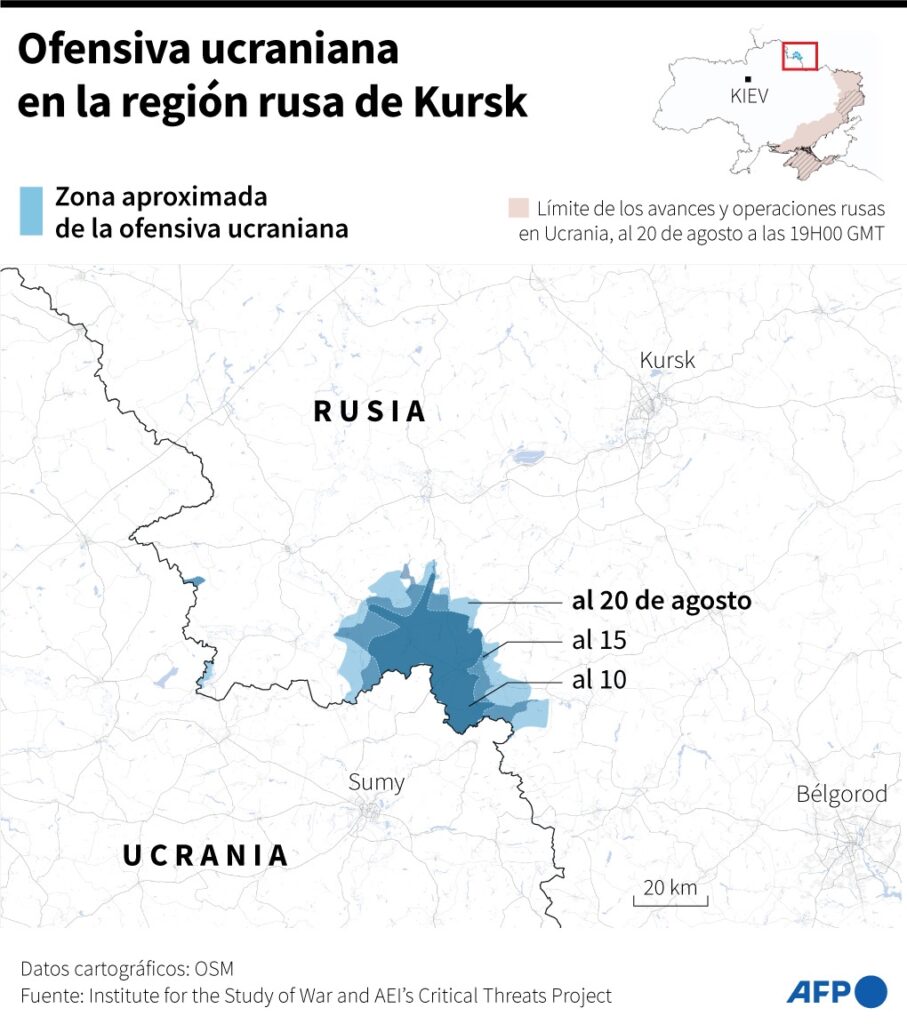
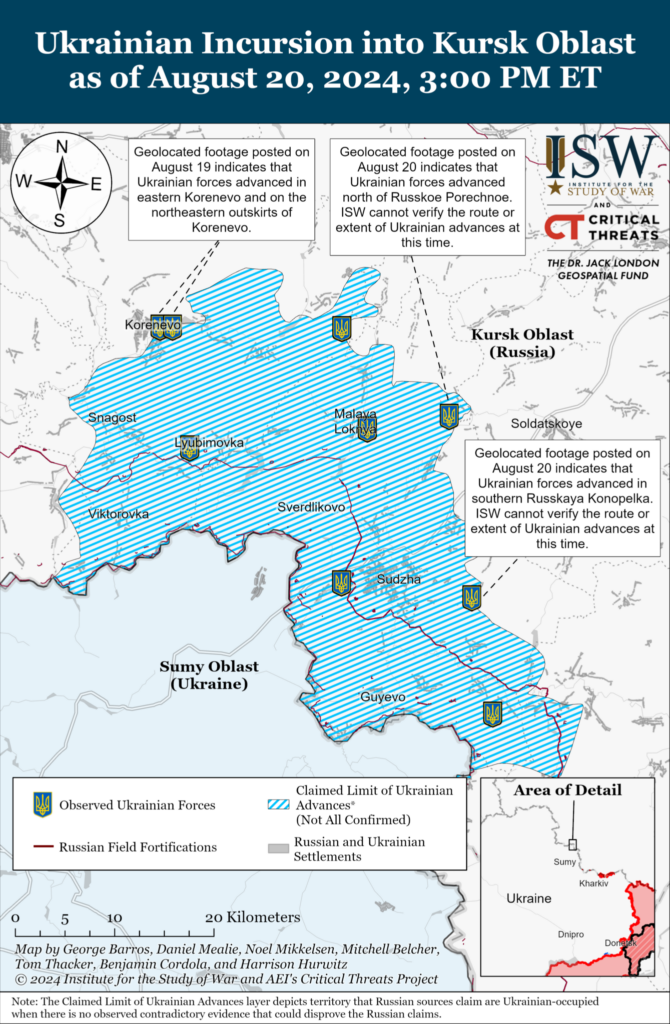
Regarding the new Ukrainian offensive, the first point to emphasize is that it was surprising. While it is not the first action that crosses the international political boundary from Ukraine to Russia, it is the first time it has done so with regular troops and on a larger scale. In this sense, it is noteworthy that the armed forces of Kyiv were able to maintain the secrecy and security of the operations, incorporating lessons learned from previous experiences, in addition to demonstrating a clear failure in Russian intelligence or in the risk assessment of the information they likely had at some point. This incursion brought ground warfare into Russian territory, which had not been seen since World War II, and broke the stability of a front that had been largely static for months. Another aspect that may have contributed to the surprise is the high risk it posed for Ukraine, as a potential failure could have left it in a much more precarious situation than before this offensive.
Similarly, all indications suggest that the operation was well planned and executed correctly, employing some of the best units available to the Ukrainian army under the concept of combined arms, something that some analysts and observers had deemed impossible against fortified Russian defensive positions. So far, Moscow has not managed to stabilize the situation; its response has been slow and seemingly disorganized.
For now, the most evident effects observed are the positive boost to the morale of Ukrainian troops, who have been on the defensive and, in some cases, retreating for months. The same effect is seen in the Ukrainian population, which sees new hope in the incursion. Another effect is that the red lines drawn by Putin, such as the idea that any threat to Russian territory would mean an escalation of the war or other cataclysms, are becoming blurred. Furthermore, this operation temporarily and locally takes the initiative away from the Russian armed forces, facilitating the capture of hundreds of prisoners of war that will allow for future exchanges of detainees with Moscow, not to mention that it puts the rest of the Russian troops guarding the long common border on alert against further incursions. For now, it is estimated that, with this offensive, Ukraine controls between 500 and 1,000 km2 of Russian territory—similar to the ground gained by Moscow after months of offensive and significant casualties and material losses—meaning nearly a hundred localities, and has resulted in the displacement of more than 120,000 Russians.
Moreover, there is no doubt that all of this has personally complicated matters for President Putin. First, he has been unable—under the perspective of the civilian population—to defend the border itself and the citizens living there, as well as those who have suffered damage or had to be evacuated; second, he has exposed numerous conscripted soldiers to the war, including captured prisoners, something that had been promised not to happen; third, it reveals weaknesses in national defense preparation and intelligence; finally, it highlights the limited flexibility of the armed forces to respond to this situation.
After two weeks, Ukrainian forces remain in Russia, and there is no real timeline for their expulsion. Hence, doubts arise about how Putin and the Russian high command will react. This is because, as time passes, it will require a greater number of resources that are not readily available, or he may eventually employ a tactic similar to what has been done so far in Ukraine, with the massive and indiscriminate use of artillery and aerial bombs, but this time on homes and towns, with the costs that this will entail.
Conversely, it should be noted that it does not appear that the actions have caused widespread panic among the Russian population. There has also been no evidence of relief in the pressure exerted by the attacking forces in the Donbas, nor has Putin’s position weakened within Russia, at least for now and with the information available.
POTENTIAL OBJECTIVES FOR UKRAINE
Many have questioned the effectiveness of the Ukrainian incursion, given the high risk already mentioned and, from their perspective, the limited long-term effects it may have. Thus, the question arises as to what the objectives of this operation are that justify President Zelensky’s decision. When defining or identifying these objectives, while they may seem logical to some, everything is handled within the realm of speculation, as no one has General Syrskyi’s operational plan.
These inferred objectives can be separated into some more immediate ones and others that could be achieved over a longer term. Nevertheless, based on the observed development of operations, statements from Ukrainian authorities, and historical and military strategy experiences, it is possible to infer that among the more immediate objectives, the operation aims to: 1) serve as a catalyst for the morale of Ukrainian troops and the population; affect the morale of the Russian population; 2) demonstrate that Ukraine can win, as a Russian victory is not inevitable; 3) wear down as many local forces and others converging in the Kursk region as possible; and 4) change the perception in Western capitals, so that they lift restrictions on the use of weapon systems in Russian territory, which would allow for an expansion of the range of attacks—one of Putin’s red lines—while also ensuring and accelerating the essential material support.
In a longer time horizon, the operation would aim to: 1) force Russia to transfer troops from other fronts—mainly from Donetsk—to relieve the pressure and systematic Russian advance by creating urgency in its own territory; 2) capture and maintain Russian territory for potential exchanges in negotiations; and 3) change the narrative of the war, from an almost deterministic view of a certain Russian victory to one that highlights real Ukrainian options if the necessary means are provided.
Overall, it seems that, on one hand, its planning was oriented towards more limited objectives, but with the initial progress and success achieved, these have expanded in time and scope; and on the other hand, that the action was developed more for political than military reasons. Additionally, the real impact of this on the campaign and, ultimately, on the outcome of the war remains in question. While in history, a single event rarely signifies a total turning point in a war, it is also clear that changes in the course of conflicts begin with something happening somewhere in the theater of operations.
WHAT COULD FOLLOW
Despite the initial success achieved—without considering that the operation is not yet over, as Ukraine continues to advance and apply pressure—this action is reaching a decision point for the authorities in Kyiv, given the risks that appear on the horizon. The more units and resources are used, the greater the risk. The more extensive and deeper the operation, the greater the risk, given the elongation of logistical supply lines and vulnerability to air attacks, artillery, and electronic warfare; not to mention communication problems, as Starlink will not function the same way in Russian territory. Therefore, the decision to maintain the territory gained or withdraw must be weighed. For the former, preparation of positions is required, for which there is already evidence of the beginning of trenches, as well as other measures, such as the destruction of bridges over the Seim River, which complicates the arrival of Russian reinforcements and protects a flank. Furthermore, maintaining occupation of this territory for an extended period will require a greater number of resources, which Ukraine apparently does not have at the moment. According to information gathered in Kyiv a few weeks ago, while mobilization effectiveness may be improving, the goal is to generate about 14 new brigades, a tremendous challenge that is taking time, and these units will not be organized, equipped, and trained before the latter part of this year.
On the other hand, if a quick withdrawal is chosen, it would squander an extraordinary opportunity to challenge Russia on its territory and generate the problems that Ukraine has had to deal with for more than two and a half years. Moreover, a withdrawal at this moment would mean having lost resources without achieving relevant operational effects. Perhaps, a middle position would be the most efficient option, that is, preparing to maintain positions for as long as possible to disrupt Putin’s regime, creating a problem of such magnitude that it ultimately diverts significant forces from the Donbas. All of this, with the final idea of ceding captured ground, buying time, and wearing down Russian forces, incurring a significant cost in lives and resources.
WHAT CAN BE CONCLUDED
While it must be reiterated that there are currently more questions than answers, whether regarding objectives, effects, or the final impact on the war, it is estimated that it is indeed feasible to conclude some ideas.
- The war will extend for quite some time—beyond 2025—considering that the positions of both belligerents are very distant and the development of operations does not favor either side conclusively.
- Despite Russian superiority and the ongoing advance in the Donbas, the high cost in lives and resources indicates that this offensive will reach its peak this year, perhaps without achieving the conquest of the entire region.
- Despite the transparency of the battlefield and the Russian defense preparation of its border, it is still possible to apply surprise and security in operations.
- The demonstration of the use of Ukrainian forces highlights the importance of experiences and the ability to obtain and apply lessons that provide comparative advantages in the current battlefield.
- The questions arising from the results of the 2023 Ukrainian offensive could be seen as unfair and hasty, as it is evident that their forces have been able to assimilate and apply doctrinal concepts, in addition to employing the concept of combined arms, which brings significant benefits, especially if projected over time and with the appropriate material means.
- The use of units under the idea of combined arms remains valid when tactics and techniques are adapted to the reality of the ongoing war.
- The incursion seems to obey more to political objectives and logics than military ones, which underscores the relevance of political leadership in conflicts and the supremacy of its objectives over those of an exclusively military nature.
- A high wear of human and material resources by Ukraine could compromise the necessary resources for a future offensive in 2025, aimed at expelling the Russians and regaining control over its territory.
- Ultimately, the real effect and success of the incursion will depend, above all, on Russia’s final reaction; in particular, on Putin’s threat assessment regarding this event in relation to the effort to continue the advance in the Donbas and the diversion of forces towards Kursk.
Marcelo Masalleras
Senior Researcher, AthenaLab
[1] Institute for the Study of War. “Russian Offensive Campaign Assessment.” Accessed August 21, 2024. Available at: https://www.understandingwar.org/backgrounder/russian-offensive-campaign-assessment-august-20-2024
[2] “Tracking the War Through Graphs.” Accessed August 21, 2024. Available at: https://www.warmapper.org/stats