Russia-Ukraine War: Affecting the Will to Fight
This article was translated automatically and may contain differences from the original. For reference, read the original.
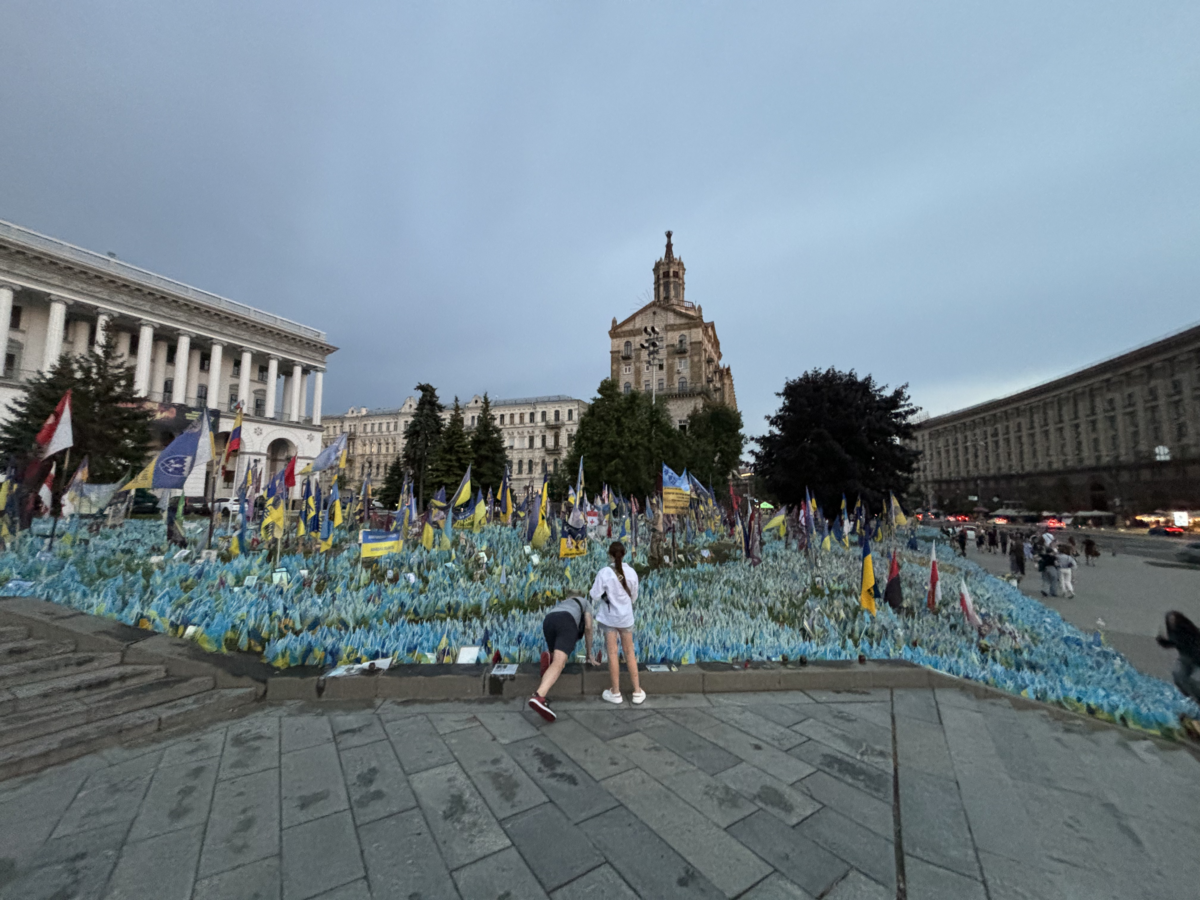
Banderas conmemorativas de caídos durante la guerra, plaza de Independencia (Maidan).
Ukraine experienced a series of missile and drone attacks from Russia this week, primarily targeting critical electrical infrastructure. While such aggressions are relatively common, the scale was significant, as it represents one of the largest since the onset of the large-scale invasion launched by Moscow in February 2022.
Ukraine experienced a series of missile and drone attacks from Russia this week, primarily targeting critical electrical infrastructure. While such aggressions are relatively common, the scale was significant, as it represents one of the largest since the onset of the large-scale invasion launched by Moscow in February 2022. This time, the affected targets included a dam in the Kyiv region, reminiscent of the damage suffered by the Kakhovka dam in June 2023[1], resulting in the flooding of a large part of the Kherson region, where multiple destructive effects were recorded and several communities were forcibly displaced.
On Monday, August 26, over a hundred missiles of various types, along with around 100 drones, were directed at different Ukrainian cities. While most were intercepted, some caused severe damage and resulted in the loss of at least seven lives.[2] The following day, another attack was felt with similar results. It is estimated that, on one hand, these actions may be a retaliation for the invasion launched by Kyiv into Russian territory a couple of weeks ago[3] (Kursk), which has been the pattern following significant victories or advances by the Ukrainian armed forces, as occurred in mid-2022 when Ukraine reclaimed the Kharkiv region.
Although the assaults are not constant, as Russia lacks the capacity to replenish stocks to sustain these actions more regularly, air attacks with missiles and drones are relatively frequent, with Ukraine’s critical energy infrastructure being a sustained target. It is estimated that around 70% of electrical capacity has been severely affected during the war. According to an article published by The Economist[4] recently, this year alone, approximately 9 gigawatts (GW) of the 36 GW of power generated before 2022 have been degraded. Of the lost capacity, it is estimated that Ukraine could recover 2-3 GW by repairing damaged plants, and could also increase electricity imports from 1.7 to 2 GW. As can be seen, the damage is massive and will have repercussions for the upcoming northern winter at the end of the year.
Such actions, some of which cannot be justified as military necessity but rather fall under the classification of war crimes[5], such as the destruction of a children’s hospital[6] or the bombing of hotels, may be aimed at affecting the will to fight of Ukrainian society. That is, by generating fear, they attempt to transform the lives of Ukrainian citizens into something complex or miserable, with the ultimate intention of gradually and steadily undermining their will to continue the war. Another objective, specifically by impacting places like hotels[7], could affect the support or attention given to the situation in Ukraine. This is because these are buildings used by foreigners for lodging, including journalists covering the war or members of foreign governments, as well as international organizations or non-governmental organizations.
Despite the attacks, it seems that the result has been entirely contrary, strengthening Ukrainian national cohesion and the conviction to fight to the last consequences, although the impact on individuals is significant and undeniable. At least, this is the perception one can form when visiting Ukraine and conversing with anyone. While an observer visiting Kyiv for the first time might—incorrectly—conclude that the capital is living in normalcy, as there are people on the streets, children going to school, restaurants and businesses still operating, etc., what exists is far from normal. What Ukrainians have experienced since 2022 is merely a new normal. This is because, upon closer inspection, damaged areas from missile and drone attacks can be identified; historical and heritage monuments are covered to protect them; there are tank obstacles at various points in the city; power outages are recorded lasting up to 14 hours a day in some areas; there is a curfew from 10:00 PM to 5:00 AM; places of high emotional impact, such as Independence Square (Maidan), are observed, where thousands of flags are displayed to honor those fallen in the war against Russia; and almost daily, attack alerts force residents to take refuge in bunkers distributed throughout the city. In summary, a new routine that they have had to adopt for survival needs, but which has not affected their will to continue defending their sovereignty.
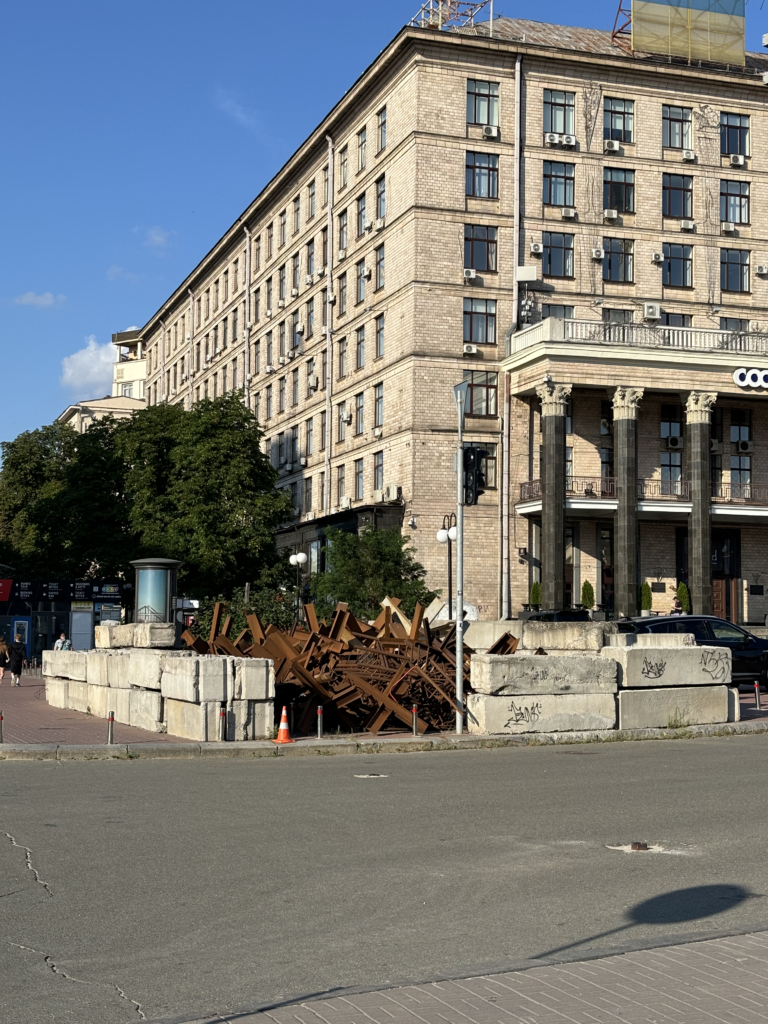
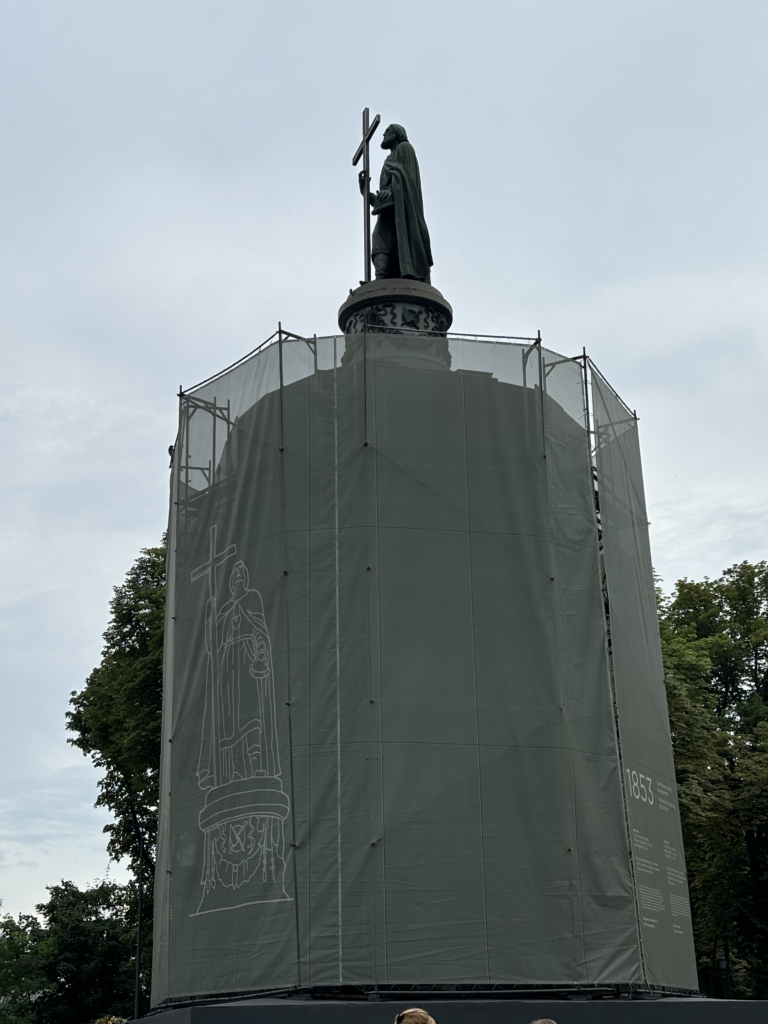
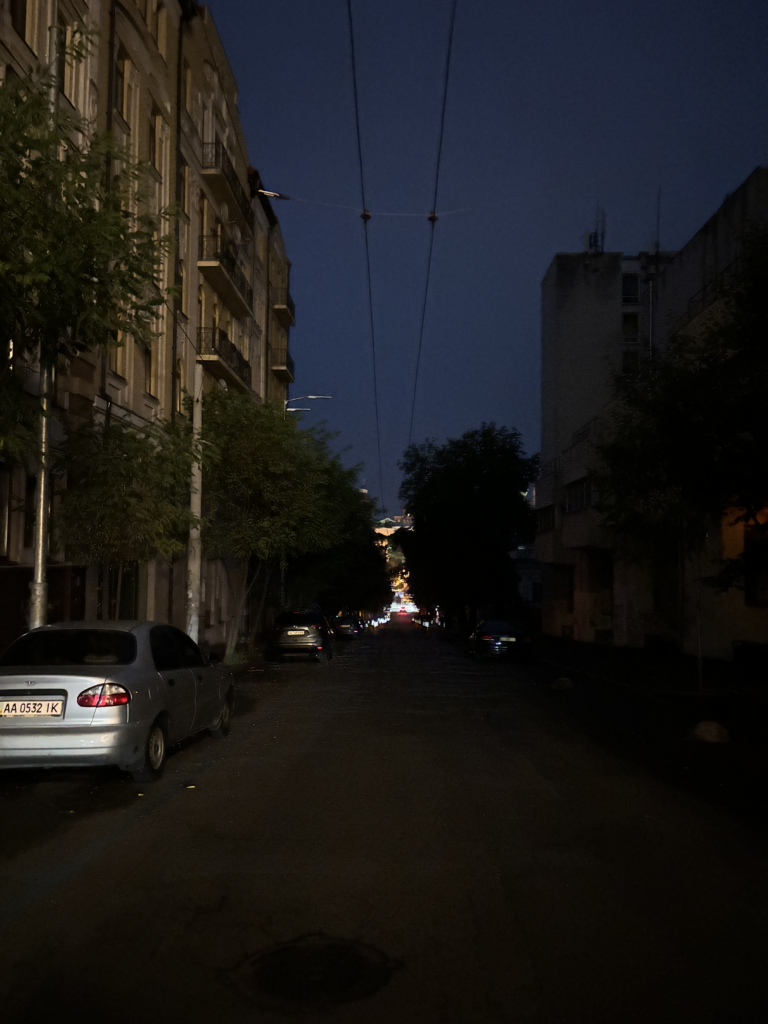
There is no doubt that these actions carried out by Russia will continue in the coming months, especially as winter approaches in the northern hemisphere, but there is no evidence that they will weaken the determination to fight, at least in the short and medium term. Furthermore, those attacks affecting targets protected by international humanitarian law should generate actions that enforce accountability for the damages caused. This is not a new phenomenon, as when Germany bombed London or the Allies did the same over cities like Berlin and Dresden, with the intention of forcing governments and populations to capitulate, the effect of degrading society’s will to continue was not achieved, or at least did not bring an end to the armed conflict.
Likewise, the Western powers supporting Ukraine’s war effort must evaluate the restrictions imposed on the use of long-range weapons. This is because some of the missile and drone launch sites or takeoff runways of Russian aircraft involved in these attacks are within the operational range of weapons such as the ATACMS[8], which could be neutralized or forced to relocate to greater distances, complicating Russian attacks. Additionally, all the self-imposed restrictions by contributing countries so far have eventually been lifted due to the weight of reality (HIMARS[9], tanks, aircraft, long-range air defense systems, etc.) and Ukraine’s survival needs. Lifting limitations for deeper attacks—whether total or partial—is an operational necessity that will partially restrict Russian freedom of action. Moreover, Kyiv is already executing similar actions with its own means (drones), but without the effect that could be achieved with Western authorization.
The accumulated experience over the last two and a half years indicates that the red lines drawn by Moscow have not proven effective, and Russia does not possess the capacity to escalate the war further—if it could have, it would have done so—unless it receives substantial external support or employs the nuclear threat. The latter is estimated to be unacceptable to the United States, China, India, and most countries within the international system. This does not imply that it is impossible, but rather that it is far beyond what is tolerable, and its eventual effect could be catastrophic for the Russian regime.
The current war in Europe is likely to continue beyond 2024 and even into 2025, and its development will depend on three factors we have identified since the beginning of the invasion in Athenalab[10]: the will to fight, external support for both belligerents, and time. The latter element currently favors Russia, at least for now.
[1] AthenaLab. Six Notes on the Destruction of the Kakhovka Dam. AthenaLab, June 2023. Available at: https://www.athenalab.org/analisis-seis-apuntes-sobre-la-destruccion-de-la-represa-de-nova-kajovka/
[2] Francesca Gillett and Will Vernon Seven killed in ‘most massive’ Russian air attack, Ukraine says. BBC, August 26, 2024. Available at: https://www.bbc.com/news/articles/c3d90ke0ello
[3] Masalleras, Marcelo. Ukrainian Incursion into Russia. AthenaLab, August 2024. Available at: https://www.athenalab.org/comentario-incursion-ucraniana-en-rusia/
[4] The Economist. Russia’s vast stocks of Soviet-era weaponry are running out. July 16, 2024. Available at: https://www.economist.com/europe/2024/07/16/russias-vast-stocks-of-soviet-era-weaponry-are-running-out
[5] United Nations Organization. Russian Federation’s Attack on Ukrainian Children’s Hospital ‘Not Only a War Crime’ but ‘Far Beyond the Limits of Humanity’, Medical Director Tells Security Council. UN Press, July 9, 2024. Available at: https://press.un.org/en/2024/sc15761.doc.htm
[6] Human Rights Watch. Russia’s July 8 Attack on a Children’s Hospital in Ukraine. HRW, July 11, 2024. Available at: https://www.hrw.org/news/2024/07/11/russias-july-8-attack-childrens-hospital-ukraine
[7] Euronews. British national killed and six injured in Russian missile strike on Kramatorsk hotel. AP, August 25, 2024. Available at: https://www.euronews.com/my-europe/2024/08/25/two-journalists-wounded-one-missing-in-russian-airstrike-on-hotel-in-ukraine
[8] U.S. Army Tactical Missile System, designed to fire rockets and surface-to-surface artillery missiles from M-270 and HIMARS platforms. More information available at: https://www.lockheedmartin.com/en-us/products/army-tactical-missile-system.html
[9] U.S.-made High Mobility Artillery Rocket System, highly flexible, with range and precision, capable of firing various types of rockets and missiles. More information available at: https://www.lockheedmartin.com/en-us/products/himars.html
[10] John Griffiths and Marcelo Masalleras. Working Paper No. 21 “One Year After Russia’s Invasion of Ukraine”. AthenaLab, February 2023. Available at: https://www.athenalab.org/category/publicaciones/publicaciones-internas-es/documentos-de-trabajo/page/2/