One year since the massive Hamas attack on Israel
This article was translated automatically and may contain differences from the original. For reference, read the original.
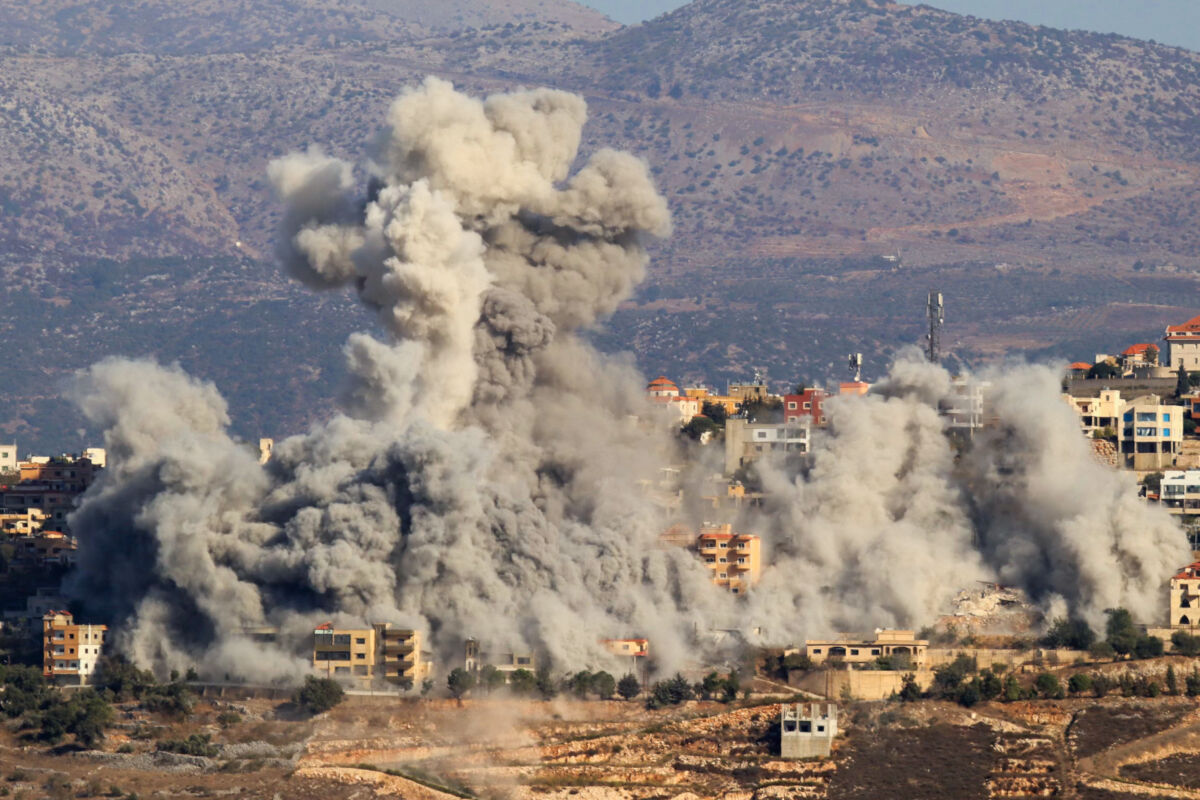
Ataques del ejército israelí contra la ciudad de Hiyam en Nabatieh, Líbano, el 3 de octubre de 2024. AFP.
Almost a year ago, the Palestinian group Hamas launched a surprise, massive, and coordinated attack on Israeli territory, resulting in the deaths of approximately 1,200 people and the capture of 220 hostages, many of whom are still in captivity. As this article is being written—October 2, 2024—many events are unfolding in a conflict that, as projected after October 7, 2023, has transcended the Gaza Strip.
Whathas happened since October 7, 2023??
The Hamas attack represented a severe blow to Israel, its intelligence system, and its armed forces (IDF). From that day onward, the IDF initiated a military campaign against that Palestinian organization, primarily in Gaza. The defined political objectives were to achieve the destruction of Hamas to prevent it from remaining a threat to the Jewish state and to recover all hostages. Under the framework of “Operation Iron Sword,” the effort aimed to stabilize the situation in the territory itself and recover communities captured by the invaders, while simultaneously targeting sites within the Gaza Strip through air power. Subsequently, operations focused on isolating the theater, continuing attacks against high-value targets, preparing ground forces to execute the main effort, and mobilizing reservists. Once these conditions were met, Israel launched a ground offensive on October 27, encircling various sectors of the strip to progressively attack and eliminate Hamas forces from north to south.
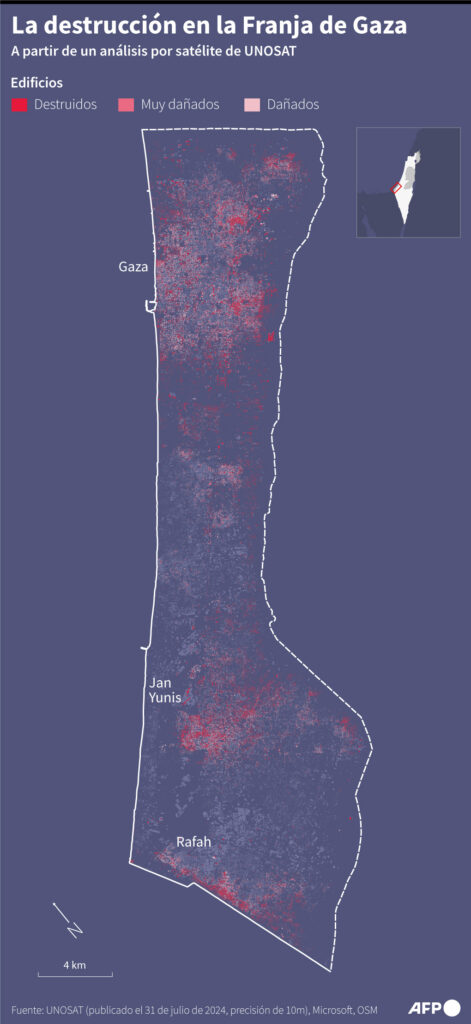
This stage of the conflict has involved the displacement of hundreds of thousands of civilians within Gaza and 40,000 deaths, according to political authorities in the strip. After a year, it is evident that Israel has achieved substantial degradation of Hamas’s military power, in addition to eliminating its main leaders, including Ismail Haniyeh in Tehran, the highest political leader of the terrorist organization.
For its part, Hamas faced Israeli forces employing guerrilla tactics and techniques, taking advantage of the challenges posed by urban areas, especially when the high level of destruction complicates the movements and coordination of ground units. However, the material and personnel attrition has meant that this group has progressively ceased to be a threat to the State of Israel, at least in the short or medium term.
Nevertheless, the conflict triggered by Hamas’s incursion has tended to escape the Gaza theater as third actors have become involved both directly and indirectly, to the point that Israel now faces six other enemies. Immediately, there is the presence of Hamas and other groups like Palestinian Jihad in the West Bank; to the north, Hezbollah in Lebanon; to the east, militias supporting Bashar al-Assad’s regime in Syria, in addition to Shiite militias present in Iraq; and from the south, Houthi rebels. Undoubtedly, the most relevant and predominant actor is the Iranian regime. In summary, what Tehran has termed the “resistance axis”[1] against Israel and the United States.
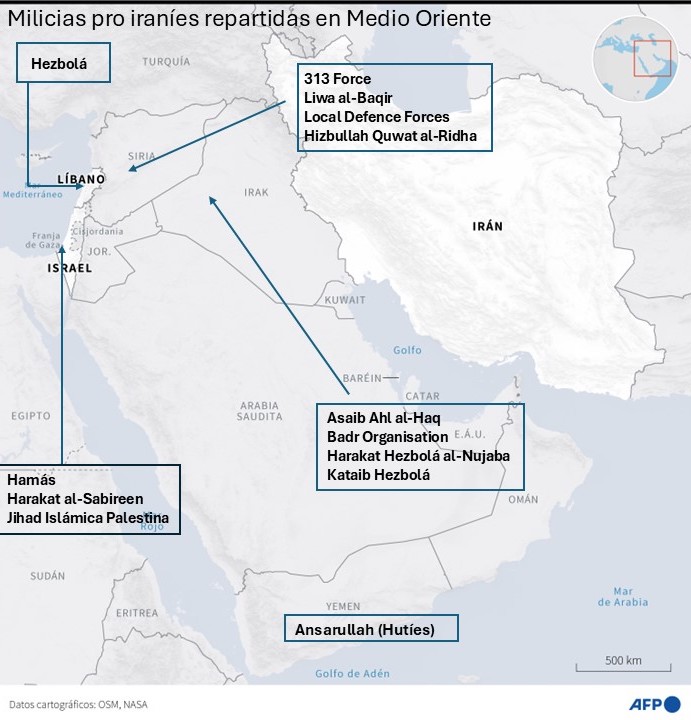
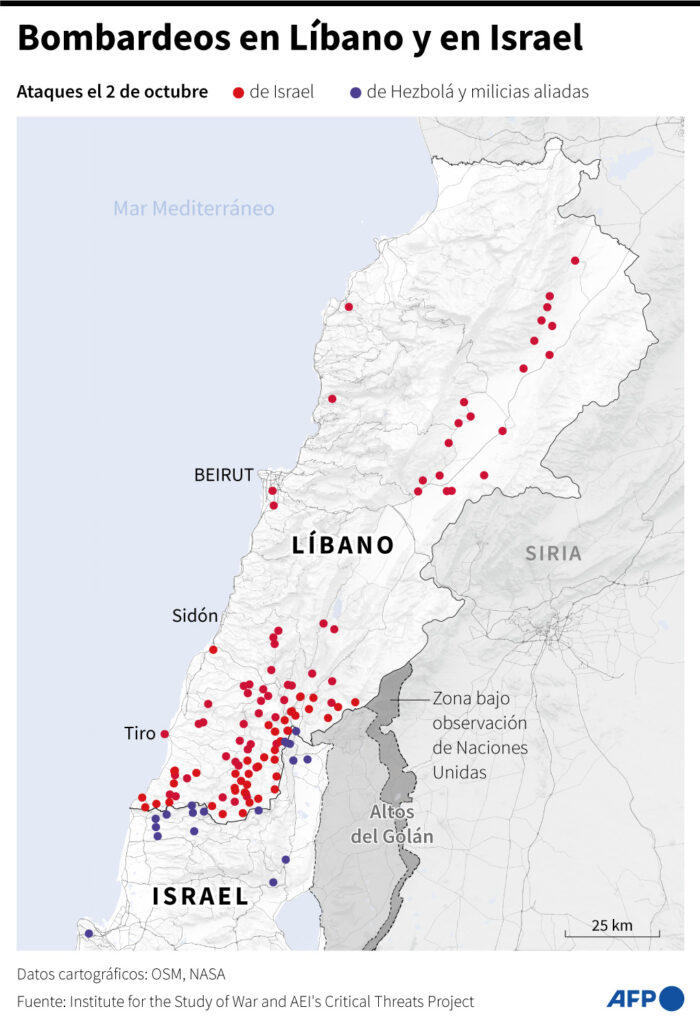
For its part, the day after the Hamas attack, Hezbollah began firing rockets and missiles that primarily affected the northern part of Israeli territory. These attacks forced the evacuation of around 60,000 people who were threatened by these actions and, consequently, triggered a response from Tel Aviv. This retaliation, initially limited in intensity, was characterized by selective attacks on targets that were part of Hezbollah’s structure, weapon depots, launch sites, or tunnels built for hiding or incursion into Israel. This changed a few weeks ago, with the intensification of actions in Lebanon.
The idea of a “unity of fronts” among groups supported by Iran, in solidarity with Hamas in its “struggle” against Israel, has meant that this country has had to face simultaneous attacks from the West Bank, where it currently maintains a significant portion of its troops. It also regularly receives rocket and missile attacks from Syria and Iraq, to which it has primarily responded through limited air incursions. Another actor threatening Israel is the Houthi rebels from Yemen. Since October 19, 2023, they have launched missile and drone attacks toward Israeli territory, which have mostly been neutralized or have not had a significant impact; however, they represent a permanent threat. In response, the IDF has already attacked facilities in Yemen on two occasions, first on July 20 of this year and, recently, on September 29. But Houthi actions do not end there. Consistently, the rebels have targeted merchant ships and vessels navigating the Red Sea, causing a serious impact on navigation and global trade. In response to these actions, various countries have deployed warships to protect these maritime routes and have attacked targets on Yemeni soil. Currently, ships from, among others, the United States, the United Kingdom, Canada, Australia, New Zealand, Singapore, Bahrain, France, Italy, Germany, Denmark, Belgium, Sweden, and the Netherlands are grouped in various coalitions, as well as countries like India, Pakistan, China, and Saudi Arabia.
One of the most significant aggressions against Israel—also involving Houthi rebels—was executed on April 13, when Iran launched a massive attack of drones and missiles (ballistic and cruise), in the first action of this type where both states directly confronted each other. This was justified by the Iranian regime as a response to an Israeli air force attack on facilities housing the Persian consulate in Damascus. It is estimated that around 320 projectiles were fired from positions in Iran, Syria, Lebanon, Iraq, and Yemen. The result of the attack was modest. Among the missiles and drones intercepted by Israeli, American, British, and other countries’ aircraft and ships, those downed directly by Tel Aviv’s air defense system must be added, as well as those that fell in places that did not pose threats. In summary, there was only one fatality, a young girl of Bedouin origin, and no strategic installations were affected. A success for Israel and a failure for Iran. The response was swift; Jewish forces attacked specific military targets on Iranian soil, but far from Tehran. All indications are that both contenders avoided greater damage that would provoke a reaction from the other side and escalate the conflict to another level.
During this past month of September, the situation has changed significantly. Once the main operations in Gaza concluded with the destruction of its military apparatus, the center of gravity for Israel shifted to Lebanon, a territory with a strong presence of the Hezbollah militia. In just over 30 days, nearly thirty leaders who formed the upper structure of the terrorist group and its military, intelligence, special operations, drones, etc., have been eliminated. Concurrently, in addition to air and artillery attacks, the IDF employed special forces to incursion into Syria and destroy a site where precision projectiles were being manufactured, as well as conducting incursions in Lebanon to gather information. On September 17 and 18, in an unexpected action, hundreds of beepers of Hezbollah users exploded in Lebanon in the hands of their operators, which was repeated the next day with portable radios, in what can be considered a significant and effective intelligence operation (to date, Israel has not claimed responsibility for the attack). The culmination of these events was the death, resulting from a Jewish airstrike, of Hassan Nasrallah, the historical leader of Hezbollah for decades and very close to Ayatollah Khamenei of Iran. The sum of these and other actions has left Hezbollah very weakened, without visible leadership, lacking a structure and means of command and control to coordinate the group’s actions and to receive support or guidance from Tehran. If it is added that the organization, in addition to its military structure, has operational cells, the loss of leaders implies the breaking of these compartmentalized networks, complicating their reconstitution even further. In summary, a significant blow to the main and strongest of the groups supported by Iran, but far from being destroyed.
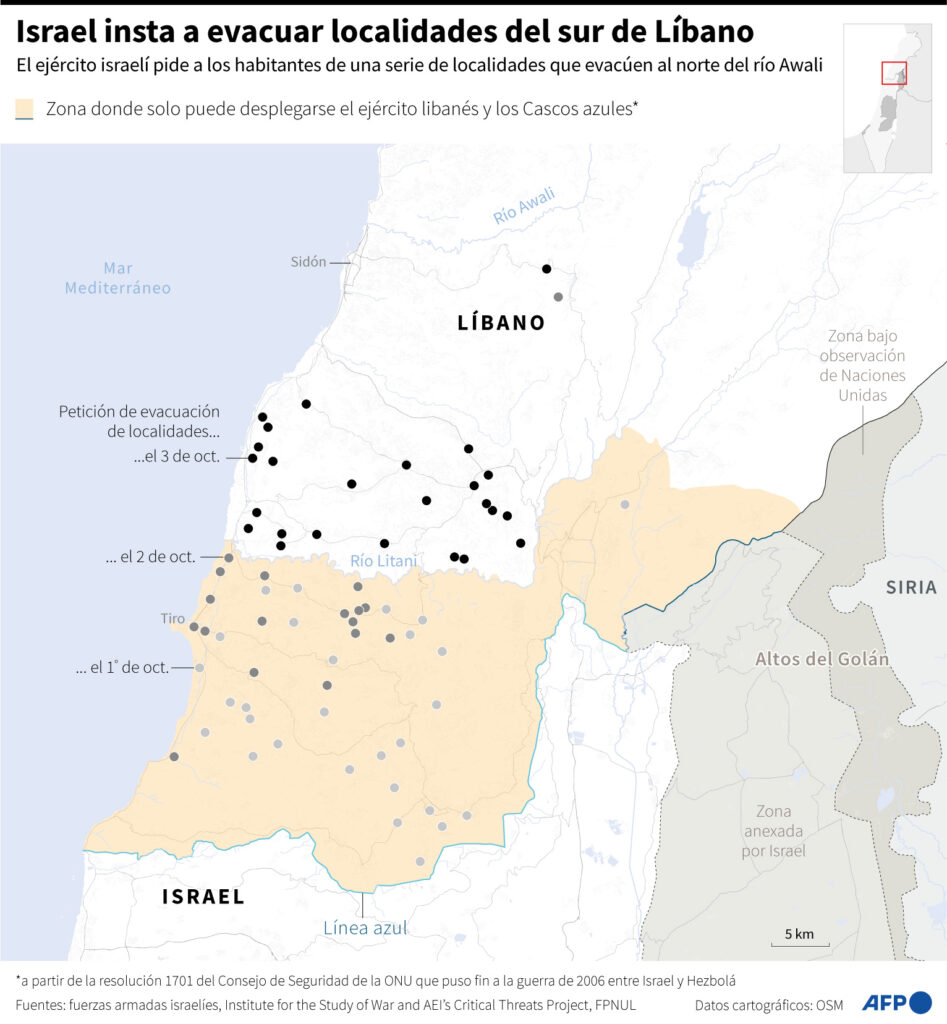
In this context, and after deploying two army divisions to its northern border, Israel entered Lebanon on October 1 in what it described as a limited operation aimed at neutralizing the threat from Hezbollah and creating conditions for its displaced citizens to return to their homes and economic activities. On the same day, in what it termed a response to the assassination of Nasrallah, Haniyeh, and members of Iran’s Islamic Revolutionary Guard Corps, Tehran launched a second attack on Israel. This time, between 180 to 200 missiles, mostly ballistic, were launched from Iranian territory. Again, both through the work of combat aircraft and Israel’s air defense shield, the damages were minimal, adding another military and technological victory for Tel Aviv.
Whatcan be expected?
While awaiting Israel’s reaction to the latest events, this analysis focuses on identifying possible scenarios. On one hand, it is estimated that Hamas is militarily severely diminished, at least in the short and medium term, limiting its options to isolated terrorist attacks or sporadic rocket fire. The prolongation of the campaign in Gaza and the possibility that it turns into a counterinsurgency operation would be a more favorable scenario for the group. Its future will depend on what happens with the cessation of hostilities—including the release of Israeli hostages—the administration of the Gaza Strip, and how Israel and the international community address its reconstruction. Hezbollah, for its part, will likely continue the fight, as it still maintains tens of thousands of armed fighters, in addition to possessing a vast arsenal of rockets and missiles. It is possible that, despite the limitations arising from the blows dealt by Israel, it will confront the ongoing invasion with the aim of inflicting maximum casualties and capturing the largest number of hostages, leveraging its experience in previous confrontations. In short, it is a weakened enemy, but one that will likely manage to organize and remain a threat.
For Iran, the situation appears complex. On one hand, its most powerful partners that share a border with Israel—Hamas and Hezbollah—are, to varying degrees, affected and weakened, and therefore, so are Tehran’s options. On the other hand, the two attacks it has launched directly against Jewish territory had minimal military impact or on the country’s economic infrastructure, which has resulted in a sort of immunity on the part of Tel Aviv. If this is compounded by the humiliations represented by the assassination of Ismail Haniyeh in an Islamic Revolutionary Guard facility in Tehran itself or the death of Nasrallah in Beirut, its position of power and prestige has been affected. It is true that the magnitude of the attacks perpetrated against Israel is limited when compared to Iran’s large available arsenal; however, when evaluating the results, they are modest. Thus, depending on Israel’s response, Tehran could continue with attacks of the same nature or, if the former’s decision is a larger-scale action, be compelled to raise the stakes. But the options are not many, beyond increasing the number and quality of the vectors used, which could even trigger a much more forceful response from Israel, even in the Persian capital.
From this, the possibility of intensifying terrorist attacks against Israeli or American interests in the region or anywhere in the world emerges as a plausible option. On the same day that Iran launched its latest barrage of missiles, there was an attack that claimed the lives of five people in Israel, with no knowledge—at the date—if it is part of an attack related to the same strike.
On the other hand, Iran could seek to destabilize other states in the region. In this case, the Kingdom of Jordan. Amman recognized the State of Israel decades ago and is even known to have collaborated in the downing of drones in the Iranian attack of April 13. Considering that Jordan shares the longest border with Israel and that the largest Palestinian population resides in its territory, it is not far-fetched to suggest that a weakened Jordan, in the style of Lebanon, would present an excellent opportunity to threaten Israel from the east, through an organization like Hamas or Hezbollah.
While the path of continuing to empower subordinate forces seems to be the most viable and secure for Iran, it will still need to make significant efforts to help reconstitute its leadership and military capabilities.
In the case of Israel, Tel Aviv will need to carefully calibrate its actions, depending on the effect it seeks in the immediate term, but also in the medium and long term. Regarding Hamas, although it has not achieved the initially set objectives (destroying the group and recovering all hostages), as mentioned, it has already achieved the destruction of the military apparatus, which will require a long time for the group to reorganize and pose a threat again.
As for the northern front, it is estimated that it will continue with the necessary actions to make Hezbollah abandon the border area north of the Litani and Awali rivers[2] and, in this way, ensure that the residents of the border area can return to their homes and normal activities. This could also involve affecting the lines of communication and supply that run through Syrian territory from Iran.
There is no doubt that there will be repercussions from the Iranian attack, as affirmed by Israeli authorities and the U.S. national security advisor. However, the manner, location, and intensity will be key. On one hand, it could operate in the same way as before, that is, attacking military targets outside Tehran. This would respond to the challenge while avoiding greater escalation. The downside is that the previous message was not clear or did not have a deterrent effect, as Iran repeated the attack of April 2023. Another option is to take advantage of this situation and potentially affect the Iranian nuclear program. This alternative, in addition to reflecting the intention to defend itself, ensures a more forceful response while addressing a problem that is escalating over the months. It is no mystery that the Tehran regime is interested in acquiring nuclear weapons, which would dramatically change the strategic and geopolitical landscape of the Middle East. This is a condition that Israel does not intend to accept and will likely try to prevent at all costs.
Another option is to impact Iran’s economy. In a recent article by Professor Edward Luttwak published by AthenaLab, the strategist proposes that Israel attack the facilities and pipelines connecting to the port terminals on Khark Island and Jask. If 83% of Iran’s exports are hydrocarbons, a blow to its strategic infrastructure will be decisive for the economy and, to a large extent, for the survival of the Tehran regime. An adventure of this nature would mean a greater escalation in the conflict, but substantial damage to Khamenei’s regime and the allied militias that largely depend on Iran’s economic and military support.
Finally, looking at the longer term, there is the alternative of “collaborating” to bring about a regime change in Iran. Ayatollah Khamenei has been in power for over 35 years, making him the longest-serving autocrat. Things in Iran have not been calm. Since 2009, protests have grown in size and frequency against an authoritarian government, indifferent to human rights, particularly those of women and minorities. Thus, with a deteriorating economic situation, which could worsen if it does not receive the benefits of oil exports, combined with popular discontent and effective opposition organization, it is plausible that events could unfold that might lead to the fall of the ayatollah and, with it, a regime change that would affect the sustainability of the “resistance axis” and certainly the geopolitical landscape of the region.
Some considerations
While it must be reiterated that today there are more questions than answers, whether regarding objectives, effects, and final impact in the war, it is estimated that it is feasible to conclude some ideas:
- The attack on October 7, 2023, activated a new cycle of violence and hostilities in the Middle East. The war is far from over, primarily because the actors most directly involved have not achieved their political objectives, unless unexpected and unforeseen events occur.
- The type and scale of Israel’s response to the last attack executed by Iran will largely shape the future of the current conflict in the region.
- At this moment, it seems that rather than attacks aimed at causing serious damage to the opponent, we are facing a sort of strategic dialogue among regional powers, manifested through the demonstration of capabilities and skills, while inhibiting extreme escalation. Both Iran and Israel clearly possess greater capabilities than those employed thus far.
- The severe effect of Israel’s campaign on the Gaza Strip and Lebanon, in addition to the humanitarian impacts observed, may translate into individuals who had no direct connection to the conflict becoming radicalized and being captured by terrorist groups. Undoubtedly, an unintended collateral effect.
- While it has been possible to visualize the initial objectives and military strategy driven by Israel, it is very complex to deduce what the objectives and strategy of Tel Aviv will be for the post-military campaign phase, which could translate into serious problems for that country. A favorable option for Tel Aviv could be to involve Arab states in the solution, who do not look favorably upon the extension of influence of the Islamic Republic of Iran.
- The strategy of “decapitation” of terrorist structures, while having immediate effects, has historically not been effective in the medium and long term. Examples like that of Al-Qaeda demonstrate that there will always be replacements and adjustments in organizations, but total destruction will not be achieved, as their nature is political and not military; therefore, the solution to the problem is also more political than military.
- Operations in Lebanon, whether aimed at eliminating Hezbollah leaders, their arsenal, infrastructure, and thousands of tunnels, as well as the ground offensive that will eliminate fighters from their ranks, could eventually offer the Lebanese state an opportunity to regain territorial control and exercise more effective sovereignty.
- The advancement of the Iranian nuclear program, especially with a new phase in its relationship with Russia, from where it can obtain technologies that would shorten the timelines for accessing deployable nuclear weapons, is a scenario that Israel should avoid at all costs.
- The United States has maintained a limited, sometimes naive strategy regarding Iran. Its lack of involvement in the conflict and the relaxation of pressure measures on the Iranian regime, thinking that rapprochement would be productive, have granted time and space for Iran to develop its hostile approach in the region, especially regarding Israel.
- Iran will continue to feed and incentivize the groups acting under its guidance in the “resistance axis” as long as it has the resources to do so.
- Likewise, given the autocratic characteristics of the Tehran regime, the internal situation, including the country’s economic performance, will always be the most relevant, prioritizing staying in power.
- In light of the real possibility of attacks on Israeli or American interests or individuals worldwide and knowing Iran’s growing interest in the Latin American region, it is prudent for Chile to take preventive measures and remain alert to actions of this nature. It is no mystery that Bolivia has intensified its relationship with Tehran and that alarms have been raised from Argentina regarding the presence of Iranian citizens with Bolivian national documents. Therefore, given the current international context marked by global conflict, it is necessary to remain vigilant and adopt all possible protective measures to avoid being affected.
[1] This should be understood more as a concept than as a coalition that acts integrated and coordinated. While they try to respond to Iranian guidelines, under the idea of “unity of front” (“Unity of Arena”), each group has its own interests and objectives, lacking coordination mechanisms.
[2] The Awali and Litani rivers configure a geographical delimitation line, in Lebanese territory, over which it is possible to establish an area of control and influence, to prevent Hezbollah attacks north of Israel, allowing the displaced to return within their territory. The military pressure on Lebanon is also causing the forced displacement of a large number of Lebanese to the north of the country.