Submarine Cables, Growing Vulnerability
This article was translated automatically and may contain differences from the original. For reference, read the original.
- por Juan Pablo Toro
- Actualidad estratégica
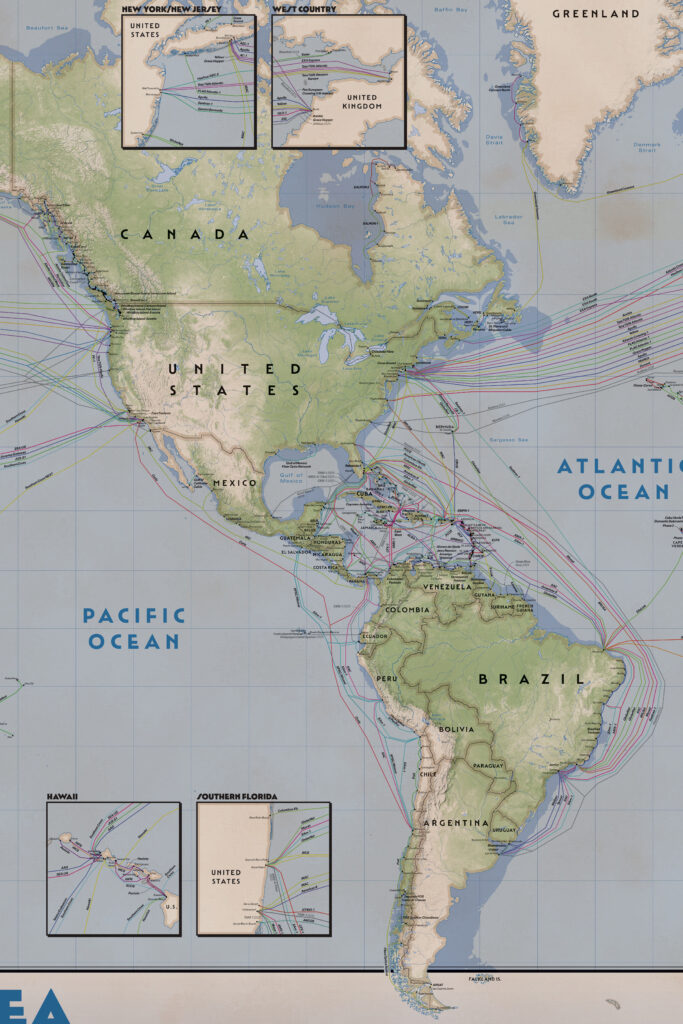
In the case of Chile, the country has comparative advantages for the security of its submarine cables, such as the depths of its waters and the relatively distant location from major nodes. However, it also presents vulnerabilities, such as having few connections.
Within weeks, submarine fiber optic cable cuts have been reported from the Baltic to the Western Pacific, involving commercial vessels linked to China and Russia.
During last Christmas, the tanker “Eagle S,” part of the “ghost fleet” transporting Russian oil subject to sanctions, was identified as responsible for damaging the Estlink-2 cable, which connects Estonia and Finland. According to the maritime registry agency Lloyd’s, it was carrying sophisticated electronic equipment to monitor naval activities.[1].
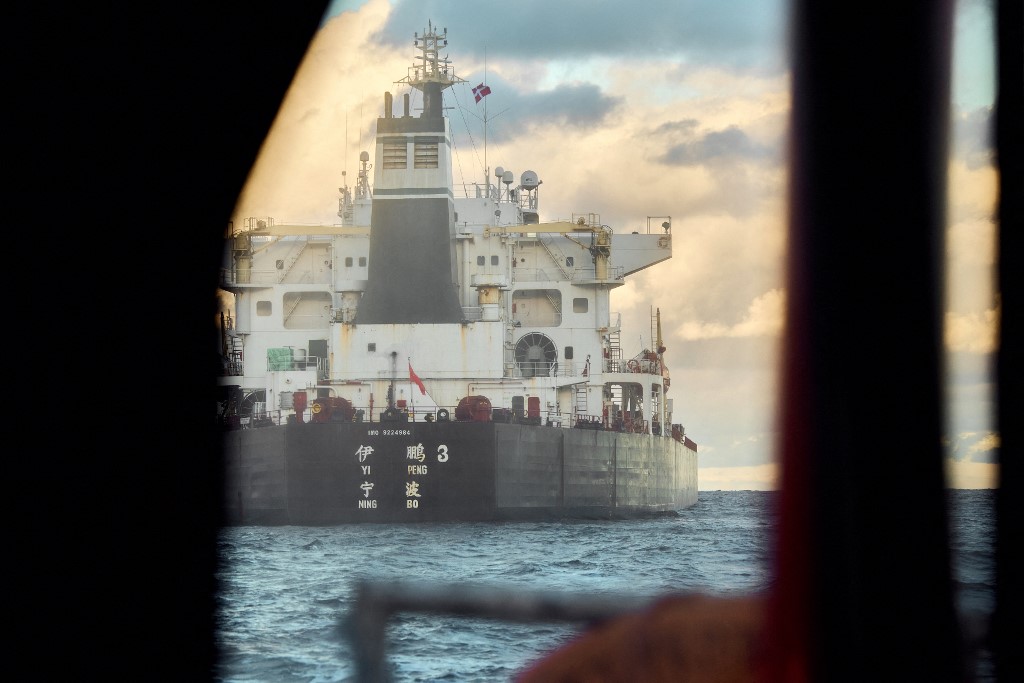
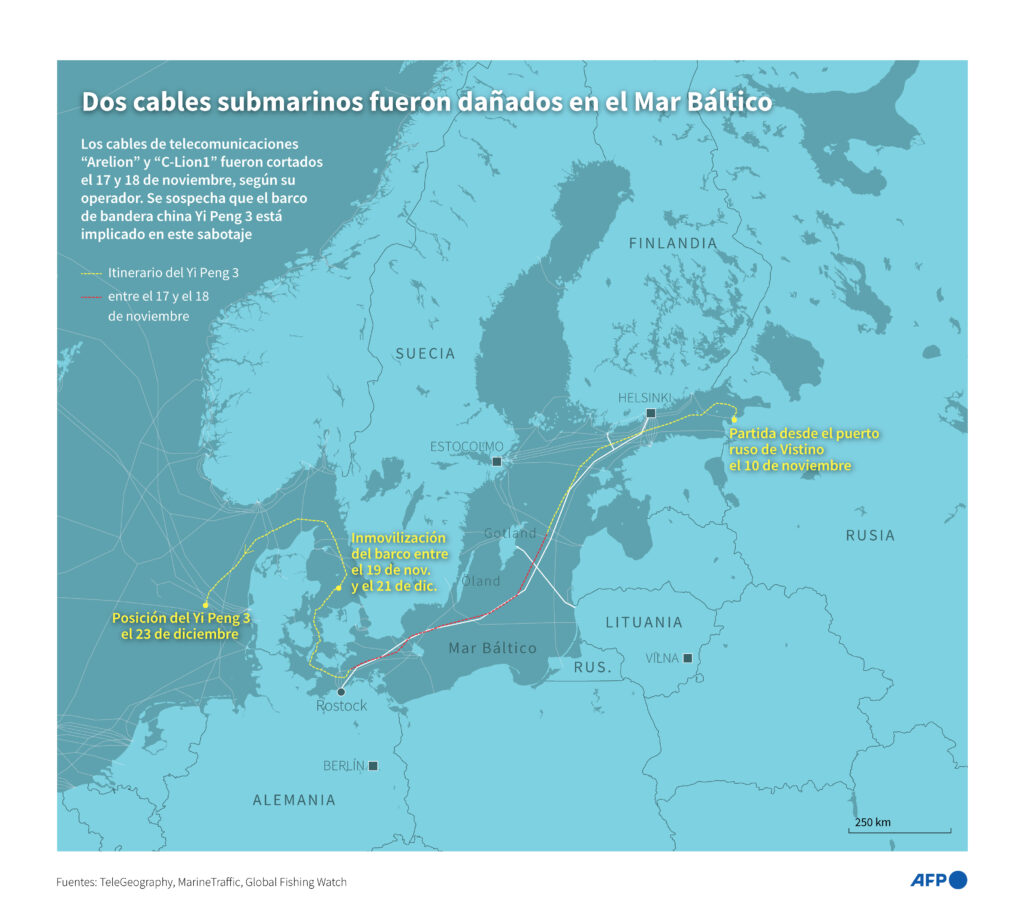
Two weeks earlier, also in the Baltic, a 1,170-kilometer communications cable between Finland and Germany was cut, as well as a 218-kilometer Internet link between Lithuania and the Swedish island of Gotland. This time, the Chinese freighter “Yi Peng 3” was pointed out, which, after leaving the Russian port of Ust-Luga, allegedly sailed a route that coincides with the locations where the interruptions were recorded.
In both cases, the tactic would be the same: dragging the anchor with the chain to cut the cables, taking advantage of the fact that this inland sea has an average depth of only 57 meters and that these communication lines have a diameter of eight centimeters.
As 2025 approached, the Coast Guard of Taiwan received a report from a telecommunications company indicating the cut of a submarine cable off the northeastern coast of the island. The involvement of the freighter “Shunxin-39,” which belongs to a Chinese shipowner, is under investigation.
All these incidents, whether related or not, demonstrate the growing vulnerability of submarine fiber optic cables through which 97% of global communications are transmitted and daily financial transactions worth 10 million trillion dollars are recorded.[2]. Although there is no alternative for them, due to the volume of data they can transport—the current satellites are insufficient—their location in isolated and poorly monitored areas is publicly available to anyone.
Given that the barriers to entry at sea for causing sabotage are very low, and generally difficult to prove, not only states can cause disruptions through direct or indirect means, such as seemingly harmless commercial and fishing vessels, but various non-state groups are also capable of carrying out such actions. In March 2024, Houthi rebels in Yemen were accused of cutting four cables in the Red Sea, affecting 25% of the data traffic flowing between Asia and Europe.
While the protection of underwater infrastructure has become an increasing concern within the realm of maritime security, the United Nations Convention on the Law of the Sea[3] is not very robust on this matter and is somewhat outdated, as it dates back to the early 1980s. Article 113 grants states the authority to impose penalties on those who commit the offense of “willfully or negligently causing damage to a submarine cable located on the high seas, by a vessel flying its flag or by a person subject to its jurisdiction, in such a way as to interrupt or obstruct telegraphic or telephone communications…” The problem is that the crime scene is tens of meters deep.
Although the tactic of cutting submarine cables to disrupt enemy communications is not new—it was widely used in World War I and even in the Pacific War in 1879—it is now framed within the activities of “gray zones,” characterized by their ambiguity, incremental nature, and ease of denial. Essentially, these are coercive measures carried out by states and third parties that do not involve the use of military force and fall below the threshold of war. This allows for tactical or strategic gains without incurring the costs of confrontation. Some prefer to refer to it as one of the many forms of “hybrid warfare.”
Freighter “Yi Peng 3.” Photo: France Presse
Given that such actions have become increasingly frequent, European countries, such as France, have developed a specific strategy regarding seabed resources[4], while others, like the United Kingdom, are building or transforming commercial vessels specialized in platforms to monitor underwater infrastructure, such as the “HMS Proteus”[5].
However, not all countries are equally exposed to these deliberate cuts. It is logical that the more connections a state has or the more critical it is in terms of security, the greater hostile actions it may attract. “While a total information cut remains an unlikely scenario for countries with multiple cable connections, the issue is more critical for small islands or states with weak connections, where the cut of a single cable can cause greater damage,” warn maritime security experts Christian Bueger and Timothy Edmunds in Understanding Maritime Security (2024).
In the case of Chile, the country has comparative advantages for the security of its submarine cables, such as the depths of its waters and the relatively distant location from major nodes. However, it also presents vulnerabilities, such as having few connections, something that is expected to change when Google completes the laying of the link between Chile and Australia and when it connects Puerto Williams to Antarctica (the feasibility study was awarded to a consortium comprising Salience Consulting from Dubai and Pioneer Consulting from the United States). Readers would likely be surprised to know how easy it is to find the point that connects the cable to land.
Given all that has been observed, ensuring the security of these critical infrastructures will become even more relevant and complex than it already is for the country, the region, and the world. The signs are evident; hopefully, someone is paying attention.
[1] Lloyd’s List (12/27/2024). “Russia-linked cable-cutting tanker seized by Finland ‘was loaded with spying equipment.'” Available at: https://www.lloydslist.com/LL1151955/Russia-linked-cable-cutting-tanker-seized-by-Finland-was-loaded-with-spying-equipment?s=08
[2] Policy Exchange (2017). “Undersea Cables: Indispensable, Insecure.” Rishi Sunak. Available at: https://policyexchange.org.uk/wp-content/uploads/2017/11/Undersea-Cables.pdf
[3] United Nations Convention on the Law of the Sea. Available at: https://www.un.org/depts/los/convention_agreements/texts/unclos/convemar_es.pdf
[4] “Ministerial Strategy for Managing Seabed Resources” (2022). Available at: https://www.defense.gouv.fr/sites/default/files/ministere-armees/20220211_GT%20MAITRISE%20FONDS%20MARINS_dossier%20de%20presse.pdf
[5] More information about the “HMS Proteus” at: https://www.royalnavy.mod.uk/organisation/units-and-squadrons/support-ships/rfa-proteus