Scope of China's "National Security Strategy in a New Era"
This article was translated automatically and may contain differences from the original. For reference, read the original.
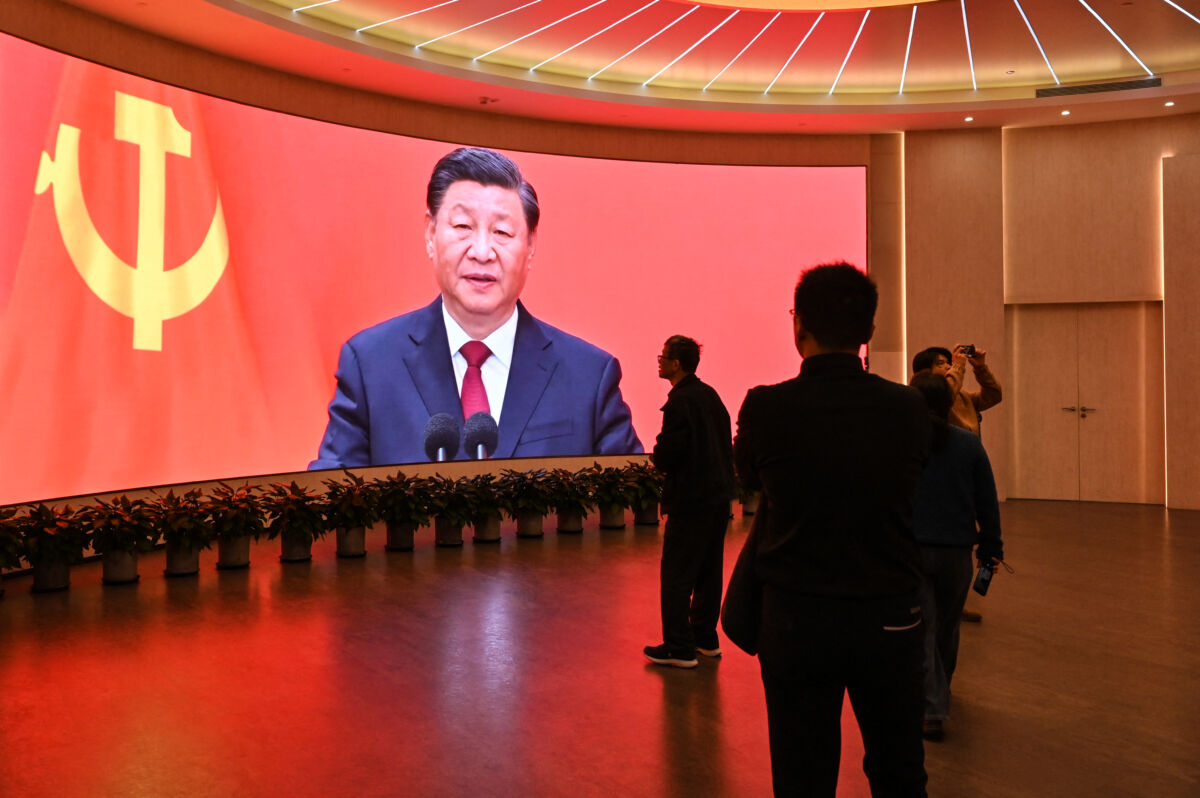
Imagen del presidente de China, Xi Jinping, mientras la gente visita el Museo del Primer Congreso Nacional del Partido Comunista Chino en Shanghái el 27 de febrero de 2025 (France Presse).
A significant shift in China’s international behavior occurred on May 12, when the State Council Information Office released its “National Security Strategy for a New Era.”[1]. This event is particularly relevant as it marks the first time Beijing has made such a document public. The publication comes at a crucial moment characterized by the urgency of a new world order marked by volatility and instability. Although there have been rumors about national security forecasts adopted as early as 2021, this is the first official text to come to light.
Below is a brief summary of the most relevant aspects of the aforementioned document.
GENERAL ASPECTS
- Xi Jinping’s doctrine introduces the concept of “comprehensive national security.”. First mentioned in 2014 by the Central National Security Commission—established by Xi himself—this notion is extremely broad, encompassing political, territorial, military, financial, cultural, societal, scientific, technological, ecological, polar, biological, and spatial aspects, among others. While this conceptual expansion is similar to what is observed in the West, where the meaning of security has also broadened without deepening, the Chinese strategy emphasizes that, although it recognizes this breadth, it does not seek to secure or protect everything. Its goal is, instead, to strengthen a national security system conceived as holistic and systemic..
- The document also introduces the idea of “political security,”, whose main objective is the preservation of the socialist regime with Chinese characteristics, including its leadership and constitutional order. This notion is integrated across all areas of government, serving as a guiding concept to permanently benefit Chinese national interests and being key to achieving the main security objectives.
- A third key point is the close relationship identified between “security and development.”. These elements, fundamental to the state as a political organization, are essential for achieving the common good and citizen well-being. There is full agreement with the Western conceptualization regarding the primary role of the state in this aspect. The text clarifies that national development requires a high level of security and, conversely, a high level of security strengthens development.
- In line with the above, the strategy underscores the urgent need to modernize state structures, both institutionally and legally, to form a “national security structure.”. In this framework, the strategy serves as a means to achieve the main objectives aligned with Chinese national interests, or more precisely, those of the Chinese Communist Party. This fully aligns with the current efforts of major Western democracies, which have also adopted national security structures to more effectively address the risks, threats, and opportunities of the new international order.
ABOUT THE CONTEXT
China’s security strategy, in its content, draws attention to three aspects of the international context that need to be highlighted:
- First, China perceives itself as a source of “stability and certainty” in a turbulent, volatile, and unstable world. It also positions itself as a defender of globalization, albeit not unconditionally, when it is used to affect its own national interests. It describes its purpose of advancing toward an irreversible historical trend of peace, development, cooperation, and mutual benefits derived from interactions between states. In passing, it envisions the “Global South” as a force that can provide stability to the international system.
- Second, it explicitly states its goal of achieving the integration of Taiwan through peaceful reunification into one China. In this regard, it asserts that its national interests are non-negotiable in the cases of Taiwan, Hong Kong, Xinjiang, Tibet, and its maritime rights. Despite the above, it expresses its intention to be an actor that promotes regional stability through dialogue and economic interaction with them.
- Third, the document highlights the need to build resilient global supply chains and achieve adequate food self-sufficiency, which would translate into increased investments in technology and storage systems. It also considers the implementation of an energy diversification policy and an increase in investment in critical minerals to be central, given their relevance for development. These actions are complemented by initiatives to reduce external dependence, particularly in key technological sectors, thereby decreasing reliance on foreign technology.
- Fourth, the text reveals a constant and manifest aspiration to establish a moral authority to govern its conduct. It argues that excessive reliance, whether on military power or on the mere benevolence of civil government, can undermine progress and national interests. Therefore, the central strategic objective is to achieve an optimal balance between these two aspects..
PRIORITIES
The main priorities inferred from the document are driven by the pursuit of a healthy balance between national security objectives and those related to development itself. Upon reviewing the text, the following strategic priorities emerge:
- Ensuring the survival of the Chinese Communist Party and its governing regime, as well as the stability of the socialist system with Chinese characteristics.
- Defense of national sovereignty, territorial integrity, and national unity.
- Strengthening capabilities against external and internal threats, with special emphasis on foreign intervention, separatism (Taiwan, Hong Kong, Xinjiang, and Tibet), terrorism, and religious extremism.
To this end, the strategy considers it relevant:
- To have a robust early warning system, as well as ongoing monitoring of risks and threats to national security.
- To establish an adequate strategic reserve of essential materials, thereby ensuring development and strengthening self-confidence.
- To possess a robust resilience capacity in urban infrastructure and disaster response, in the context of a global climate change.
- To ensure a stable macroeconomic environment to mitigate financial fragilities and systemic risks.
Overall, it aims to build a powerful security shield against unpredictable threats (black swans) or those categorized as having a high probability of occurrence (gray rhinos), while additionally minimizing exposure to potential foreign sanctions or disruptions in supply chains.
RISKS
Another interesting aspect to highlight is the identification of risks in this “holistic” security vision. As stated, China recognizes an increasingly uncertain and unstable international environment, with intertwined contradictions and risks, offering an alternative of common stability and security. It characterizes the scenario as one presenting a deficit of peace, security, and global governance, in which geopolitical conflicts have intensified.
This document emphasizes that China does not limit threats and risks to traditional aspects but broadens the spectrum to include other non-traditional natures. Among the traditional threats, it directly and vigorously addresses Western pressures to contain China, as well as the growing regional tensions in the Asia-Pacific, resulting from alliances and military deployments by extra-regional states. It takes on the task of denouncing interference in China’s peripheral affairs (borders) and in issues it considers internal, among which the previously mentioned Taiwan—above all others—Xinjiang, Tibet, Hong Kong, and conflicts in both the South and East China Seas stand out.
Regarding non-traditional risks and threats, the scope is very broad. On one hand, there are terrorism, separatist movements, and religious extremism, all issues that have long concerned the Chinese regime. On the other hand, it identifies aspects related to ecological security, food security, energy security, pandemics, among others. Similarly, it recognizes that its interests face risks in cyberspace, polar regions, deep seas, and outer space, which transcend the immediate spaces of Chinese territory.
RELATIONS WITH THE WORLD
China asserts that it plays an important role in the world by promoting peace, stability, and international cooperation, advocating the concept of “common, comprehensive, cooperative, and sustainable security.” In this sense, it reiterates that it does not pursue hegemony and criticizes, of course, the power aspirations of other powers, labeling them as ideas characteristic of the Cold War, from the past.
In this way, China proposes that its relationship with the world would be based on mutual respect and the rules of the international system.
The document highlights some special references. First, Russia. It mentions the comprehensive strategic cooperation partnership, which is being deepened vigorously, as it is based on non-aligned, non-confrontational states that are not directed or influenced by third parties. Regarding the United States, it emphasizes the need to maintain principles such as mutual respect, peaceful coexistence, and cooperation. However, it also identifies friction points in the relationship with Taiwan, highlighting that it would be “unwise and undesirable to contain China and that such an effort will not succeed.” On Europe, concepts such as “partner” or “pole of development in a multipolar world” are expressed, supporting the strengthening of its strategic autonomy. As for what it defines as the “Global South,”, it commits its actions to promote the “cause of the Global South” in strengthening global governance, addressing issues that affect them, and maintaining a stable situation for peace. Lastly, and briefly, it supports “African countries in improving their capacity to maintain peace independently” and “Latin American and Caribbean countries to oppose external interference, maintaining their own peace and stability.”
FINAL CONSIDERATIONS
- China ultimately articulates its National Security Strategy, including definitions, interests, and priorities, and sets some “red lines” on issues it considers internal, such as Taiwan, Tibet, and Xinjiang, among others.
- In this exercise, China addresses not only the concept of national security but also national interests, risks and threats, national security structure, and the close relationship between security and development, where the central role of the Chinese Communist Party is evident.
- China identifies an unstable and uncertain international context and positions itself as a power called to promote the idea of common security, being key to achieving stability.
- Among the risks and threats, it identifies both external and internal, traditional and non-traditional, evidencing a broad spectrum of its conception of security, which includes aspects such as food, energy, and ecological security.
- It seems to intend to lead the so-called “Global South,” acting as a unifier of demands and guardian of the less fortunate; however, the document gives relatively little importance to the Latin American and African regions.
- There are certain contradictions in some aspects, such as promoting democracy in a one-party state, or when emphasizing the importance of respecting international norms and, a few pages later, praising the relationship with Russia, a state that invaded Ukraine.
John Griffiths
Marcelo Masalleras
May 23, 2025
[1] http://english.scio.gov.cn/m/whitepapers/2025-05/12/content_117870467.html