Anchors and Recycling of Violence in Colombia
This article was translated automatically and may contain differences from the original. For reference, read the original.
- by Juan Pablo Toro
- Strategic Affairs
AFP
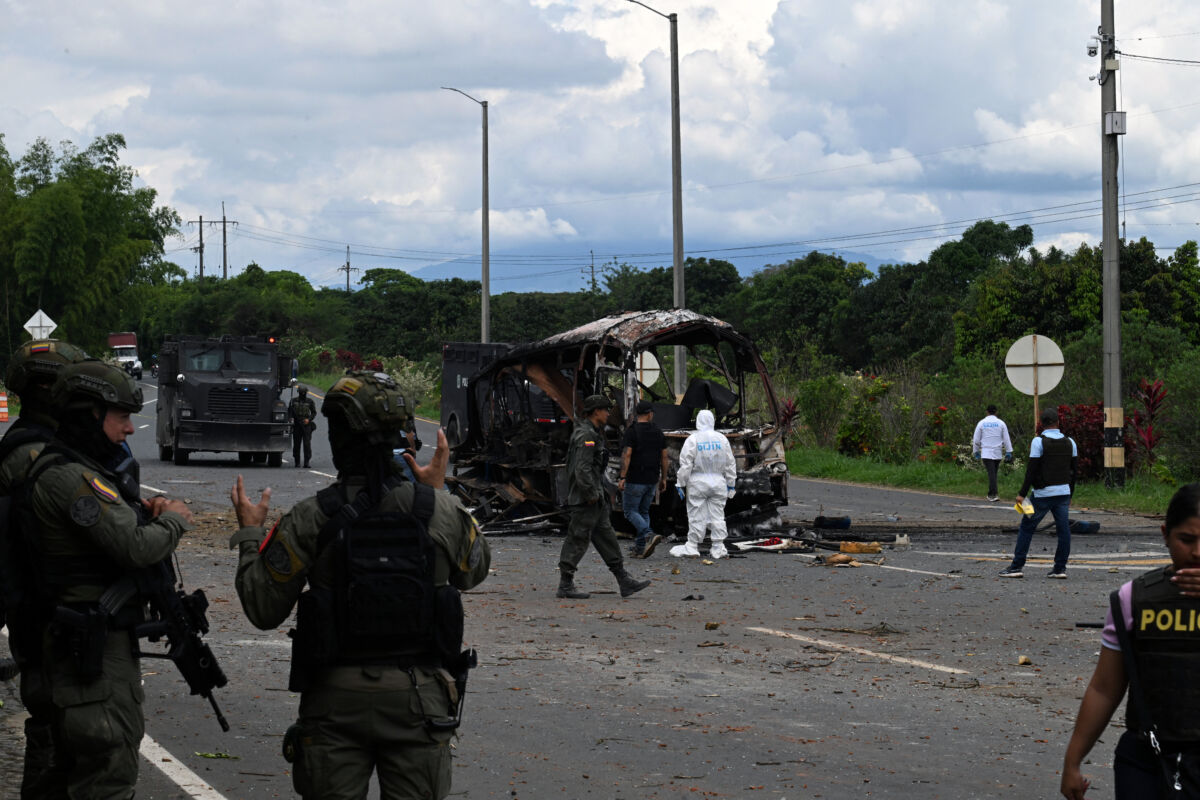
The recent assassination attempt against presidential candidate Miguel Uribe has brought back memories of the past in Colombia, recalling political campaigns stained with blood due to the actions of drug cartels, guerrillas, and paramilitary groups. This is reminiscent of the 1989-1990 period, marked by the assassinations of three presidential candidates (Luis Carlos Galán, Bernardo Jaramillo, and Carlos Pizarro Leongómez), or the events of 2002, when the Revolutionary Armed Forces of Colombia (FARC) attacked a convoy of Álvaro Uribe, who would later become president.
As Miguel Uribe fights for his life and investigations are underway into the criminal networks behind the minor who attempted to take his life, the incident underscores the security conditions during the government of leftist President Gustavo Petro, where concerning and contradictory trends are evident.
According to official statistics, in 2024, the homicide rate was 25.4 per 100,000 inhabitants, the lowest since the 1990s.[1] This rate has been declining since the government of Álvaro Uribe (2002-2010), who effectively broke the trend with his policies of direct confrontation against narco-insurgencies. Approximately 13,400 homicides were recorded the previous year.
On the other hand, coca cultivation has reached a historic high of 253,000 hectares, with an estimated production of 2,700 tons of cocaine, according to data from the United Nations Office on Drugs and Crime.[2]. The number continues to rise and far exceeds the just over 50,000 hectares that existed in the mid-2000s, when Plan Colombia, sponsored by the United States, was in full swing with its aerial herbicide fumigations.
Following the demobilization of the FARC in 2016, as a result of the peace process led by the government of Juan Manuel Santos (2010-2018), armed groups have multiplied, and their behavior today is more aligned with regional than national logics related to the illicit economies that sustain them. In the rush to dismantle what was then the largest leftist guerrilla group in the country, the state was unable to cover all the territories where that rebel group had a presence, leading to the entry of other actors to take control or for some fronts to decide to remain armed.
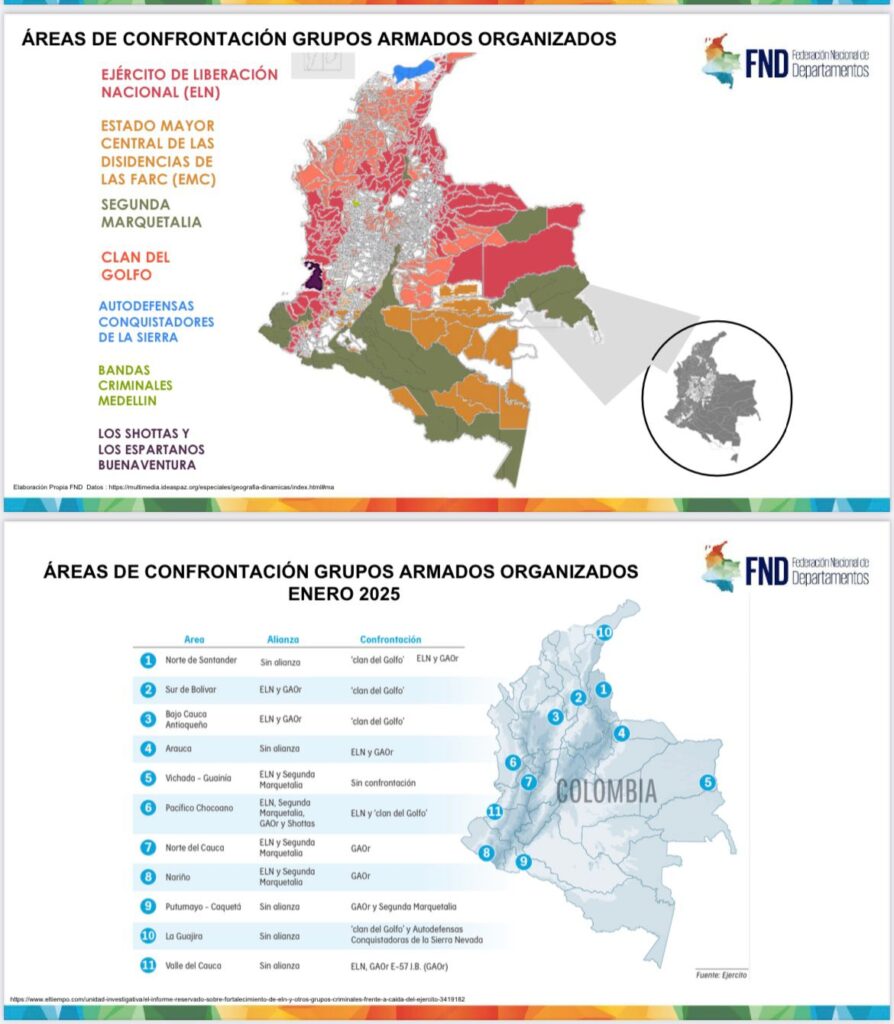
A security report from the National Federation of Departments (FND), released earlier this year, identified the presence of 12 theaters of confrontation in the country, where a strengthening of the National Liberation Army (ELN) guerrilla is evident. Additionally, several dissident factions of the FARC, the Gulf Clan, and other criminal groups are operating.[3]. It is estimated that the total number of armed individuals comprising the various illegal structures could exceed 20,000.
At the same time, military and police forces have experienced a reduction in size following the demobilization of the FARC, as well as budget cuts. There have also been successive resignations of high-ranking officials since Petro took office, a former demobilized guerrilla from the M-19.
A military intelligence report published in the newspaper El Tiempo stated that, if in 2012, the second year of Santos’ presidency, the Army had 242,350 personnel, the current figure is around 177,800 soldiers.[4]. Budget cuts in Defense and Security[5], resulting from the fiscal constraints facing the country, have also severely impacted Colombia’s air fleet, leaving helicopters grounded due to lack of fuel and maintenance, and reducing the number of anti-narcotics operations by the police. Additionally, U.S. aid has declined.
When analyzing the structural factors of the armed conflict during the period from 1948 to 2016, the presence of a closed democracy and the lack of state presence throughout the territory were identified. While the first factor has been overcome with the opening of political participation spaces and the popular election of authorities at all levels, the second has yet to be resolved. The drug trafficking industry, which was seen as a rather circumstantial variable fueling the internal war as a means rather than an end in itself, has now become a structural element. The more the drug business thrives, the greater the availability of money, thereby increasing the firepower of armed groups.
For all the above reasons, the current situation presents an explosive combination of rising cocaine production with a “Balkanization” of the conflict, amid a reduction in the size of military and police forces, along with available resources. Furthermore, the failure of Petro’s ambitious “Total Peace” initiative to attempt to demobilize all armed groups simultaneously, following the steps agreed upon with the FARC, is evident, as is the lack of clarity regarding his government’s security strategy leading up to August 2026. Reactively, the president has even been compelled to declare a “state of internal commotion” to address the effects on the civilian population from the intense fighting between the ELN and FARC dissidents near the border with Venezuela. The head of state has also called for national mobilizations when Congress blocks his reforms, fueling polarization that does not contribute to social peace.
Thus, violence in Colombia appears to be recycling under new forms (state versus armed groups; illegal armed groups fighting among themselves; armed groups pressuring the civilian population, etc.), resulting from factors that seem to be anchored in time, such as the lack of state presence throughout the territory (1.1 million km2) and the existence of profitable illicit economies led by cocaine production. Preventing a further deterioration of security is the task of Petro’s administration for the remainder of his term and will certainly be a duty of the next head of state. The criminal groups apparently behind the attack on Miguel Uribe have already made this clear, in case anyone still had any doubts.
[1] https://www.larepublica.co/economia/presidente-gustavo-petro-dijo-que-la-tasa-de-homicidios-en-colombia-ha-disminuido-4126728
[2] https://www.unodc.org/rocol/uploads/res/noticias/colombia/monitoreo-de-territorios-con-presencia-de-cultivos-de-coca-2023_html/Resumen_ejecutivo_2023_07112024_BAJA.pdf
[3] https://www.elcolombiano.com/colombia/confrontacion-armada-en-colombia-12-frentes-activos-segun-informe-de-la-fnd-MG26465876
[4] https://www.eltiempo.com/unidad-investigativa/el-informe-reservado-sobre-fortalecimiento-de-eln-y-otros-grupos-criminales-frente-a-caida-del-ejercito-3419182
[5] https://www.elnuevosiglo.com.co/politica/pesar-de-desafios-en-seguridad-las-fuerzas-militares-les-han-recortado-70000-millones-de