Update on the Middle East Conflict: Quo Vadis Peace Process
This article was translated automatically and may contain differences from the original. For reference, read the original.
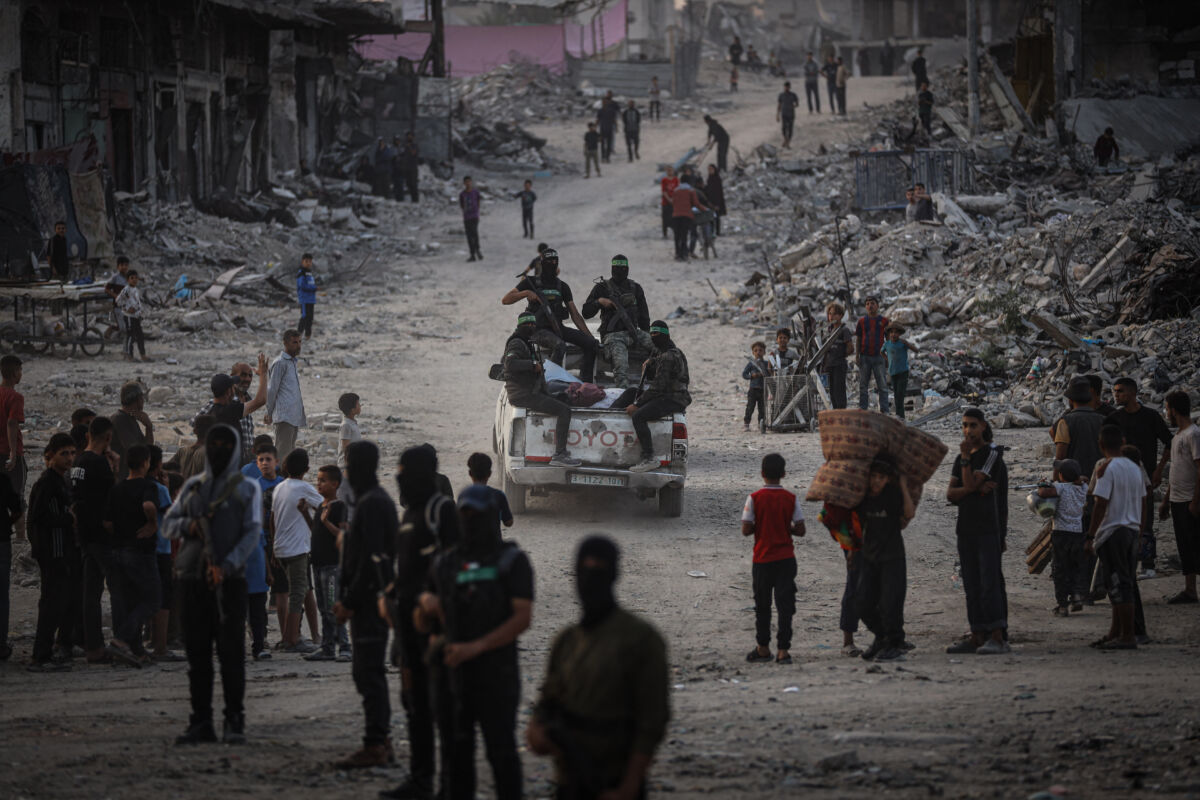
The gradual withdrawal of the Israel Defense Forces from Palestinian territory must occur alongside the demobilization and effective disarmament of Hamas and other armed groups, which presents a significant challenge.
Following the ceasefire achieved on October 10, the first phase defined in the ceasefire and peace process plan is still underway. Israel has withdrawn to what is referred to as the first line, maintaining control over 58% of the territory in the Gaza Strip, covering a total area of 365 km.2.
According to the plan proposed by the United States and accepted by various actors, Israel will withdraw its forces and assets in three phases: the first phase of withdrawal has already been executed; the second phase of withdrawal is about to begin, and the third phase should lead to the establishment of a security zone, as shown in the following image.
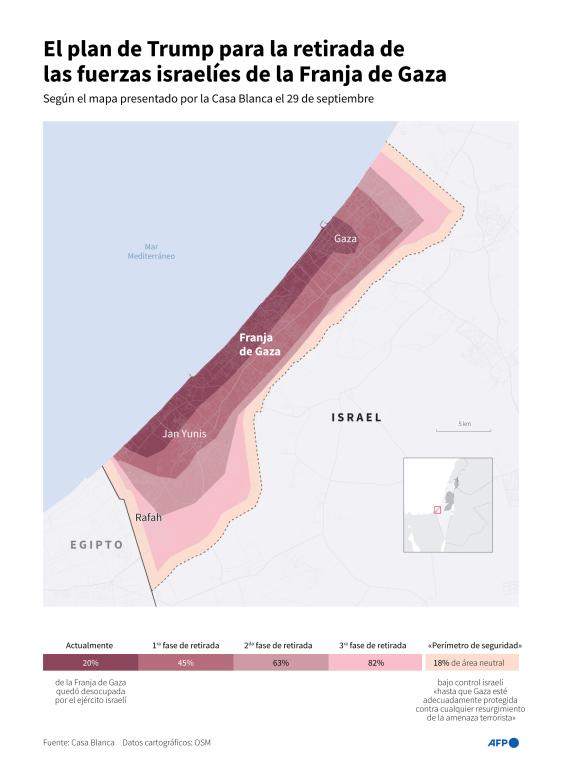
The withdrawal phase to the first line is still in process, as it included the release of all hostages in its possession— a task that has been completed— as well as the return of all deceased hostages’ bodies; a commitment that remains pending, as eight bodies are yet to be delivered as of November 5.
The second phase of withdrawal involves the mobilization of an International Stabilization Force (ISF) to oversee security and support the Palestinian police, while Israeli troops withdraw further from Gaza.
The third and final phase involves the withdrawal of the Israel Defense Forces (IDF) to a designated security zone under their control, while an international body should oversee governance in the Strip, as well as the transition of the process.
Earlier this week, the resolution that President Donald Trump will present to the United Nations in the coming days was made public. It proposes a two-year international government, as well as security control over the Gaza Strip. This resolution considers that, by the end of 2027, the Palestinian National Authority may assume power.
This international government should be— according to Trump— led by the U.S., along with other participating countries. This provisional authority, together with the international force, should be capable of securing the borders of the assigned geographical area, both with Israel and Egypt; ensuring the safety of civilians and designated humanitarian areas, while training the new Palestinian police agents.
The major question observed for advancing this proposal is that the plan requires the effective demobilization and disarmament of the remnants of the Hamas group as a prerequisite for the success of this plan. The objective has not yet been achieved, as neither Hamas nor other armed groups in the Strip have been disarmed to date. Additionally, the existing terrorist infrastructure should be destroyed; essentially, the tunnels and command posts, to then prevent the reconstruction of these capabilities. Since the ceasefire, there have been clashes with remnants of Hamas that have attacked the IDF, triggering a focused military response from the latter.
From an economic and political perspective, this plan proposed by the President of the United States considers creating a transitional government endowed with international legal personality. This is intended to develop the necessary economic budgets for an effective recovery of the Gaza Strip, until, within the indicated timeframe, the Palestinian Authority presents its own reform and governance program. The proposal establishes that any modification to the timelines or objectives will require consultation with Israel, Egypt, and the UN Security Council.
The proposal that we will learn about in detail in the coming days envisions a gradual withdrawal of the IDF, until their definitive withdrawal, which, however, considers a perimeter security presence in the hands of Israel.
As final considerations, we can express and reiterate that any plan intended to be established requires, in our view, the following initial conditions as basic premises:
- Demobilization and disarmament of the Hamas group, as well as other smaller forces operating in the Strip.
- Destruction of the terrorist infrastructure in Gaza (tunnels and command posts), from where logistical sites for rocket launches were even set up.
- Regional support and desirable participation from other Arab countries, as guarantors of the initiative and the peace process, without being clearly committed to either side.
- Greater unity and national cohesion in Israel regarding the various peace proposals to be considered.
In the medium term, a scenario would be desirable in which:
- Regional agreements for greater security and stability will be established; for example, the expansion of the Abraham Accords.
- The presence of the Lebanese government is consolidated in southern Lebanon (south of the Litani River), preventing the resurgence of Hezbollah, a group that has developed activities for its rearticulation in recent months, deriving resources and armaments from Syria.
It is acknowledged that, to date, we are still in the first phase, hoping that this will conclude with the fulfillment of the agreements, where the final considerations previously expressed in the preceding paragraph will be key to continuing to advance in this complex peace process. If not realized, we will once again be discarding a new attempt to seek peace in this complex area, where in the last two years there has been a notable geopolitical shift and confrontation of forces, which has raised a new possibility of generating a more stable regional order.