With an aircraft carrier in the Caribbean, the U.S. emphasizes the importance of securing its "third border"
This article was translated automatically and may contain differences from the original. For reference, read the original.
- by Juan Pablo Toro
- Strategic Affairs
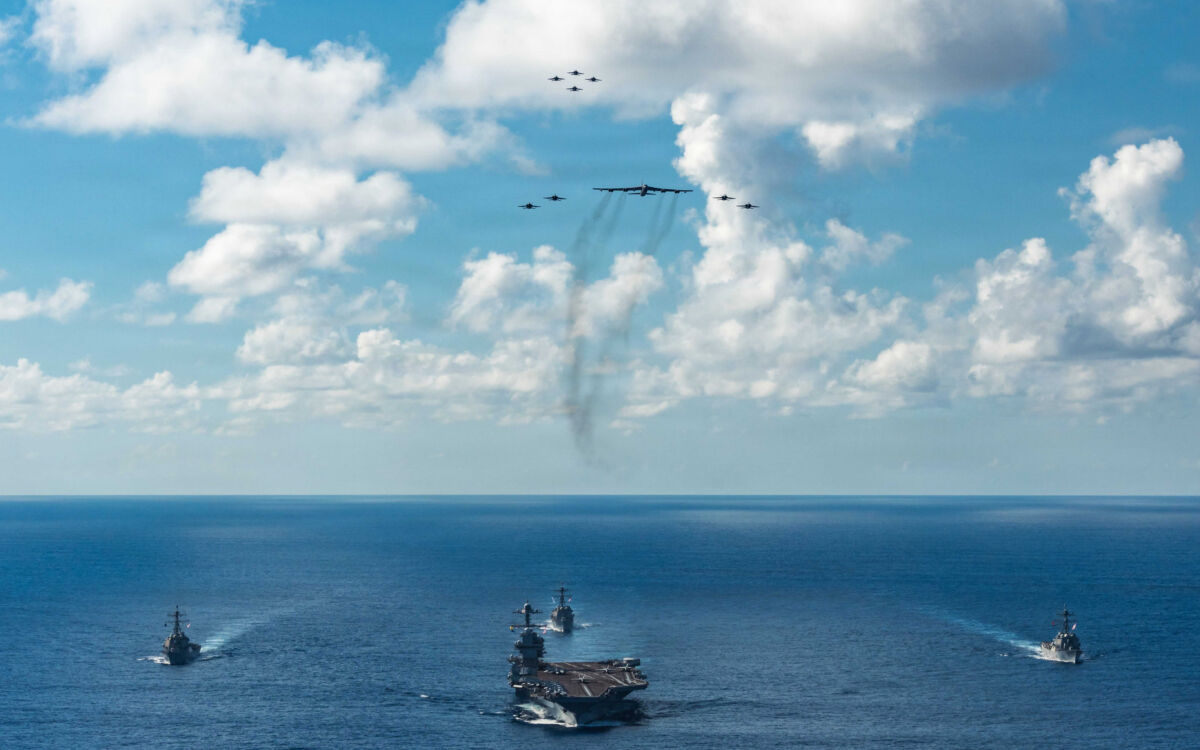
The deployment of the "USS Gerald R. Ford" aircraft carrier in the Caribbean intensifies the military encirclement of Venezuela, raising alerts in the country. Although the Pentagon justifies it as a counter-narcotics operation, the magnitude of the naval force suggests an interest in a possible regime change and seeks to reaffirm the U.S. sphere of influence in the Western Hemisphere.
The largest and most powerful warship in the world has just joined the U.S. Navy’s Fourth Fleet, further demonstrating that today there are no peripheral oceans or seas; all are central to the security of an interconnected world.
With the arrival of the “USS Gerald R. Ford” aircraft carrier and its battle group in the Caribbean, the military encirclement around Venezuela not only tightens but practically eliminates the possibility of defense for Nicolás Maduro’s regime, which is experiencing frantic days, amid announcements of popular mobilizations — which rarely occur — and desperate plans for resistance.
In fact, the Minister of Defense and head of the Bolivarian National Armed Forces, General Vladimir Padrino López, responded by raising military alert levels in Venezuela, which has been observing for over three months how the United States accumulates ships, planes, and Marines outside its territorial waters.
“This mission defends our homeland, eliminates narcoterrorists from our hemisphere, and protects our homeland from the drugs that kill our people,” announced Pentagon chief Pete Hegseth on platform X. “The Western Hemisphere is the neighborhood of the United States, and we will protect it,” he added.
While strong, the statements and reports from Washington regarding the final scope of “Operation Southern Lance” have been ambiguous, suggesting at the same time that Maduro’s days are numbered, that he may be trying to negotiate some exit, that there will be no ground attacks — much less an invasion like Grenada in 1983 or Panama in 1989 — or that a massive bombing campaign against military and logistical infrastructure used by traffickers is forthcoming.
Since President Donald Trump decided to apply the global war on terrorism approach launched by George W. Bush in 2001 to the war on drugs initiated by Richard Nixon in 1971, at least 20 vessels allegedly loaded with drugs have been attacked with missiles launched by drones and planes, resulting in over 75 fatalities. Respect for international legality when destroying suspicious vessels at sea has not hindered this campaign, mostly conducted in Caribbean waters, although the bulk of the cocaine traveling to the United States does so via the Pacific. However, the United Kingdom and Colombia decided to temporarily suspend intelligence sharing on illicit activities in the Caribbean with their American partners, while France directly criticized the validity of the actions.
While striking, the deployment of the aircraft carrier does not seem justified by the proximity of the United States to Venezuela — just two hours by commercial flight — and because this country has access to runways in the Caribbean, especially in Puerto Rico. Rather, it serves to reinforce the message of what will be the new show of force by the United States towards the Western Hemisphere. Essentially, the sphere of influence is being redrawn in the same place where the U.S. became an empire in the late 19th and early 20th centuries through a series of successive military interventions.
“Through unwavering commitment and the precise use of our forces, we are prepared to combat transnational threats that seek to destabilize our region,” stated Admiral Alvin Holsey, head of Southern Command, who made these remarks at a time when internal differences are reported within the U.S. government regarding the lethal actions being carried out in the Caribbean. “The deployment of the ‘USS Gerald R. Ford’ aircraft carrier strike group represents a fundamental step to reaffirm our determination to protect the security of the Western Hemisphere and U.S. territory,” Holsey added, who will leave his position in a month, completing just one year instead of the planned three.
What was once considered an “American Lake” ceased to be so in the first 25 years of this century as Washington focused its post-Cold War deployments in the Middle East and the seas near China. During this period, new dictatorships, such as those in Venezuela and Nicaragua, and old ones, like Cuba, opened their ports to countries like Russia, China, and Iran.
Frigates, cruisers, signal collection ships, and even a Russian nuclear-powered submarine have entered the Caribbean in the last decade on missions of flag display and monitoring of the U.S. fleet, raising growing concerns. Meanwhile, China is preparing to establish a special economic zone in Antigua and Barbuda, while Iran has supplied missile boats to the Venezuelan navy.
Although it is difficult to grasp, the Caribbean basin, with its 2,750,000 km², is larger than that of the Mediterranean and contains an interoceanic passage (Panama Canal); important cargo distribution ports, such as Colón (Panama), Kingston (Jamaica), and Freeport (Bahamas), and even territories of European countries (France, the Kingdom of the Netherlands, and the United Kingdom).
When the United States reconstituted the Fourth Fleet in 2008 within the jurisdiction of Southern Command, some socialist governments of the time raised their eyebrows with concern, but over time it became clear that it was merely an operational fleet and would not have its own assets. Indeed, it would incorporate vessels in the area with specific and temporary tasks.
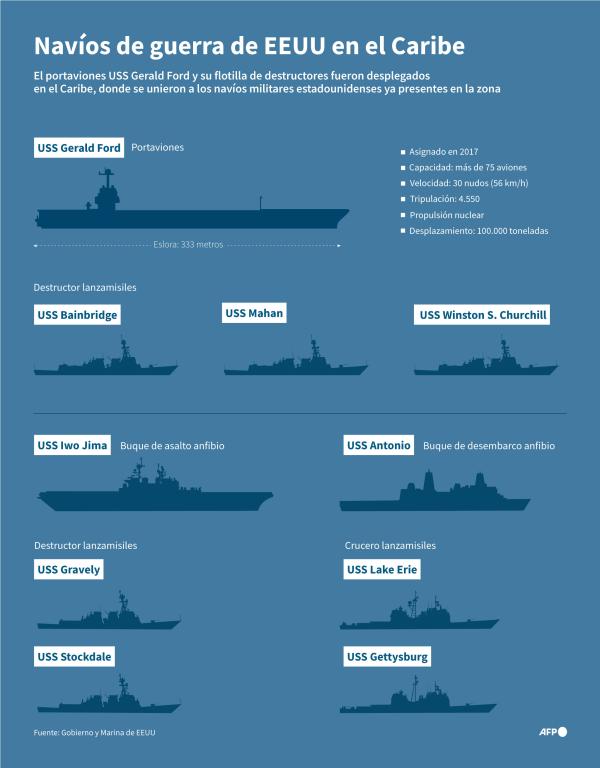
Now, with the addition of an aircraft carrier, which joins destroyers, amphibious assault ships, and other auxiliary vessels already positioned, the United States emphasizes the importance it assigns to its so-called “third border” in the Caribbean. It also escalates the crisis with Venezuela to levels not seen in decades and fuels expectations about the next step of the Trump administration against Maduro, whom it accuses of leading the so-called Cartel of the Suns, an organization considered “narcoterrorist” by Washington. Especially when the strength of the deployed naval power contrasts with the uncertainty about its final effects, as what began as a counter-narcotics operation now seems to be heading in another direction.
Juan Pablo Toro, Executive Director of AthenaLab
November 12, 2025