Securitization and State Failures in the Southern Macrozone
This article was translated automatically and may contain differences from the original. For reference, read the original.
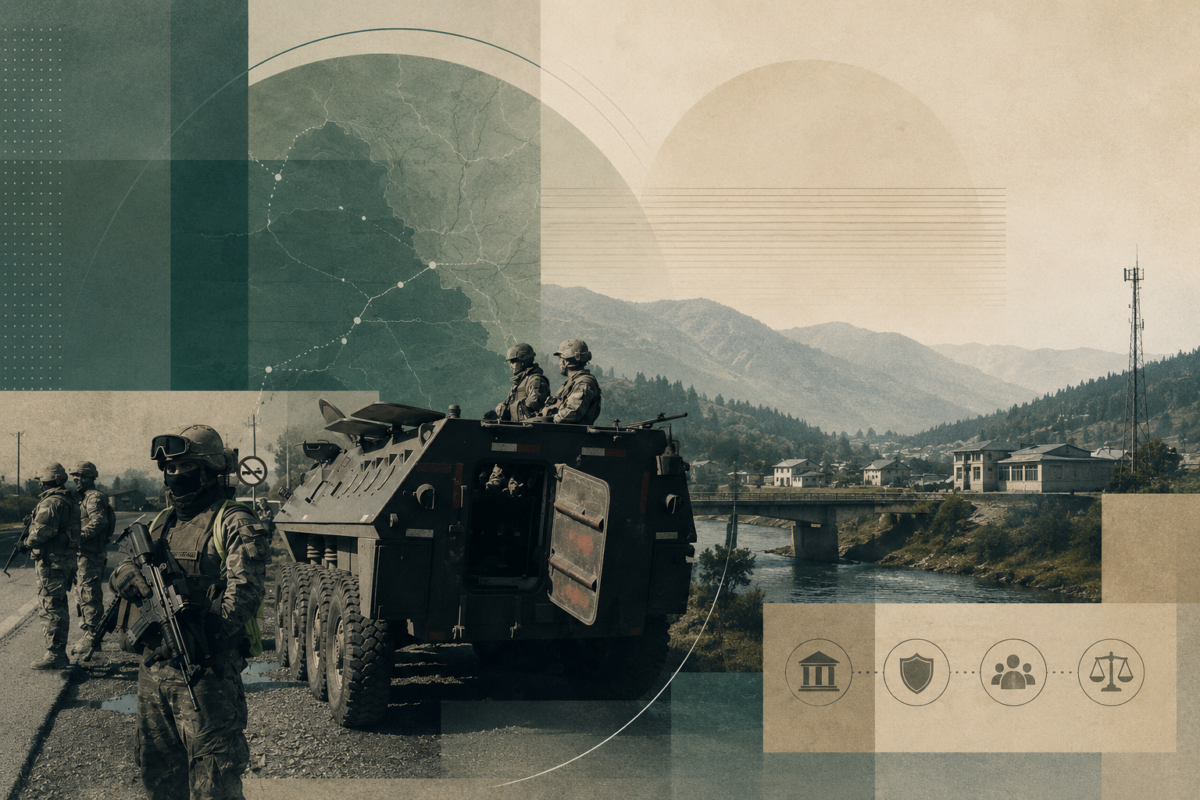
Chile has had military forces deployed in the Southern Macrozone for over four years. What began as a supportive measure in response to a sustained situation of violence has now extended into a permanent military presence. The initial political diagnosis framed the issue as an urgent security threat. However, after constant renewals of the state of emergency and the results of the Presidential Commission for Peace and Understanding, it is possible to assert that two distinct phenomena coexist in the Southern Macrozone. On one hand, there is an unresolved political situation in the relationship between part of the Mapuche people and the Chilean State, and on the other, the presence of criminal organizations that, taking advantage of the State’s gaps, commit various illegal acts under the umbrella of that conflict. Certainly, clarifying this diagnosis is important, as the response depends on it.
The theory of securitization[i] provides a useful framework for understanding this situation. This proposition indicates that when the state authority presents a political problem that should be addressed with the normal institutional framework of a state as an existential threat and manages to have public opinion accept it as such, a scenario is created where extraordinary measures are accepted. This is precisely the mechanism that operates in the Southern Macrozone. Phenomena such as terrorist actions and the presence of criminal organizations in areas with low state presence have been framed as existential threats, enabling a military response.
This analysis argues that militarization in the Southern Macrozone responds to a process of securitization that, while understandable as an initial reaction, has tended to shift a police and state presence problem towards a military logic that does not resolve the underlying causes of the phenomenon. The solution is not to withdraw the State, but to strengthen its public service and police capabilities, using military force as a temporary measure.
The Problem and the Exceptional Role of the Military
In the Southern Macrozone, two distinct phenomena coexist that public debate tends to confuse. On one hand, there is an unresolved situation in the relationship between part of the Mapuche people and the Chilean State, which has long-standing political, cultural, and territorial dimensions. On the other hand, the presence of criminal organizations has progressively established itself, which, taking advantage of the State’s gaps in that area, commit various illegal acts. What the evidence shows with greater consistency is that the sustained violence in the area is significantly associated with that second phenomenon. Criminal organizations have found in this territory a convenient space for drug trafficking[ii], systematic timber theft[iii] and extortion of farmers and transporters[iv] . These groups have used the narrative of the Mapuche conflict as cover, taking advantage of the political complexity of the issue to operate with less scrutiny.
The determining factor that has allowed this situation is the low state presence in the area. In particular, deficient public services and infrastructure in terms of coverage[v], insufficient police resources[vi] and the absence of coordinated and sustained state action in those territories[vii]. These shortcomings enable the problem and, therefore, are the axis from which the solution must be constructed.
In this context, the deployment of military forces has had a legitimate containment function. Given the insufficiency of available police capabilities and the urgency of restoring minimum conditions of order in some areas, military support has been a comprehensible response. In this regard, evidence indicates that the legitimacy of an extraordinary security measure depends on the coherence between the nature of the threat and the instruments used, as well as its institutional acceptance[viii]. Thus, the main problem is not the deployment of military personnel; the issue is not having used that time to build the capacities that should replace them.

The military are not organized or trained for criminal investigation tasks, everyday territorial control, or community work, as an effective police strategy would entail. Their presence can deter and contain, but cannot replace the work of police, prosecutors, judges, and state services (health, infrastructure, among others). If military presence becomes a permanent substitute for state presence, the result is a normalization of the exceptional that does not resolve the underlying problem and may generate unnecessary friction with communities.
An extraordinary security measure can be justified when the threat is real, ordinary alternatives have proven insufficient, the response is proportional to the threat, and when there are clear mechanisms to reverse it once the crisis is over[ix]. In the Chilean case, the first two conditions have been reasonably met. The violence in the area has been real and sustained, and police capabilities have been insufficient. However, the last two conditions remain pending, as the proportionality of the instrument concerning the nature of the problem (primarily criminal) is debatable, and the exit mechanisms from the exceptional situation have not been clearly defined.
Conclusion
Chile needs a strategy that clearly distinguishes criminal phenomena from the historical situation between part of the Mapuche people and the State, and that responds to each with the appropriate instruments. For the former, the response is police, judicial, and institutional, which requires greater resources, better equipment, increased police presence and justice system involvement, and specialized criminal intelligence. For the latter, the response is political, long-term, and involves the participation of other state actors and local communities. Confusing both dimensions produces inefficiency and weakens the consolidation of an effective state presence that guarantees security for all citizens in the area.
Military support can be maintained while these capacities are built, but it must be subject to a timeline and an explicit exit strategy. More than four years of a state of exception without a roadmap for strengthening civil capacities is not a security policy, but rather an indefinite delay of one.

The securitization of the situation in the Southern Macrozone has been, in part, a comprehensible response to a difficult reality. However, a comprehensible response is not necessarily a sufficient one. What Chile requires is not more exceptionalism, but more State; that is, greater police capacity, more institutional presence, and effective justice to confront organized crime and a long-term policy that addresses the unresolved historical situation. Military support can be maintained, but what cannot be delayed any longer is having a clear strategy to build the capacities that must replace it.
Securitization is ambivalent, as it offers benefits of control and order, but can become a substitute for the structural solutions that the problem demands. The challenge is not only to define when securitization is justified, but, above all, how to build the conditions for extraordinary measures to cease being necessary. Otherwise, the risk is that exceptionalism becomes normality, consolidating a deficit of state presence that no democracy can afford.
[i] Buzan, Barry; Wæver, Ole; and De Wilde, Jaap. Security: A New Framework for Analysis. Boulder: Lynne Rienner Publishers, 1998.
[ii] National Prosecutor’s Office of Chile. 2025. “Report on Organized Crime in Chile”. Santiago de Chile: Public Ministry of Chile. p. 23.
[iii] Radio Bio-Bío. “Seven sawmills formalized for receiving stolen wood in Bío Bío and La Araucanía.” July 18, 2025. https://www.biobiochile.cl/noticias/nacional/region-de-la-araucania/2025/07/18/formalizan-a-siete-aserraderos-por-receptar-madera-robada-en-bio-bio-y-la-araucania.shtml; Radio Bio-Bío. “147 arrested for timber theft in Los Ríos during 2024: seizures amount to $1.5 billion.” January 3, 2025.
[iv] EMOL. “Anti-terrorism law or project against organized crime: The debate on the tool to confront crimes in the Southern Macrozone.” November 11, 2022 https://www.emol.com/noticias/Nacional/2022/11/11/1078076/ley-antiterrorista-crimen-organizado-debate.html; La Tercera. “With support from GOPE, COP, and drones: OS-9 of Carabineros arrests a community member investigated for extortion in Ercilla.” August 5, 2025. https://www.latercera.com/nacional/noticia/con-apoyo-del-gope-cop-y-drones-os-9-de-carabineros-detiene-a-comunero-investigado-por-extorsion-en-ercilla/
[v] La Tercera. “Chile Offline: the inequality generated by the digital divide.” 2025.
[vi] EMOL. “Reduced Carabineros personnel: The reasons for the decline and proposals to reverse the complex scenario of the institution.” April 29, 2026.
https://www.emol.com/noticias/Nacional/2026/04/28/1198484/dotacion-carabineros-razones-propuestas-policias.html
[vii] Ministry of the General Secretariat of the Presidency. Presidential Commission for Peace and Understanding, “Final Report.” Santiago, 2025. pp 82-87. https://www.comisionpazyentendimiento.gob.cl/wp-content/uploads/2025/06/Informe-final_2da-edicion.pdf
[viii] Balzacq, Thierry. “The Three Faces of Securitization: Political Agency, Audience and Context.” European Journal of International Relations 11, no. 2 (2005): 171–201.
[ix] McDonald, Matt. “Securitization and the Construction of Security.” European Journal of International Relations 14, No. 4 (2008): 563–587.