The Next Earthquake Could Be Digital: Chile's Resilience Against Technological Fragility
This article was translated automatically and may contain differences from the original. For reference, read the original.
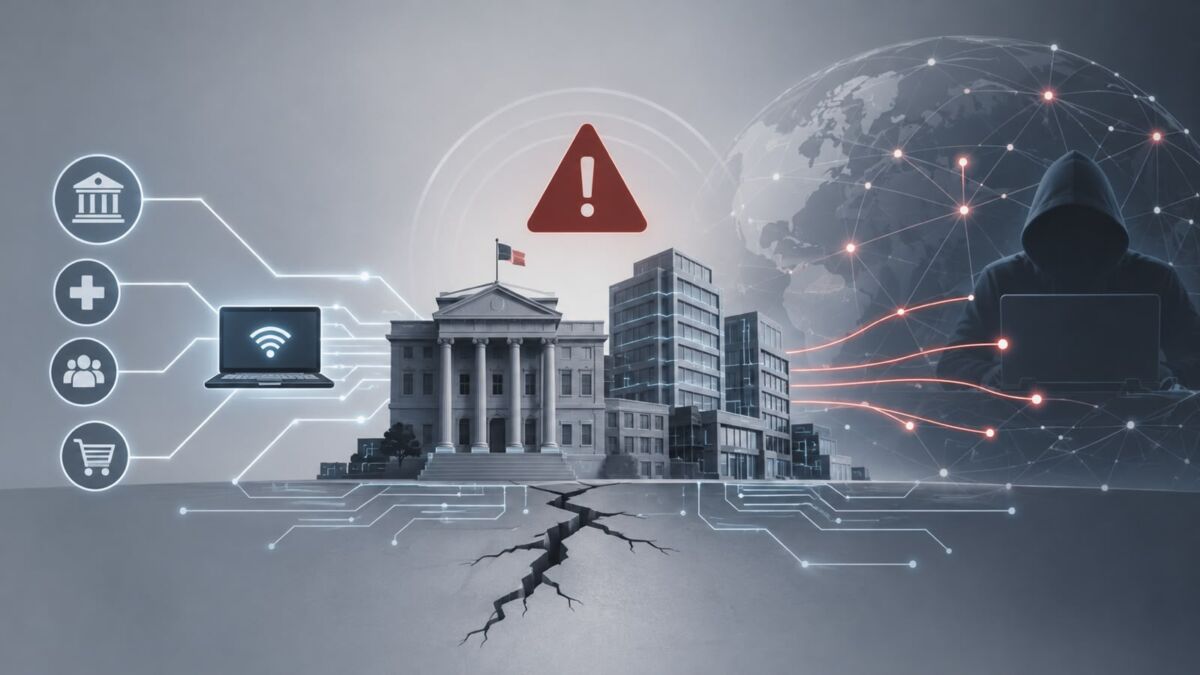
The digitalization of public and private services has increased the efficiency of contemporary societies, but it has also expanded their exposure to risks previously considered marginal.
On November 13, the Federal Aviation Administration (FAA) of the United States halted all departures in the country for over four hours1, while Microsoft faced one of the most extensive global service outages in its history2. None of these failures required the intervention of an attacker, revealing that reliance on digital systems constitutes a fragility capable of paralyzing critical services.
This structural fragility is compounded by the growing threat of cyberattacks enhanced by artificial intelligence, a technology that enables both state and non-state actors to exploit vulnerabilities more quickly, at a larger scale, and at a lower cost. In this scenario, a country’s digital resilience depends on society as a whole, and it is the state’s responsibility to coordinate the preparation and response of all its components. Certainly, Chile is not immune to this reality, and at least three plausible scenarios allow us to gauge its exposure.
The first corresponds to the interruption of a provider upon which all public agencies depend simultaneously, such as the State’s Secure Connectivity Network, or a cloud service relied upon by various private companies. The second is a nationwide failure in the electrical system, similar to the blackout of February 20253, whose effects would be amplified by disconnecting data centers that support public and private services. The third is a cyberattack executed with artificial intelligence tools against a vital operator, whose detection and attribution would test the institutional framework established by the Cybersecurity Framework Law. None of these scenarios require extraordinary assumptions, and together they reveal risks that exceed the capacity of any institution to confront them alone. The recent cases analyzed below, occurring in other countries and in Chile, demonstrate that the elements comprising these scenarios have already manifested separately.
2. RECENT CASES
The cases presented below are organized according to the origin of the interruption. The first group includes technical failures occurring without the intervention of an attacker; the second corresponds to attacks against non-critical sectors impacting the population, and the third examines how these threats manifest in Chile. Certainly, artificial intelligence intersects all three areas, as it tends to increase the number of connected devices, the scope of existing vulnerabilities, and the speed at which they can be exploited.
a. Technical Failures Not Associated with a Cyberattack
A significant part of digital fragility arises from the systems themselves, whether due to the obsolescence of their equipment or reliance on external providers whose failures cannot be compensated. In the case of the FAA in the U.S., the nationwide halt of departures occurred with approximately 3,500 aircraft in flight and caused thousands of cancellations across the United States. The Secretary of Transportation attributed the failure to outdated equipment that, upon receiving an excessive volume of data, provided inconsistent information to radar and communication systems4. Regarding the Microsoft outage, it originated from an internal failure of the provider and paralyzed government offices and businesses worldwide for nearly 24 hours5. This episode illustrates the first of the scenarios posed for Chile, as it demonstrates how the failure of a single technology provider simultaneously affects public agencies, businesses, and citizens. Both cases indicate that the obsolescence of systems and concentration on a few providers are risks that require attention comparable to that given to the deliberate actions of an adversary in cyberspace.
b. Attacks Against Non-Critical Sectors Impacting the Population
When this fragility is compounded by the hostile intent of an attacker, the effects directly reach the daily lives of the population. On November 2, a cyberattack against the refrigeration systems of supermarkets affected stores in several European countries. The attackers remotely altered the temperature of refrigerators and freezers to as high as 50 °C, forcing the disposal of large quantities of food6. This episode followed a similar attack in October in France, which affected hundreds of supermarkets through controllers manufactured by the Danish company Danfoss7. Some media outlets have linked these attacks to pro-Russian hacktivist groups, although their authorship has not yet been officially confirmed8. These cases show that an ordinary commercial device connected to the internet for remote management can become a pathway to disrupt the food supply chain. This raises the question of whether operators of equivalent systems in Chile are subject to security requirements comparable to those imposed by the Cybersecurity Framework Law on vital operators.
c. The Expression of These Threats in Chile
Recent incidents recorded in the country show that these global trends already have a national expression. Since the Cybersecurity Framework Law made incident reporting mandatory in March 2025, the National Cybersecurity Agency (ANCI) received 213 significant incidents by December of that year9. Between January and October 15, 2026, a similar duration period, the number rose to 566, representing a 166% increase; although part of this rise could be explained by the consolidation of the reporting obligation. During the first half of 2026, the State Administration accounted for the highest number of reports, followed by digital services and third-party managed technology providers, while data exfiltration or exposure was the most frequent impact10.
Two recent cases illustrate the potential impact of these incidents on essential services and critical infrastructure. In September 2026, the Clinical Hospital of the University of Chile filed a lawsuit following the leakage of personal data and test results of its patients, obtained through unauthorized access to its imaging platform11. On the other hand, since August 27, 2026, the Huatacondo solar park and its battery system have remained out of service due to a disconnection attributed to a cyberattack, the extent of which has yet to be clarified12. This latter case is particularly relevant, as it directly links cybersecurity with the stability of the electrical system, the area of the second scenario posed at the outset.
None of the described incidents have been attributed to the use of artificial intelligence. However, this technology has begun to reduce the cost and increase the speed at which adversaries discover and exploit vulnerabilities such as those exposed in these cases. According to the CrowdStrike 2026 Global Threat Report, the activity of adversaries enabled by artificial intelligence increased by 89% year-on-year13, a trend that is likely to be reflected in Chile as well.
Together, these cases show that digital fragility already affects various areas directly dependent on the daily lives of the population and that artificial intelligence tends to exacerbate it. In light of this reality, the relevant question for Chile is how to prepare to face its consequences before they occur.
3. WHAT DO WE NEED TO DO?
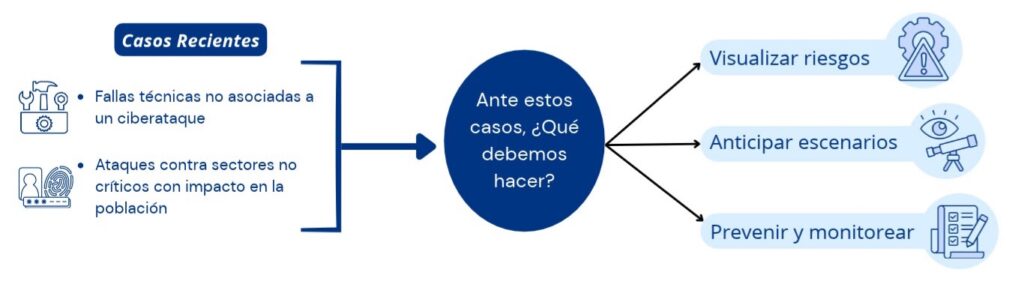
The need for action becomes more urgent when considering the advances necessary for the modernization of the Chilean state. Law 21180 on Digital Transformation14 has driven the evolution towards electronic administrative procedures, which extends the surface of vulnerabilities and reduces the analog channels that currently serve as backup. This is compounded by a growing public-private interdependence, in which the failure of a private provider can immediately disrupt the provision of public services. To address this challenge, three successive phases are proposed to visualize risks, anticipate scenarios, and prevent and monitor potential events.
a. Visualizing Risks
The first phase involves conceiving what could fail, through a national risk map that identifies the interdependencies between critical services and their potential cascading effects. The resolution of the National Cybersecurity Agency (ANCI) that classified vital operators (OIV) already evaluates the components that support the digital functioning of the public and private sectors15, information that should be integrated and connected into a comprehensive view. Risk measurement should also incorporate social impact, that is, how many people would be affected by a failure and for how long. In this phase, the contribution of society as a whole is essential, as OIVs possess data about their own dependencies that the state cannot see. Academia, for its part, can construct and disseminate independent risk assessment methodologies, while public agencies and private companies can identify vulnerabilities in their respective territories.
b. Anticipating Scenarios
Once risks are identified, the second phase involves projecting their evolution through scenarios that simulate how a specific crisis would unfold. This exercise allows for testing decisions before the crisis occurs and reveals second-order effects that a static map cannot show. It also creates a common language among actors who typically do not work together and allows for investment decisions in prevention based on evidence. The construction of a scenario begins by combining an identified risk on the map, such as the failure of a cloud provider, with a plausible threat, such as a cyberattack on a basic services operator. Critical variables that modify the severity of the crisis, such as occurring at night, in mid-winter, or during an earthquake, are then adjusted. From that configuration, it is possible to model cascading effects and test them in simulations involving the various actors involved. Artificial intelligence can contribute at this stage, as it allows for generating a greater number of scenarios and subjecting them to extreme conditions that would be difficult to consider otherwise. For this, an innovation ecosystem composed of academia, industry, and public agencies could develop simulators and detection tools based on artificial intelligence. These capabilities would also reduce dependence on foreign technological solutions in a sensitive area for national security.
c. Preventing and Monitoring
The scenarios guide the third phase, which consists of preventing their effects and continuously monitoring the state of digital resilience at the national level. A first initiative would be to create a resilience observatory with indicators such as service recovery time and levels of redundancy. A second measure involves promoting sectoral centers for information exchange and analysis in areas such as commerce, energy, and health. These centers, led by the companies themselves and linked to the National CSIRT, would allow for alerting other actors in a sector before a failure becomes widespread or an attack spreads. Thirdly, periodic national exercises can be scheduled with the participation of private entities, municipalities, and citizens to prepare society to react to failures in critical digital services. This training would allow rehearsing how to communicate, access healthcare, or receive official information when institutional systems cease to function. Finally, the operational continuity plans required by Law 21663 for OIVs should extend to large-scale technological failures that do not originate from cyberattacks16. In this way, episodes like those previously described would cease to be unforeseen and would become part of national planning.
4. CONCLUSIONS
The resilience of a digitized society is measured by its ability to continue functioning when the computer systems it depends on cease to operate. The cases analyzed demonstrate that such interruptions can originate from obsolete equipment, external providers, or attackers exploiting the connectivity of commercial and industrial systems. Artificial intelligence accelerates this trend, as it enables adversaries to exploit these vulnerabilities more quickly and at a larger scale and at a lower cost. In light of this landscape, the Chilean state has taken significant steps with the Cybersecurity Framework Law and the establishment of the ANCI; although its scope focuses on cybersecurity without considering other large-scale technological failures.
For the proposed phases of visualizing, anticipating, preventing, and monitoring to be effective, at least two enabling institutional conditions are required. The first is a national security architecture that integrates digital resilience as a component of the country’s security and articulates the contributions of the state and civil society. The second is a high-level body that identifies cross-cutting risks to society, anticipates scenarios, and coordinates the prevention phase among different sectors.
Chile’s digital resilience will depend on the state’s ability to coordinate a society that already possesses knowledge, data, and resources to confront these threats. The sooner it is recognized that the next crisis could begin with the failure of a server, just as it is currently assumed with an earthquake, the better prepared our country will be to sustain its daily functioning.
ALEJANDRO AMIGO
Senior Researcher, AthenaLab
REFERENCES:
- “FAA Lifts Ground Stop as U.S. Airports Grapple with Thousands of Canceled Flights”, NBC News, 13 de noviembre de 2026, https://www.nbcnews.com/news/us-news/live-blog/live-updates-flights-grounded-faa-communications-outage-rcna609268 ↩︎
- “Microsoft Services Hit by Major Outage across the World,” NBC News, 12 de noviembre de 2026, actualizado el 13 de noviembre de 2026, https://www.nbcnews.com/tech/tech-news/outlook-widespread-outage-hits-microsoft-apps-rcna609047 ↩︎
- Coordinador Eléctrico Nacional, Estudio de Análisis de Falla EAF 089/2025. Apagón total del 25 de febrero de 2025 (Santiago: Coordinador Eléctrico Nacional, 2025), https://www.ciperchile.cl/wp-content/uploads/EAF-089-2025.pdf ↩︎
- “Nationwide Ground Stop Lifted after More than 4 Hours as Trump Administration Blames Old, Overloaded Tech”, ABC News, 13 de noviembre de 2026, https://abcnews.com/US/nationwide-ground-stop-ordered-airports-faa/story?id=138121848 ↩︎
- “Microsoft Says Services Fully Restored after Outage Roiled World”, Bloomberg, 13 de noviembre de 2026, https://www.bloomberg.com/news/articles/2026-11-13/microsoft-says-making-progress-fixing-one-of-its-longest-outages ↩︎
- Reuters. “Temperature Soars in Swedish Grocery Store Freezers, One Store Blames Hackers”, 2 de noviembre de 2026, https://www.reuters.com/business/retail-consumer/temperature-soars-swedish-grocery-store-freezers-one-store-blames-hackers-2026-11-02/ ↩︎
- Agence France-Presse. “Des supermarchés français touchés par une cyberattaque inédite de leurs installations frigorifiques”, 12 de octubre de 2026, actualizado el 13 de octubre de 2026, reproducido en Le Petit Journal, https://lepetitjournal.com/expat-mag/societe/des-supermarches-francais-touches-par-une-cyberattaque-inedite-de-leurs-installations-frigorifiques ↩︎
- “European Supermarket Fridge Cyberattack: 7 Countries, 50 °C”, Tech Insider, noviembre de 2026, https://tech-insider.org/european-supermarket-fridge-cyberattack-7-countries-50c-2026/ ↩︎
- Yerko Roa Núñez. “Servicios esenciales bajo ciberataque: ‘incidentes significativos’ crecieron 166% este 2026”, BioBioChile, 7 de noviembre de 2026, https://www.biobiochile.cl/especial/bbcl-investiga/noticias/de-pasillo/2026/11/07/ciberataques-a-servicios-esenciales-organismos-han-reportado-566-incidentes-significativos-en-2026.shtml ↩︎
- Agencia Nacional de Ciberseguridad (ANCI). Panorama de las amenazas en Chile. Primer semestre 2026 (Santiago: ANCI, 2026), https://anci.gob.cl/documents/5140/Panorama_Actual_de_Amenazas_2026_Octubre.pdf ↩︎
- Natalia Cancino y Daniela Lobos J. “Hospital Clínico de la U. de Chile se querella tras sufrir ciberataque y filtración de información médica confidencial”, T13, 30 de septiembre de 2026, https://www.t13.cl/noticia/nacional/hospital-clinico-chile-querella-tras-ciberataque-filtracion-informacion-confidencial-30-9-2026 ↩︎
- Cristian Recabarren Ortiz. “Una planta solar lleva meses desconectada tras un ciberataque y ahora el Congreso exige explicaciones”, Redimin, 16 de noviembre de 2026, https://www.redimin.cl/una-planta-solar-lleva-meses-desconectada-tras-un-ciberataque-y-ahora-el-congreso-exige-explicaciones ↩︎
- CrowdStrike. 2026 Global Threat Report (Austin: CrowdStrike, 2026), https://www.crowdstrike.com/global-threat-report.html ↩︎
- Biblioteca del Congreso Nacional de Chile. “Ley 21180. Transformación Digital del Estado”, https://www.bcn.cl/leychile/navegar?idNorma=1138479 ↩︎
- Agencia Nacional de Ciberseguridad, Resolución Exenta N.° 87, “Aprueba nómina de operadores de importancia vital correspondiente al primer proceso de calificación”, Diario Oficial de la República de Chile, N.° 44.326-B, 17 de diciembre de 2025, CVE 2743431, https://www.diariooficial.interior.gob.cl ↩︎
- Biblioteca del Congreso Nacional de Chile. “Ley 21663. Ley Marco de Ciberseguridad”, https://www.bcn.cl/leychile/navegar?idNorma=1202434 ↩︎