On the National Security Council and States of Exception
This article was translated automatically and may contain differences from the original. For reference, read the original.
El Líbero, January 3, 2024
Asking the Armed Forces to take charge of public security in the Metropolitan Region is like asking a cat to put its paws in the fire to retrieve chestnuts.
Due to the insecurity experienced in much of Chile, particularly in the Metropolitan Region, parliamentarians from across the political spectrum have requested the President of the Republic to convene the National Security Council (Cosena) and declare a constitutional state of emergency in the capital and other major cities in Chile.
The serious criminal problem affecting much of Chile clearly impacts national security. It adds to the insurgency we face in the Southern Macrozone, the use of Chile as a transit country for drug trafficking, and the fact that our northern and northeastern borders are used for the illegal entry of immigrants, some of whom, and perhaps the fewer, come to enhance the capabilities of the criminal groups operating within the national territory.
Except for the insurgency operating in the Southern Macrozone, all other problems are clearly of a criminal nature and therefore must receive solutions where the capabilities of Carabineros and the PDI are combined with those of the Ministry of the Interior and Public Security, the Public Prosecutor’s Office, the courts, and other state organizations dedicated to addressing criminal issues.
In situations like these, the Armed Forces can provide logistical and technological capabilities, but nothing more than that, as they are trained for war and not for police duties. Unfortunately, due to the fact that part of the material the Armed Forces possess is multipurpose, and because they are organized and disciplined, some attempt to have them take charge of all of Chile’s problems, including, of course, criminal issues.
Constitutionally, the Armed Forces can only be used exceptionally, and I repeat exceptionally, for situations classified as emergencies, whether these arise from natural events or from situations of turmoil or internal disorder. There is a whole legal protocol that must be followed and control mechanisms that fall under Congress and the General Comptroller of the Republic. This is due to the ever-present temptation of the Executive to use them for purposes other than emergencies, such as maintaining power with the support of arms.
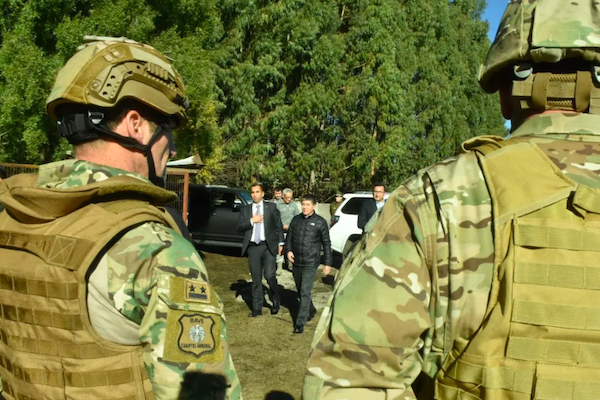
Clearly, the above is not well understood either by the Executive, which has been using them permanently and not exceptionally in the Southern Macrozone, or by the politicians who request them to resolve all of Chile’s problems, including criminal ones.
As if it were not enough for the purposes of the Executive and politicians in general, they also created the constitutional figure of critical infrastructure protection, which allows the use of National Defense institutions to safeguard infrastructure from damage that Chileans themselves may cause. The definition made by politicians is quite broad and more extensive than what common sense or what is critical would indicate. A good example is that it includes the safeguarding of border areas, which has nothing to do with infrastructure and rather aims to prevent illegal immigration, which is more of a police issue than a military one.
Regarding the Cosena, its purpose in the 1980 Constitution was to allow the Armed Forces to supervise the political system. This was corrected in the 2005 amendments, in the so-called Lagos Constitution, which rendered the council useless and purposeless, as it lacks executive powers, convenes only when called by the President, and is merely consultative, leading to the understanding that parliamentarians are only seeking publicity and newspaper headlines.
Public security is a responsibility of the Executive, exercised through Minister Tohá as Minister of the Interior and Public Security. The President, Minister Tohá, and their Undersecretaries of the Interior and Crime Prevention are the only ones responsible for the prevailing situation, and they gain nothing by kicking the ball to the corner or blaming others for the current mess.
Asking the Armed Forces to take charge of public security in the Metropolitan Region is like asking a cat to put its paws in the fire to retrieve chestnuts. It is asking them to do something for which they lack the material and personnel capabilities, as well as the legal protection that their work would require.
It is already enough that they have to put out fires in the summer, be deployed in the provinces of the Southern Macrozone, and safeguard borders to prevent further illegal immigration to Chile. All excesses are bad, and we are clearly facing one here.
Richard Kouyoumdjian
Vice President AthenaLab
Source: El Líbero