Soldiers as Police? Evidence of the Effects of Military Involvement in the Fight Against Organized Crime
This article was translated automatically and may contain differences from the original. For reference, read the original.
- por Diego Sazo
- Análisis
EXECUTIVE SUMMARY
In Latin America, evidence regarding the effects of military intervention in the fight against organized crime converges on three main findings.
- Military deployments do not lead to sustained crime reduction and may even increase crime once the intervention ends.
- Military participation in domestic security tasks significantly raises the risk of human rights violations.
- This risk often spreads to the police forces operating alongside the military, becoming incorporated into their daily practices.
European experience offers a relevant contrast to Latin America. There, evidence does not document that the use of armed forces leads to a deterioration in security conditions. However, in the studied cases, the armed forces have primarily fulfilled static surveillance and technical support roles, rather than direct criminal pursuit and combat.
In Italy, one of the most cited cases, the state’s offensive against mafia organizations relied on investigative and judicial capabilities, asset forfeiture, and prison tools aimed at reducing their operational capacity, rather than the operational use of armed forces.
1. CONTEXT
Chile is currently discussing an expansion of the role of the armed forces in domestic security. The Agenda Against Organized Crime and Terrorism (ACOT) includes a new state of public security exception that would allow military deployment to support police in areas affected by serious threats related to organized crime. The proposal from the government of José Antonio Kast is part of a broader agenda that also considers new military powers during states of exception and modifications to the critical infrastructure regime.[i].
Military participation has significant political support[ii] and public opinion. In August 2026, 69% of respondents supported the use of armed forces alongside Carabineros in operations against organized crime, although support for the new state of exception reached 55%[iii]. Part of this support for the armed forces rests on a conventional expectation that their greater firepower, equipment, and discipline should produce a deterrent effect superior to that of the police[iv].
In Chile, this support for military involvement does not start from scratch. Our country already employs armed forces in domestic security through the current state of exception in the Southern Macrozone[v] and border protection in the Northern Macrozone[vi]. The difference is that the current initiatives would expand their participation into new functions and urban scenarios associated with organized crime.
This change directs the central question of this analysis. What consequences can be expected when the armed forces assume greater public security functions? The political debate on this issue has included arguments for and against, but the available evidence to support positions has taken a secondary role. The following analysis examines recent research on cases in Latin America and Europe, prioritizing empirical studies capable of measuring the effects of military intervention and the mechanisms that explain them. This comparative exercise requires caution, as much of the available evidence comes from countries with levels of violence, institutional designs, and political cultures different from those of Chile.
2. MILITARIZATION OF LAW ENFORCEMENT
The literature on security studies distinguishes various ways in which military instruments can be incorporated into public security. Political scientists Gustavo Flores-Macías (University of Maryland) and Jessica Zarkin (Claremont McKenna College) group these variants under the concept of militarization of law enforcement. This term describes the process by which institutions responsible for security—commonly the police—incorporate aspects typical of the armed forces[vii].
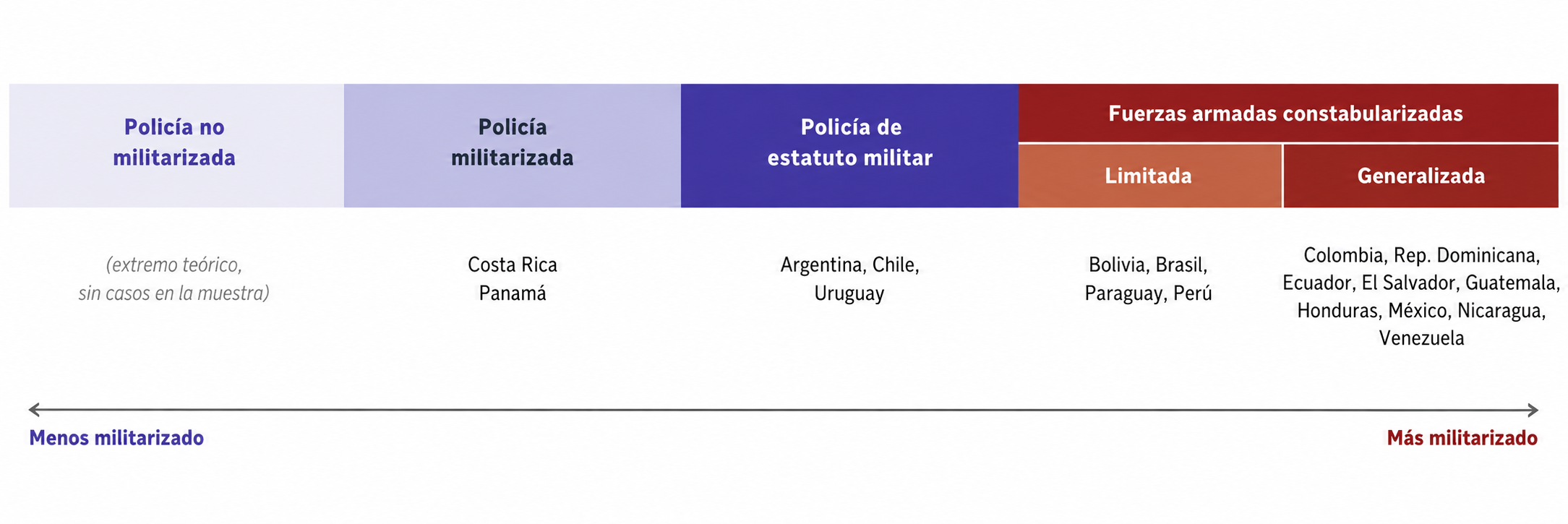
The authors categorize these forms along a continuum of four types, defined by jurisdiction, armament, training, and organizational structure. At one end is the non-militarized police, subject to civil jurisdiction and oriented toward the use of force as a last resort. Next is the militarized police, which retains its civil character but incorporates military-inspired equipment, tactics, or units. The third type corresponds to the military-status police (in English, paramilitary police). These institutions maintain a permanent police mission but possess hierarchical structures, equipment, and deployment methods typical of the military[1]. At the extreme end of the continuum are the constabulary armed forces. In this category, the military directly assumes public security functions such as patrols, arrests, raids, or seizures, without abandoning their organization and training oriented toward combat. Within this last category, Flores-Macías and Zarkin distinguish between limited and generalized constabulary.
Applied to eighteen countries in Latin America, the typology produces the classification represented in Figure 1.
Figure 1. The continuum of law enforcement militarization in Latin America.
Source: Own elaboration based on Flores-Macías and Zarkin (2021).
This distinction is particularly relevant for Chile. Carabineros corresponds to a military-status police due to its legal regime, organization, doctrine, and mode of operation. Its Organic Law defines it as a technical police institution of a military nature[viii], and the Military Justice Code considers its officials as military personnel[ix]. In terms of doctrine and discipline, its regulations establish a hierarchical structure based on obedience to command, while its training occurs in its own institutional schools. In its organization, it maintains ranks and classifications equivalent to those of the armed forces and a hierarchical command structure. In its operations, it deploys public order control units with military-origin armament, equipment, and tactics. These features have persisted despite successive changes in ministerial dependency since 2011.
The reform currently being discussed in the Chilean Congress introduces a different layer because, alongside the functions currently performed by Carabineros, it would expand the direct participation of the armed forces in public security functions. In terms of this literature, Chile would move toward a limited form of constabulary.
3. FINDINGS IN THE LITERATURE AND THEIR MECHANISMS
Empirical research on the effects of military involvement in public security tasks is a growing field of interest, but still incipient. For decades, the question was approached from the perspective of law, doctrine, and civil-military relations, with abundant normative literature but scarce measurement of results[x].
This began to change over the last decade, as the expansion of the phenomenon in Latin America coincided with the dissemination of causal identification methods in social sciences[xi]. By 2026, there exists a still limited body of research with causal design, although of high methodological quality and with notably convergent results. Its geographical distribution, however, is very uneven. Evidence is concentrated in a few Latin American countries with high levels of violence, while the Southern Cone and other regions of the world remain virtually unassessed. This selection bias warrants caution regarding the external validity of these findings.
Based on the data available so far, three coinciding findings can be identified regarding the consequences of military employment in domestic security tasks. Each also responds to a distinct causal mechanism.
3.1. Military deployment does not produce a sustained reduction in crime
Evidence shows that military deployment can temporarily alter the behavior of criminal organizations, but rarely destroys their capacity to operate.
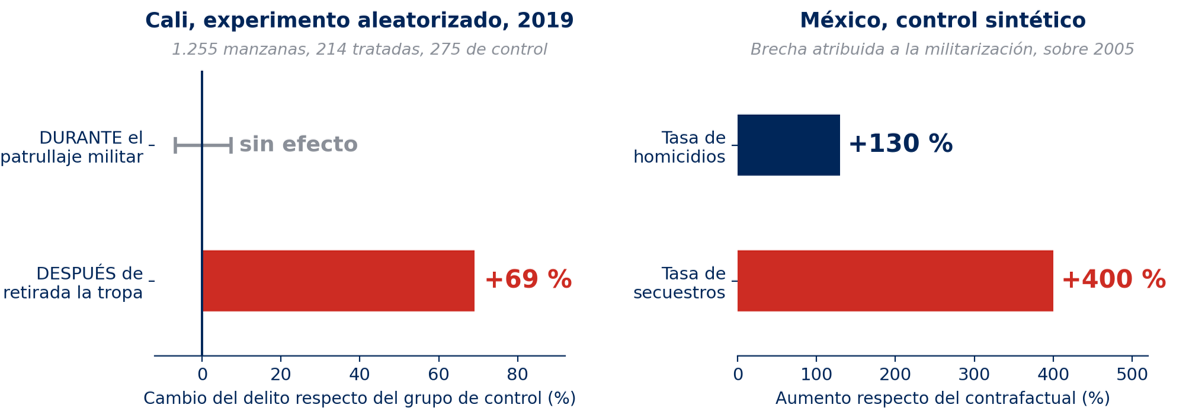
The city of Cali in Colombia offers the most rigorous causal measurement[xii]. In September 2019, the mayor’s office and the Army implemented the “Fortaleza Plan” in communes 18 and 20, two areas that concentrated local gangs and micro-trafficking markets. The program included nighttime military patrols alongside the police with the explicit goal of deterring crime through visible military presence. The evaluation of the impact of this measure was based on a randomized experiment, administrative data, surveys of over ten thousand residents, and civilian observers on the ground. The result was concrete: crime remained unchanged during the intervention, and once the deployment ended, it increased by 69% compared to the control group[xiii].
Mexico shows that the problem also arises when deployment reaches a larger scale and is prolonged over time. After taking office in December 2006, Felipe Calderón mobilized around 45,000 troops in operations that began in Michoacán and reached nine states. In some cases, there were up to four soldiers for each police officer, and command was in military hands. A synthetic control estimation attributes to this militarization an additional gap of nearly 17 annual points in the homicide rate compared to the counterfactual[xiv].
Figure 2. Two distinct designs, a similar result.
Source: Own elaboration based on Blair, Mendoza-Mora Weintraub (2026) and Flores-Macías (2018).
Figure 3. Mexico, the estimated effect of deployment and what followed*.
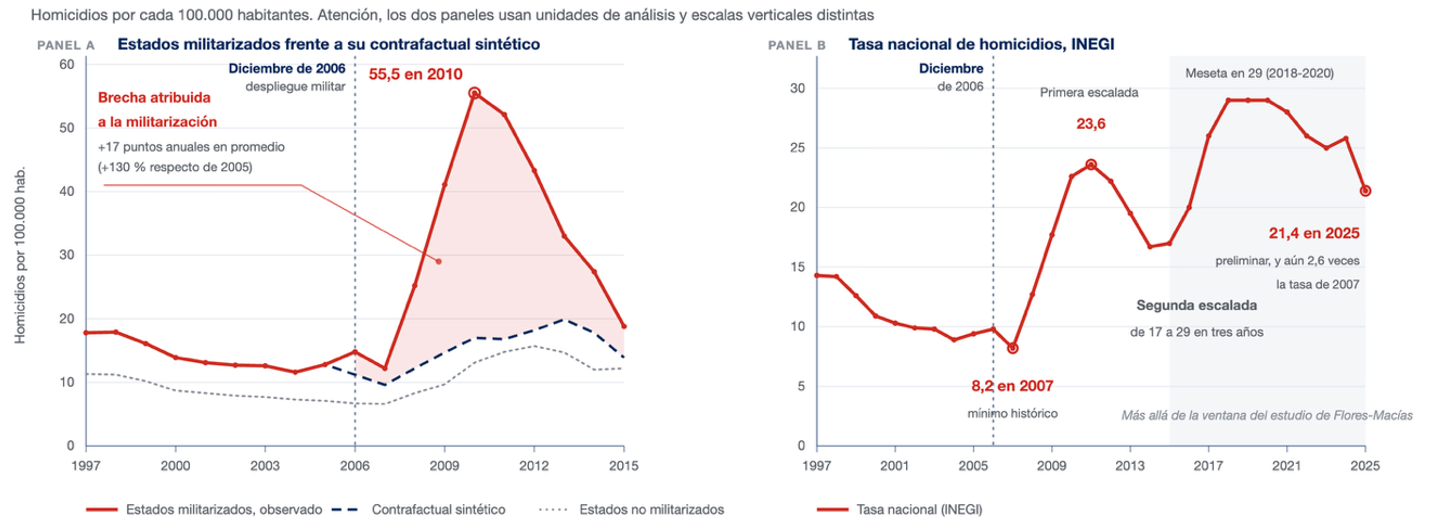
* The panels are not comparable in level. Panel A averages militarized states, and panel B is the national aggregate. The vertical scales differ.
Source: Own elaboration based on Flores-Macías (2018) and INEGI (2026).
In Brazil, the occupation of Complexo da Maré in Rio de Janeiro illustrates why the reduction of violence during deployment can fade shortly after its conclusion[xv]. The city had accumulated two decades of federal interventions when the government of Dilma Rousseff occupied Maré on the eve of the 2014 World Cup. The goal was to demonstrate the Brazilian state’s capacity to ensure security during the tournament. Two factions dedicated to drug trafficking and a militia operated in the complex. Between April 2014 and June 2015, around 2,500 troops were deployed. The initial balance seemed encouraging: the homicide rate fell from 21 to 6 per 100,000 inhabitants. However, criminal organizations regained territorial control just hours after the troops withdrew.
Research explains the limited impact of these military interventions based on the strategic calculations of criminal organizations. When a group faces a threat from a rival gang, abandoning the territory means ceding it, so they have incentives to fight. Faced with a much superior force, such as the Army or the Marine Corps, they may choose to hide, temporarily shift their activities, and wait for their withdrawal. In Maré, the occupation had been announced and had a known duration. For criminal organizations, waiting was less costly than confronting the state. The drop in homicides thus reflected a temporary suspension of criminal activity, not the destruction of their operational capacity.
3.2. Military intervention increases the risk of human rights violations
Existing empirical studies show that the participation of armed forces in police tasks increases the risk of abuses and disproportionate use of force.
Mexico provides the most consistent evidence regarding this mechanism. Since the deployment began in 2006, the armed forces have assumed public security tasks that included patrols, arrests, and operations against criminal organizations. Various studies have demonstrated that serious complaints of human rights violations increased by between 150% and 218% after the arrival of the military in the intervened states[xvi]. The difference also appears when comparing which institution performs an arrest. According to field studies, the probability of reporting torture increases by 28.8 percentage points when the arresting officer is the Army rather than the municipal police[xvii].
Lethality shows the same pattern. For every civilian injured in operations by the Army and Navy, between 10 and 17 civilians were recorded as dead, compared to 6.6 in operations by the Federal Police[xviii]. Between 2007 and 2011, moreover, in 39% of recorded confrontations, there were civilian deaths and no injuries[xix]. The convergence of these measurements suggests that the outcome exceeds the classification of isolated episodes.
Figure 4. Three independent estimates of human rights damage in Mexico.
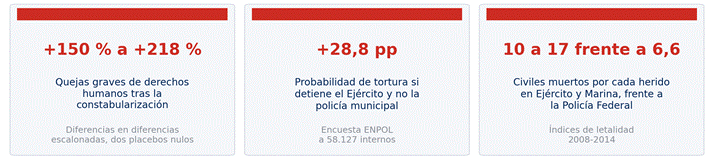
Source: Flores-Macías and Zarkin (2024), Magaloni and Rodríguez (2020), and Gaussens and Jasso (2020).
The causal mechanism explaining this pattern lies in the mismatch between training and function. The armed forces prepare their members to combat threats and neutralize them through the use of force, including lethal force, while the police function requires containing its use, collecting evidence, and contributing to law enforcement. When an institution trained for combat assumes police functions, the likelihood increases that it interprets certain situations as threats and responds with a logic of neutralization typical of the military.
The risk of an intervention leading to lethal confrontations, therefore, does not depend solely on the criminal context. It is also conditioned by the doctrine, training, and rules of use of force that guide the actions of the deployed institution.
3.3. Joint operations can transmit abusive practices to the police
Evidence shows that the effects of military intervention are not limited to the armed forces but often extend to the police operating alongside them. When both institutions participate in the same operation, the environment in which police officers decide how to make arrests, conduct raids, or use force is altered. Thus, police officers may adopt more coercive practices due to the transfer of military routines, operational pressures, or the dilution of responsibilities within the joint command.
Mexico provides evidence of this spillover effect. In joint operations against criminal organizations, the probability that a detained person suffered abuses increased by 9.5 percentage points. The increase affected all participating forces, not just the military[xx]. Another study concluded that these deployments caused a 150% increase in complaints of human rights violations against federal security forces[xxi].
The case of Cali allows for a more precise identification of where the increase in abuse was concentrated. During the “Fortaleza Plan” of 2019, soldiers and police patrolled together in communes 18 and 20. The reported increase in abuse during the intervention was primarily attributed to the police accompanying the troops, not the military themselves[xxii]. This suggests that military presence can modify police behavior even when the police retain direct execution of their functions.
Figure 5. The contagion of abuse in the joint operation, measured in three different sources.
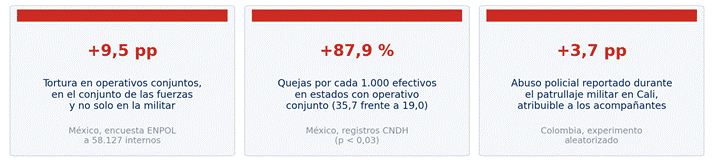
Source: Magaloni and Rodríguez (2020), Flores-Macías and Zarkin (2024), and Blair and Weintraub (2023).
Together, these investigations suggest that the mechanism operates through the interaction between both institutions. The police do not need to be formally militarized to adopt more coercive practices. Sustained exposure to military routines, operational pressures, and performance standards typical of military deployment can modify their way of operating. Once internalized, these practices may persist after the withdrawal of troops. A temporary intervention can thus generate institutional effects that survive the deployment.
This finding is relevant for Chile. The modality currently discussed in Congress involves joint operations between police and military contingents. Comparative evidence warns that this configuration may become a channel for transmitting coercive practices to the police institution, rather than containing the risks associated with military deployment.
4. EL SALVADOR AND ECUADOR: THE EXCEPTION AND ITS REVERSE
The Salvadoran case is often presented as a refutation of the negative effects associated with the use of armed forces against organized crime. The decline in violence in that country is indisputable. Since 2024, El Salvador has recorded a homicide rate of about 2.4 per 100,000 inhabitants, one of the lowest in the Western Hemisphere[xxiii]. The result, however, occurred under a state of exception in effect since March 2022, accompanied by mass arrests and prolonged restrictions on guarantees. These conditions do not allow for isolating how much specifically corresponds to military participation in the reduction of homicides.
Moreover, the success attributed to the “Bukele method” rests on particular conditions of criminal coordination that operated in El Salvador. A significant part of gang leadership operated from prisons, so interrupting communications between their incarcerated leaders and the structures outside through a strict isolation regime was central to dismantling their coordination[xxiv]. Additionally, the small territorial scale of the country facilitated the simultaneous execution of arrest and control operations throughout the territory.
Ecuador illustrates why these results cannot be extrapolated without considering domestic conditions. There, criminal organizations also maintain command structures within prisons, but the state has lesser institutional capacities and a weaker prison infrastructure to control them. The weakening of security institutions and cuts to the prison budget since 2015[xxv], along with the expansion of forms of criminal co-governance, have turned prisons into spaces of organization rather than neutralization[xxvi]. Under these conditions, the increase in incarceration, far from dismantling criminal organizations, has concentrated their members and allowed the continuity of their command chains.
The state’s offensive in 2024 tested these differences. In January of that year, following the escape of a criminal leader and an armed incursion into a television channel, the government declared the existence of an internal armed conflict, labeled 22 criminal groups as terrorists, and ordered the massive deployment of armed forces, in a strategy reminiscent of the Salvadoran formula. Between January 9 and April 6, security forces arrested more than 18,000 people. During the first weeks of the operation, weekly homicides dropped from 202 to 66[xxvii]. The effect, however, was transitory. Homicides again exceeded one hundred per week, while extortions and kidnappings increased. In 2025, the homicide rate reached a historic high of 50.9 per 100,000 inhabitants[xxviii].
The contrast delineates the value of El Salvador as an exportable model[xxix]. Mass detention can only weaken criminal organizations when the state effectively controls prisons and manages to isolate their leaders. Where it does not, each additional detainee enters the space from which these organizations recruit, reorganize, and maintain their command chains, reducing the impact of the military force deployed outside the prisons.
5. EUROPE IS NOT THE COUNTEREXAMPLE AS INVOKED
In the Chilean debate, European experience is often invoked as a precedent for collaboration between armed forces and police against organized crime. The comparison is useful but shows something different from what is sometimes assumed. In the studied cases, the armed forces performed limited functions of protection, technical support, or interdiction. Criminal investigation and prosecution remained primarily in the hands of police and judicial authorities.
Italy provides the broadest case of military deployment. Following the murders of magistrates Giovanni Falcone and Paolo Borsellino in 1992, the “Vespri Siciliani” operation mobilized up to about 7,000 simultaneous troops and lasted until June 1998. The military received limited powers as public security agents, but their role focused on the custody of courts, prisons, magistrates’ residences, and other sensitive targets, as well as road control[xxx]. The Army did not engage in criminal combat nor did it carry out the main arrests of mafia leaders. The offensive against Cosa Nostra relied primarily on the Anti-Mafia Investigation Directorate, specialized prosecutors, and strict control of the prison regime, among other measures (Figure 6). Therefore, the military contribution was complementary.
Figure 6. What the armed forces did in each case.
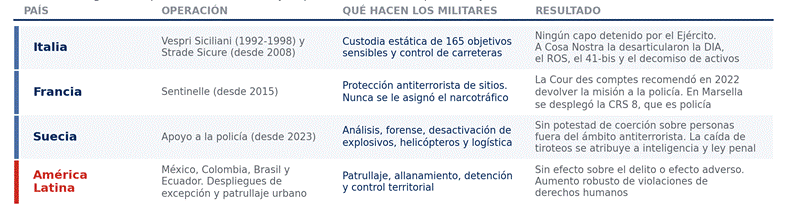
Source: Own elaboration based on open sources.
France shows a similar division of functions. The “Sentinelle” operation, deployed since 2015, primarily responded to the terrorist threat and focused on the protection of sensitive locations. The French state’s own oversight body recommended in 2022 reducing that military participation and returning the mission to internal security forces, as the military lacked the intelligence, powers, and equipment suitable for urban environments. In contrast, against drug trafficking in cities, France has resorted to specialized police. When in 2023 violence between gangs overwhelmed Marseille, the government did not deploy the military already stationed there but rather a rapid reaction civil police unit, and the anti-drug legislation of 2025 strengthened fiscal and judicial capacities instead of contemplating military employment.
Sweden adopted an even more limited formula. Following the increase in shootings in 2023, the government requested military support in analysis, logistics, IT, transport, and explosive deactivation. The military did not assume coercive police functions, as the law only allows their intervention with the use of force in certain cases of terrorism. A proposed reform in 2025 would expand those powers starting in 2027, but it has not yet come into effect. Shootings fell from 391 in 2022 to 158 in 2025, a decrease that the police attributed to their greater preventive capacity, new surveillance powers, and the arrest of members of criminal networks, not to military support.
From this experience, Europe does not provide evidence that military participation in the direct pursuit of organized crime produces better results. It does show that certain military capabilities can be useful when fulfilling limited and complementary functions to police action. This difference is central to evaluating which aspects of the European experience can be transferred to the Chilean debate.
6. CONCLUSIONS
The examination of existing research allows for the gathering of three findings around two complementary theses. The first is that the coercive capacity of the state and its ability to reduce organized crime are not equivalent. Military deployment can alter the behavior of an organization, displace it, or temporarily weaken its territorial presence, but these effects become fragile when the markets, incentives, and opportunities that allow for its reproduction remain intact[xxxi]. This gap helps to understand why interventions capable of producing visible results in the short term may have limited effects once the force is withdrawn.
The second thesis points to the adequacy between institution and function. The armed forces were designed to perform tasks distinct from ordinary law enforcement. When they assume police functions, that difference in training, doctrine, and organization matters for how force is used. Evidence also shows that the effect can transcend the military institution when police and soldiers operate together. The problem, therefore, is not simply how far the deployment extends, but also the practices that it may introduce into the security system.
European experience helps to clarify this point. The reviewed cases do not show armies consistently replacing police in the pursuit and combat of organized crime. Rather, they show military capabilities used for delineated tasks that can complement police action. Criminal investigation, asset forfeiture, judicial action, and prison control remain in the hands of specialized institutions. The contrast suggests that the relevant question is not simply whether the armed forces can contribute to domestic security, but for what specific function they possess an advantage that other institutions cannot provide.
However, the available evidence leaves three relevant questions for Chile.
- The design currently discussed in the constitutional reform of President Kast’s government lacks an equivalent causal evaluation. No study has precisely measured a modality that combines police leadership, subordinate military contingents, territorial focus, and defined duration. The available background allows for formulating expectations, but not for accurately anticipating its impact on the national reality.
- El Salvador does not allow for separately identifying the effect of military participation. Its reduction in violence occurred alongside mass incarceration, prolonged suspension of guarantees, and particular prison and institutional conditions. The result is relevant but does not allow attributing success to the military component.
- The effects of prolonged interventions remain poorly understood. The adaptation of organizations may modify results over time, and there is still no causal evidence on processes of constabulary maintained for more than a decade.
Therefore, the external validity of the reviewed studies is limited for Chile. The most rigorous research comes primarily from countries with violence levels higher than those of Chile and with different institutional designs, capacities, and political cultures. The Southern Cone remains virtually absent from that evidence. While the identified mechanisms are plausible for Chile, their transfer remains an extrapolation with too many conditions.
From this balance, a practical implication emerges. The decision of the Executive and legislators should not begin by determining whether to employ the armed forces, but by identifying what specific capacity the state needs to strengthen. If the deficit is surveillance of critical infrastructure or interdiction in areas where the police lack sufficient means, certain military capabilities could offer a specific contribution. If the problem lies in controlling and combating criminal organizations, tracking their assets, managing prisons, or dismantling illicit markets, the evidence presented in this analysis points toward capacities of a different nature.
The central question is, then, what problem is being sought to resolve and which institution is better prepared to do so. Framing the discussion in those terms allows for evaluating military participation by the capacity it brings and not by the visibility (and popularity) of its deployment.
DIEGO SAZO
Head of Research in International Relations
[1] Carabineros de Chile, the Spanish Civil Guard, and the French Gendarmerie Nationale belong to this category.
[i] BioBioChile, “The Legislative Offensive of the Government: 10 Security Projects Will Have Immediate Discussion”, August 31, 2026, https://www.biobiochile.cl/noticias/nacional/chile/2026/08/31/la-ofensiva-legislativa-del-gobierno-10-proyectos-de-seguridad-tendran-discusion-inmediata.shtml
[ii] Emol, “RN Deputies Urge the Government to Prioritize the Project Allowing Military Support to Police”, August 1, 2026, https://www.emol.com/noticias/Nacional/2026/08/01/1207325/diputados-rn-proyecto-apoyo-militar.html; Emol, “Pressure from Deadlines and a Wave of Homicides: The First Days of Minister Steinert”, Emol, March 21, 2026, https://www.emol.com/noticias/Nacional/2026/03/21/1194914/gestion-seguridad-plazoshomicidios.html
[iii] T13, “Criteria Reveals Broad Support for Security Reform, Although with Reservations on Specific Measures”, August 23, 2026, https://www.t13.cl/noticia/politica/criteria-amplio-respaldo-reforma-seguridad-aunque-reparos-medidas-especificas-23-8-2026
[iv] Gustavo Flores-Macías (2018) “The Consequences of Militarizing Anti-drug Efforts for State Capacity in Latin America: Evidence from Mexico”, Comparative Politics 51(1): 1-20.
[v] La Tercera, “Government Highlights Drop in Violent Incidents and Meets to Coordinate Unified Command for the Southern Macrozone”, August 28, 2026, https://www.latercera.com/nacional/noticia/gobierno-destaca-baja-de-hechos-de-violencia-y-se-reune-para-coordinar-el-mando-unificado-para-la-macrozona-sur/
[vi] BioBioChile, “Report Reveals 86% Drop in Illegal Entries to Chile and 76% Increase in Expulsions During 2026”, August 6, 2026, https://www.biobiochile.cl/noticias/nacional/chile/2026/08/06/informe-revela-caida-de-86-en-ingresos-ilegales-a-chile-y-aumento-de-76-en-expulsiones-durante-2026.shtml
[vii] Gustavo Flores-Macías and Jessica Zarkin (2021), “The Militarization of Law Enforcement: Evidence from Latin America”, Perspectives on Politics, 19(2): 519-538.
[viii] Law 18.961, Constitutional Organic Law of Carabineros de Chile, Article 1.
[ix] Military Justice Code (Decree 2,226 of 1944), Article 6.
[x] Omar García-Ponce (2025), “Criminal Violence, the State, and Society”, Annual Review of Political Science 28(6): 435-456; Carlos Vilalta (2020), “Violence in Latin America: An Overview of Research and Issues”, Annual Review of Sociology 46: 693-706.
[xi] Nicole Jenne and Rafael Martínez (2022), “Domestic Military Missions in Latin America: Civil-Military Relations and the Perpetuation of Democratic Deficits”, European Journal of International Security 7(1): 58-83.
[xii] Robert A. Blair, Lucía Mendoza-Mora, and Michael Weintraub (2026), “Mano dura: An Experimental Evaluation of Military Policing in Cali, Colombia”, American Journal of Political Science 70(2): 673-690.
[xiii] Robert A. Blair and Michael Weintraub (2023), “Little Evidence That Military Policing Reduces Crime or Improves Human Security”, Nature Human Behaviour 7(6): 861-873.
[xiv] Flores-Macías, “The Consequences of Militarizing Anti-drug Efforts for State Capacity in Latin America”.
[xv] Nicholas Barnes (2022), “The Logic of Criminal Territorial Control: Military Intervention in Rio de Janeiro”, Comparative Political Studies 55(5): 789-831.
[xvi] Flores-Macías and Zarkin, “The Consequences of Militarized Policing for Human Rights”.
[xvii] Beatriz Magaloni and Luis Rodríguez (2020), “Institutionalized Police Brutality: Torture, the Militarization of Security, and the Reform of Inquisitorial Criminal Justice in Mexico”, American Political Science Review 114(4): 1013-1034.
[xviii] Pierre Gaussens and Carolina Jasso González (2020), “Militarization of Public Security and Violation of Human Rights in Mexico (2000-2020)”, The Age of Human Rights Journal 15: 26-50.
[xix] Gaussens and Jasso González, “Militarization of Public Security and Violation of Human Rights in Mexico”.
[xx] Magaloni and Rodríguez, “Institutionalized Police Brutality”.
[xxi] Flores-Macías and Zarkin, “The Consequences of Militarized Policing for Human Rights”.
[xxii] Blair et al. “Mano dura”.
[xxiii] Gustavo Flores-Macías (2024, March 20). “The Costs of El Salvador’s Crime Crackdown.” Foreign Affairs.
[xxiv] Jonathan D. Rosen, Mary Fran T. Malone, Sebastian A. Cutrona, and Lucia Dammert (2026), “The Appeal of the Bukele Regime in Latin America: The Scope and Limits of Citizen Support”, Latin American Policy 17(3): e70069.
[xxv] Jorge Mantilla, Carolina Andrade, and María Fe Vallejo (2023), “Why Cities Fail: The Urban Security Crisis in Ecuador”, Journal of Strategic Security 16(3): 141-153.
[xxvi] Mantilla et al. “Why Cities Fail”.
[xxvii] Elena Dressler and Jonas Wolff (2024), “From Political Instability to ‘Internal Armed Conflict’: Ecuador’s Multiple Crisis”, Revista de Ciencia Política 44(2): 269-293.
[xxviii] InsightCrime (2026), “InSight Crime’s Balance of Homicides in 2025”, updated March 31, 2026, https://insightcrime.org/es/noticias/balance-insight-crime-homicidios-2025/
[xxix] Rosen et al. “The Appeal of the Bukele Regime in Latin America”.
[xxx] Jane Schneider and Peter Schneider (2003). Reversible Destiny: Mafia, Antimafia, and the Struggle for Palermo (Berkeley: University of California Press).
[xxxi] Lucia Dammert (2025). Anatomy of Illegal Power. Violence, Organized Crime, and Corruption in Latin America (Santiago: Planeta).